How AI Is Transforming Email Marketing in 2025–2026

Ask ten marketing leaders how AI changed their email program this year, and nine will tell you it writes the copy now. They are not wrong. They are just describing the least interesting part.
Copy generation is the story everyone tells because it is the one you can see. You type a prompt, a subject line appears, and the future feels like it has arrived. But writing was never the expensive part of email.
The expensive part was deciding what to say, to whom, and when, then doing that differently for thousands of individual people at once. That is the work no human team could ever scale by hand. And that is the work AI quietly made cheap.
So here is the argument this piece will make, and it is worth stating before you read another word: the genuine transformation in email is not automated writing. It is that AI has made true one-to-one personalization economically viable at scale for the first time in the channel's history.
Not a first name in the subject line. Real per-recipient decisions about content, timing, and offer, produced at a marginal cost that rounds to zero. Get that distinction right and the rest of your AI roadmap organizes itself.
The real story is not that AI writes your emails. It is that AI just made one-to-one personalization affordable.
The Economics That Broke
Why The Batch-And-Blast Era Is Finally Ending
For three decades, email personalization hit the same wall. You could picture the perfect message for every subscriber. You could not afford to produce it.
A lean lifecycle team can maintain maybe a few dozen meaningful segments before the math falls apart, because every new variant means more copy, more design, more QA, more approvals. So, teams did the rational thing. They blasted. One message, lightly segmented, to the whole list.
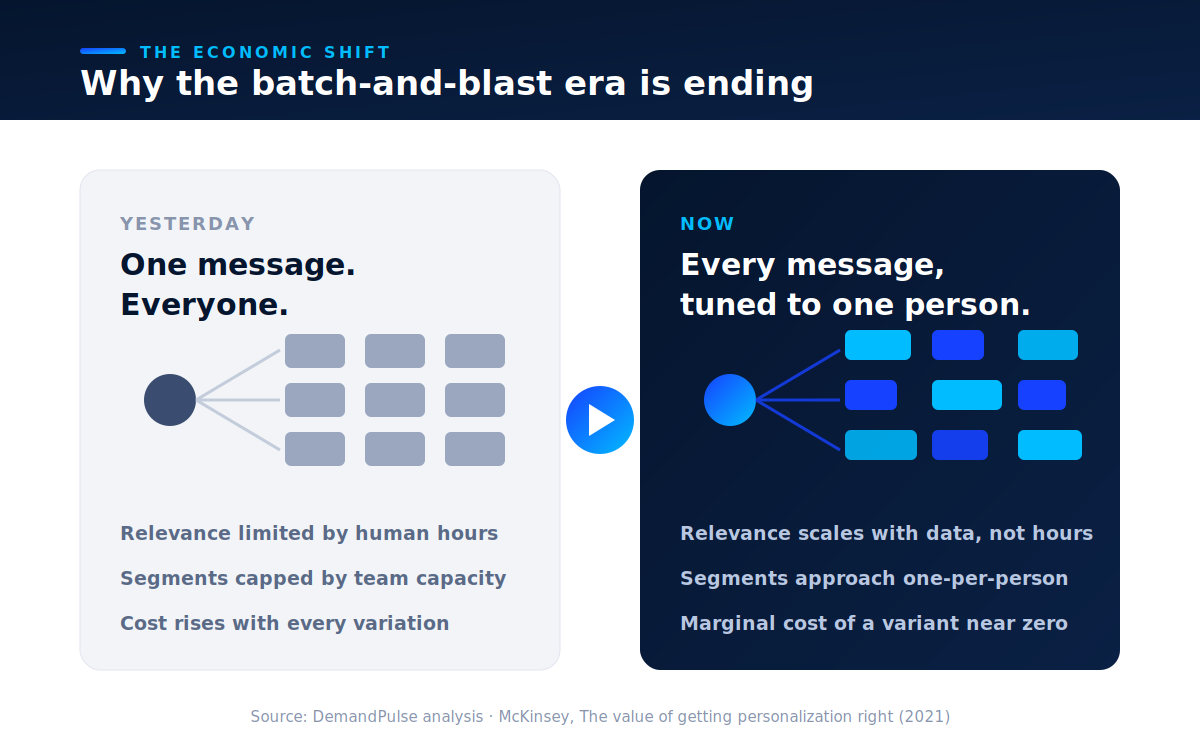
The economics that changed: relevance used to be capped by human hours. Now it scales with data.
The cost of relevance used to climb in a straight line with the number of variations. AI flattened that line. When a model drafts forty versions of a content block in the time it once took to write one, and a decision engine assigns the right version to the right person automatically, the constraint that created batch-and-blast simply stops existing. Relevance now scales with the quality of your data, not the size of your team. That is the whole shift in one sentence.
This is not a tidy efficiency win. It moves the ceiling on what email can earn. McKinsey found that faster-growing companies drive 40 percent more revenue from personalization than their slower-growing peers, and that getting personalization right typically lifts revenue by 5 to 15 percent while improving marketing efficiency by 10 to 30 percent.
For most of email's history, those gains sat behind a labor cost no CFO would approve. That barrier is gone.
What This Means For You
The edge no longer belongs to whoever has the biggest list or the slickest template. It belongs to whoever can act on customer data at the level of the individual. That used to be a luxury. It is turning into the price of entry.
Turn These Shifts Into Pipeline
DemandPulse builds the AI-plus-human email engine that turns these shifts into measurable pipeline. We embed experienced operators who wire prediction, personalization, and automation into your data and your daily workflow, then stay until it produces results.
Talk to a specialist →Inside The Workflow
What AI Is Doing to Your Email Program
Strip away the marketing language and AI is handling a specific set of jobs inside a modern program. None of them are mystical. All of them are useful, and most of them are already boring, which is exactly what you want from infrastructure.
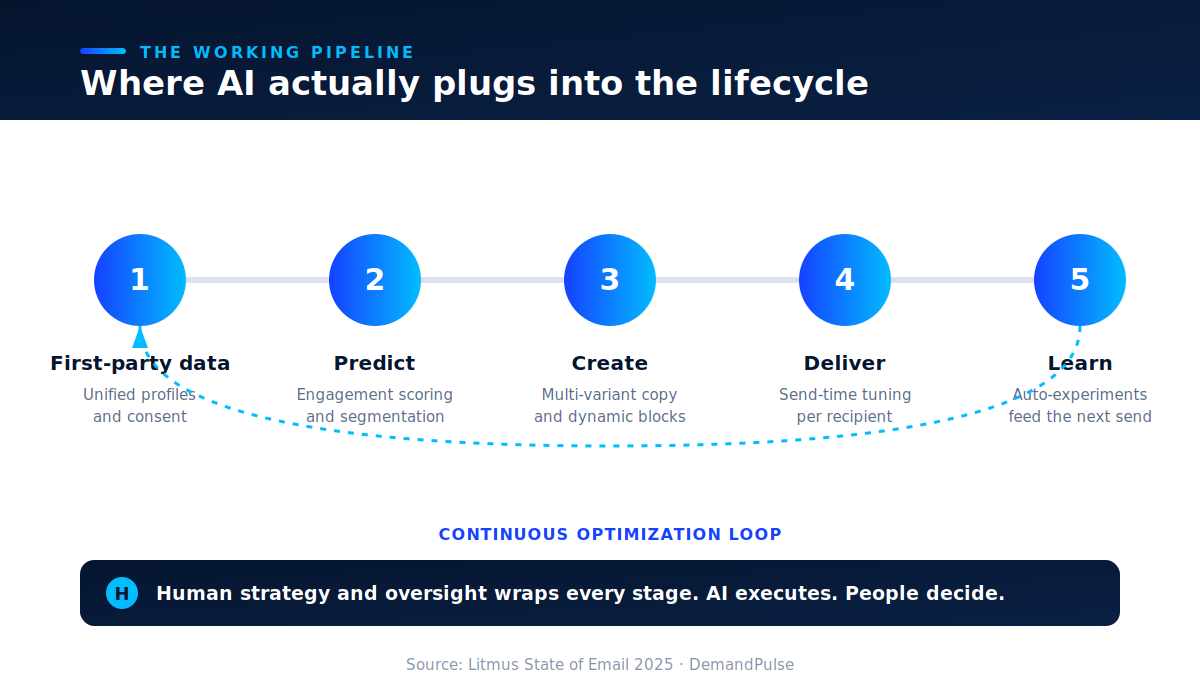
Where AI plugs into the lifecycle: data feeds prediction, prediction feeds creation, delivery feeds learning, and a human wraps the whole loop.
Strip the marketing language and six specific jobs are already running quietly inside modern programs. Most are boring, which is exactly what you want from infrastructure.
Content Generation
The visible one. The honest framing isn't "AI writes my emails." It's "AI clears the blank page, so my team spends its hours on judgment, not first drafts."
Multi-Variant Creation
The same engine that writes one draft writes twenty. This is the mechanism that makes per-segment and per-recipient content practical for the first time.
Predictive Send-Time
Instead of one send hour for the whole list, models predict when each subscriber tends to open and engage, then stagger delivery per person.
Dynamic Content
Product blocks, headlines, images, and CTAs assembled at open time from behavior and profile data. Every neighbor sees a materially different email.
Segmentation & Scoring
Models group subscribers by behavioral pattern and score how likely each is to engage, convert, or churn. Segmentation becomes a live input, not a quarterly project.
Automated Experimentation
Systems launch variant tests, read the results, and shift volume toward winners without a human touching the dial each time. Cleanly bounded, brand-safe.
The Pattern
AI is strongest wherever the job is prediction, pattern-finding, or fast first-pass production across a lot of data. That describes most of the mechanical labor in an email program, and handing it off shows up directly on the clock.
2025
6%
The production model, rebuilt underneath the profession.
Where To Invest, What To Ignore
What AI Still Cannot Do Reliably, And Why
This is the section most vendor content skips, which is precisely why it matters most to anyone holding a budget.
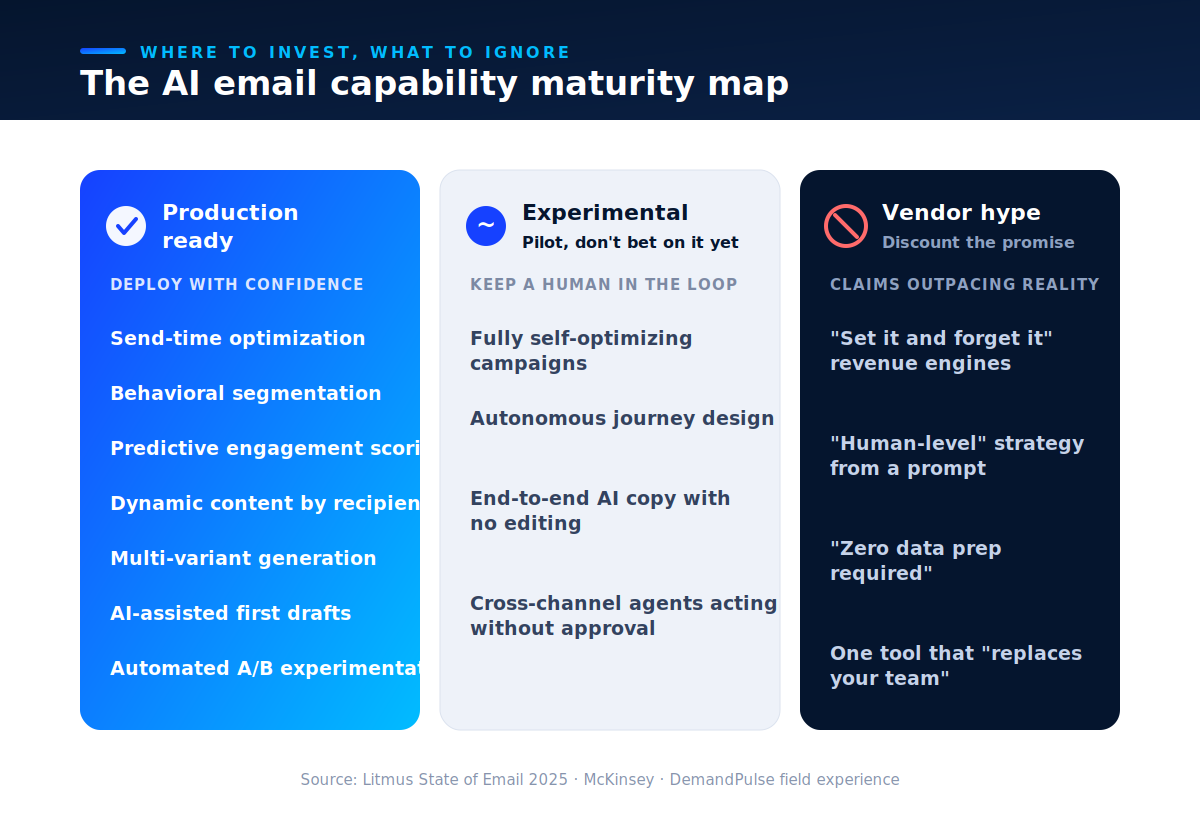
A working map for 2026 planning: fund the production-ready column, pilot the experimental one, and decline the hype.
AI is a pattern engine. It is excellent at guessing what tends to work based on what has worked before. It has no model of what is true, what fits your brand, or what is appropriate in a specific situation. That one limitation explains almost everything on the "not yet" list.
Judgment
What AI Cannot Decide
Original strategy is off the table.
A model can recombine positioning it has seen. It cannot decide what your product should stand for, which segment to prioritize this quarter, or why a campaign matters to the business. Those are judgment calls that depend on context the model does not have and cannot infer from a prompt.
Pilot
Not a Policy
Fully autonomous, hands-off campaigns are a pilot.
Self-optimization is reliable for narrow, measurable choices. Handing a system an entire lifecycle journey to design, write, and send with no human review is where quality breaks and where brand and compliance risk concentrate.
Oversight
Co-Pilot, Not Pilot
Keep a person in the loop.
The practitioner consensus is blunt: keep a person in the loop, especially on oversight. Voice, nuance, and accessibility still need a human hand. AI output can reinforce bias, skip accessibility basics, or land half a degree off brand in a way a competent editor catches in seconds and a model never notices.
And none of it works on a broken data foundation. This is the quiet failure that sinks most personalization efforts. The algorithm is rarely the weak link. Fragmented identity, stale records, and unresolved consent are.
Buying advanced personalization tooling before your first-party data is unified is like bolting a turbocharger onto an engine with no oil. The tool is not the problem. The foundation is. When you evaluate a vendor, the sharpest question you can ask is not what the AI can do. It is what data it needs to do it, and whether you have that data in usable shape.
So, The Leadership Move Is a Sorting Exercise, Not A Shopping Spree:
Production-ready
Send-time optimization, behavioral segmentation, predictive engagement scoring, dynamic content, multi-variant generation, AI-assisted drafting, and bounded A/B automation. Fund these now.
Experimental
Fully self-optimizing campaigns and autonomous journey design. Give them a small, fenced pilot with success defined up front, and measure honestly.
Vendor hype
The "set it and forget it revenue engine" that "replaces your team" and needs "zero data prep." Decline politely, then ask about data requirements and watch the confidence drain out of the room.
The Pace Of Change
Why This Is a 2026 Decision, Not a Someday Decision
If this still reads like next year's problem, the adoption data disagrees. Litmus found that nearly 70 percent of email marketers expect up to half of their email operations to be AI-driven by the end of 2026, and 18 percent expect 50 and 75 percent of their email work to run on AI. This is no longer early adopters tinkering at the margins. It is the mainstream of the profession rebuilding how the work happens.
That has a direct planning consequence. The advantage does not go to whoever bolts on the most features. It goes to whoever wires the right ones into a coherent lifecycle. Teams that treat AI as a drawer full of point tools tend to end up with a faster way of sending forgettable email.
Teams that treat it as a new operating model, where data feeds prediction, prediction feeds creation, creation feeds delivery, and results feed the next cycle, are the ones converting it into pipeline.
And the channel is worth the effort. Email still returns roughly 36 dollars for every dollar spent, the highest ROI of any channel. AI does not replace that with math. It compounds it by making every send more relevant at a cost the old model could never carry.
How To Sequence It
A Practical Order of Operations for The Next Two Quarters
If you are deciding where to begin, resist the pull to buy the most advanced thing first. The sequence that works in the field looks like this, and the order is not optional.
Fix The Data Foundation First.
Unify customer profiles, resolve identity, and clean up consent. Nothing downstream pays off until this is done, and this is exactly where most programs quietly stall for a year.
Turn On the Proven, Bounded Capabilities.
Deploy predictive send-time optimization and behavioral segmentation. Clear inputs, measurable outputs, low brand risk. This is the fastest route to a visible win that earns internal trust for everything after it.
Scale Content and Dynamic Personalization with Guardrails.
Use AI for variant generation and dynamic blocks, but keep human review on voice, accuracy, and accessibility. Start with one lifecycle flow, measure against your current baseline, then widen.
Pilot The Frontier on Purpose.
If you want to test self-optimizing campaigns or more autonomous journeys, box them into a low-stakes program, define success before you start, and name a person accountable for the output.
Run it in that order and AI stops being a line item you must defend and starts being an engine you can point at revenue.
The Takeaway
Where This Leaves You
The batch-and-blast era is ending, but not because AI learned to write. It is ending because AI finally made relevance affordable at the level of the individual person. That is the shift worth organizing your program around.
The teams that win over the next two years will not be the ones with the longest feature list. They will be the ones who put AI on the parts of the funnel where prediction and personalization compound, and who keep human judgment exactly where it still earns its cost.
Which is the real skill now: knowing which capabilities are ready, which are experimental, and which are noise. It also happens to be where an experienced operator quietly earns their keep, because the gap between an AI email program that produces pipelines and one that merely sends faster is almost never the tool. It is how that tool is wired into strategy, data, and daily work.
Want to skip the trial and error?
We'll build you a free custom AI email assistant tuned to your firm and practice area. Tell us what you do and who you're reaching — we'll send you the tool.
Related Articles
How AI Improves Email Marketing Campaign ROI
AI works both sides of the ROI ratio: more revenue per send and lower cost to produce.
AI Email Personalization at Scale: Beyond "Hi {First Name}"
First-name merge tags are the floor, not the ceiling. Real personalization at scale.
Cold Email for Law Firms: What Actually Gets Replies
What 85M+ cold emails reveal about earning replies in the first send.
Marketing Automation for Law Firms
Choose the right growth path: HubSpot vs. Clio Grow in 2026.
Subscribe for Insights That Drive Growth
Practical tips to help you grow your business and build a great team, sent to your inbox.