How AI Improves Email Marketing Campaign ROI

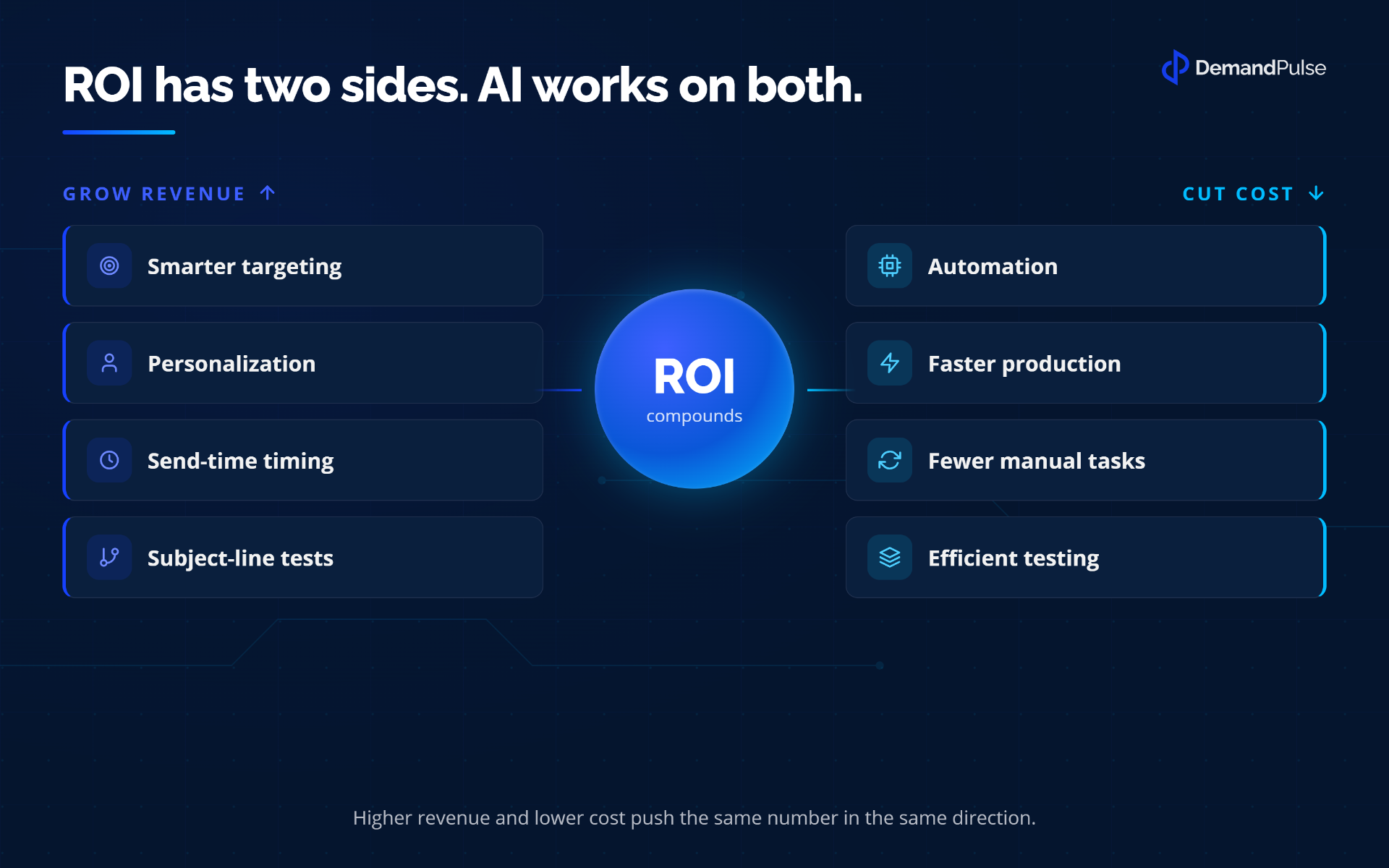
Email still returns between $36 and $42 for every dollar spent, the best return of any channel most companies own. That number headlines every vendor deck, and it hides the more useful question: which dollar?
Same tools, very different results.
The gap is execution.
ROI is a ratio, with a top and a bottom. Most writing about AI in email works only the top, the revenue, and ignores the bottom, the cost. The programs that pull ahead work both at once. Here is the whole idea. AI can grow what you earn per send and cut what you spend to make it, and because ROI is a ratio, those effects multiply.
The Catch
It only pays off when the program underneath is healthy. Same tools, very different results. The gap is execution.
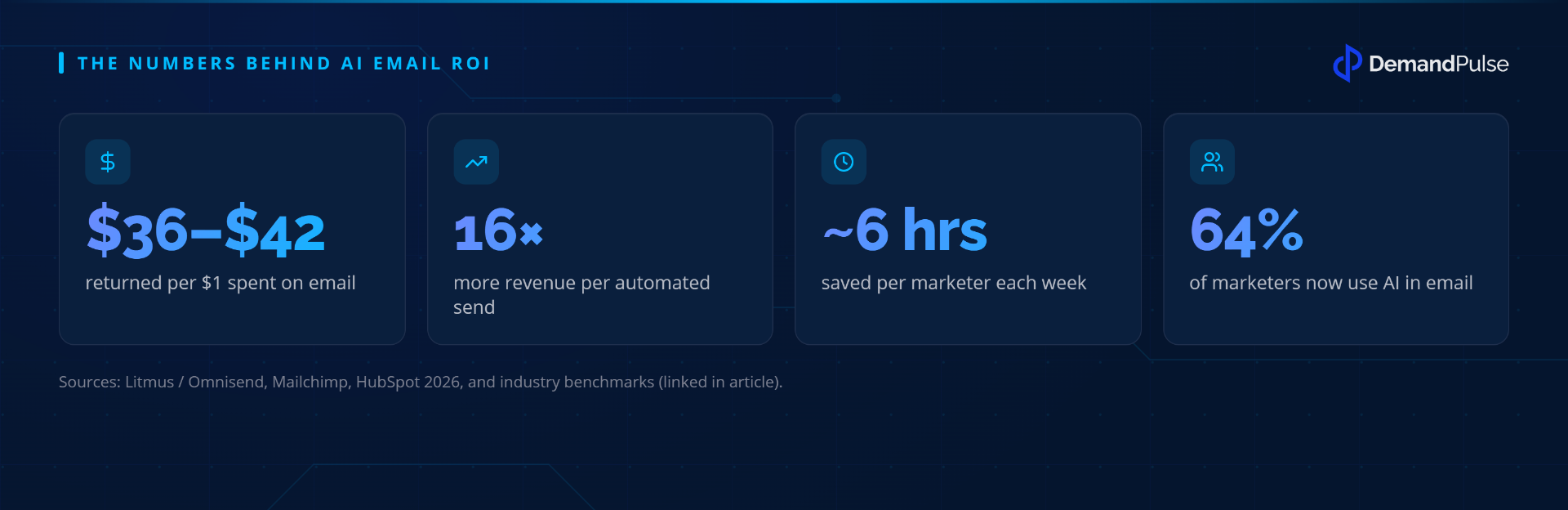
ROI Has Two Sides. AI Works Both.
ROI is revenue minus cost, divided by cost. Push revenue up and it climbs. Pull costs down and it climbs too. Do both and the gains compound, because you're growing the numerator and shrinking the denominator at the same time.
Classic email optimization chased one lever: higher opens, higher clicks, more revenue from the same blast. What changed is that AI now works the cost side as hard as the revenue side. A campaign that used to take a small team three days can take one person an afternoon, and that reclaimed time is real margin.
Most teams miss this because they track the revenue their email earns but never cost their own labor, so half the ratio is invisible to them. Keep both sides in view, because everything below sits on one of them.
See what AI could add to your program
Most programs sit on revenue they can't see. Tell us what you are sending and we will point to exactly where yours is hiding.
How AI Grows the Revenue Side
Revenue in email runs through a short chain: the right person opens, clicks, and converts when the message fits what they need. AI strengthens nearly every link.
Targeting and segmentation is the oldest lever and still the strongest. Group people by behavior and predicted intent instead of a spreadsheet column, and a first-time buyer stops getting the same email as a lapsed customer.
Mailchimp's benchmarks put segmented campaigns at roughly 30% more opens and 50% more clicks than unsegmented ones. The mechanism is just relevance. (Don't overdo it: a few segments that map to real intent beat a dozen tiny, ones.)
Personalization past the first name is next. The version that moves revenue changes the body, the product shown, the proof point, the next step, not the greeting. McKinsey found the fastest-growing companies earn about 40% more of their revenue from personalization than slower peers, and AI makes that affordable on a scale.
Then timing and testing. Send-time optimization learns when each contact opens and delivers into that window, lifting opens without a word of new copy. AI can also generate and rank subject lines against your own history, with teams reporting around a 26% lift in open rates over hand-written ones. None of them are exotic. It's the same fundamentals, running faster and on more data than a person can hold.
How AI Cuts the Cost Side
This is the half most case studies skip, and often the bigger prize. Roughly 64% of marketers now use AI somewhere in their email programs, usually starting with production.
HubSpot's 2026 data have marketers saving about six hours a week once AI is in the workflow. First drafts, resizing subject-line variants, one email reshaped into five: the repetitive work that used to swallow a specialist's week. Fewer hours per campaign means lower cost per campaign. Just remember AI hands you a strong first draft, not a finished send, so budget time to edit for voice and accuracy.
Automation compounds the effect. Triggered flows (welcome, cart recovery, re-engagement, post-purchase) run untouched after setup and punch far above their volume. Automated emails earn about 16 times more revenue per send than manual campaigns, roughly $2.87 against $0.18, despite being a sliver of total sends. That's both levers at once: more revenue at near-zero marginal cost. AI can also run more tests than a human can babysit, so you learn faster and stop funding variants that don't work.
Put Real Numbers on It
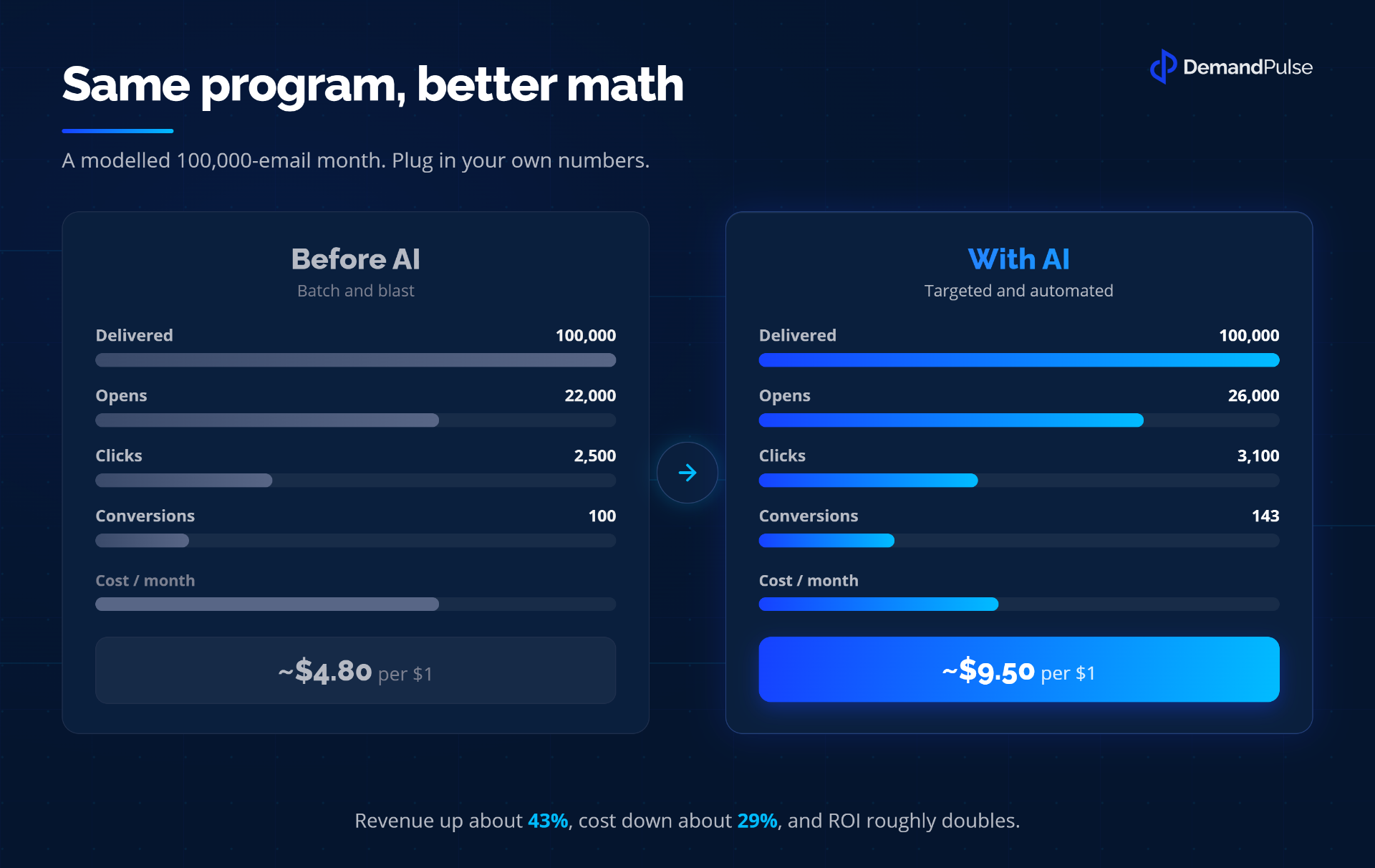
Picture a program sending 100,000 emails a month. Before AI, it runs a 22% open rate and a 2.5% click rate, converts 4% of clicks at $200 each, and costs about $4,200 a month once you count labor honestly, not just the platform fee.
| Before AI | With AI | |
|---|---|---|
| Delivered | 100,000 | 100,000 |
| Opens (22% to 26%) | 22,000 | 26,000 |
| Clicks (2.5% to 3.1%) | 2,500 | 3,100 |
| Conversions (4% to 4.6% of clicks) | 100 | 143 |
| Revenue ($200 each) | $20,000 | $28,600 |
| Cost per month | $4,200 | $3,000 |
| Return per $1 | ~$4.80 | ~$9.50 |
The lifts here are deliberately modest, well inside the benchmarks above. Opens rise from sharper subject lines and timing, clicks and conversions from tighter targeting, and cost falls because automation and faster production cut labor hours. Revenue climbs about 43%, cost drops about 29%, and the return per dollar roughly doubles. Your numbers will differ, and that's the point.
AI Amplifies, It Doesn't Fix
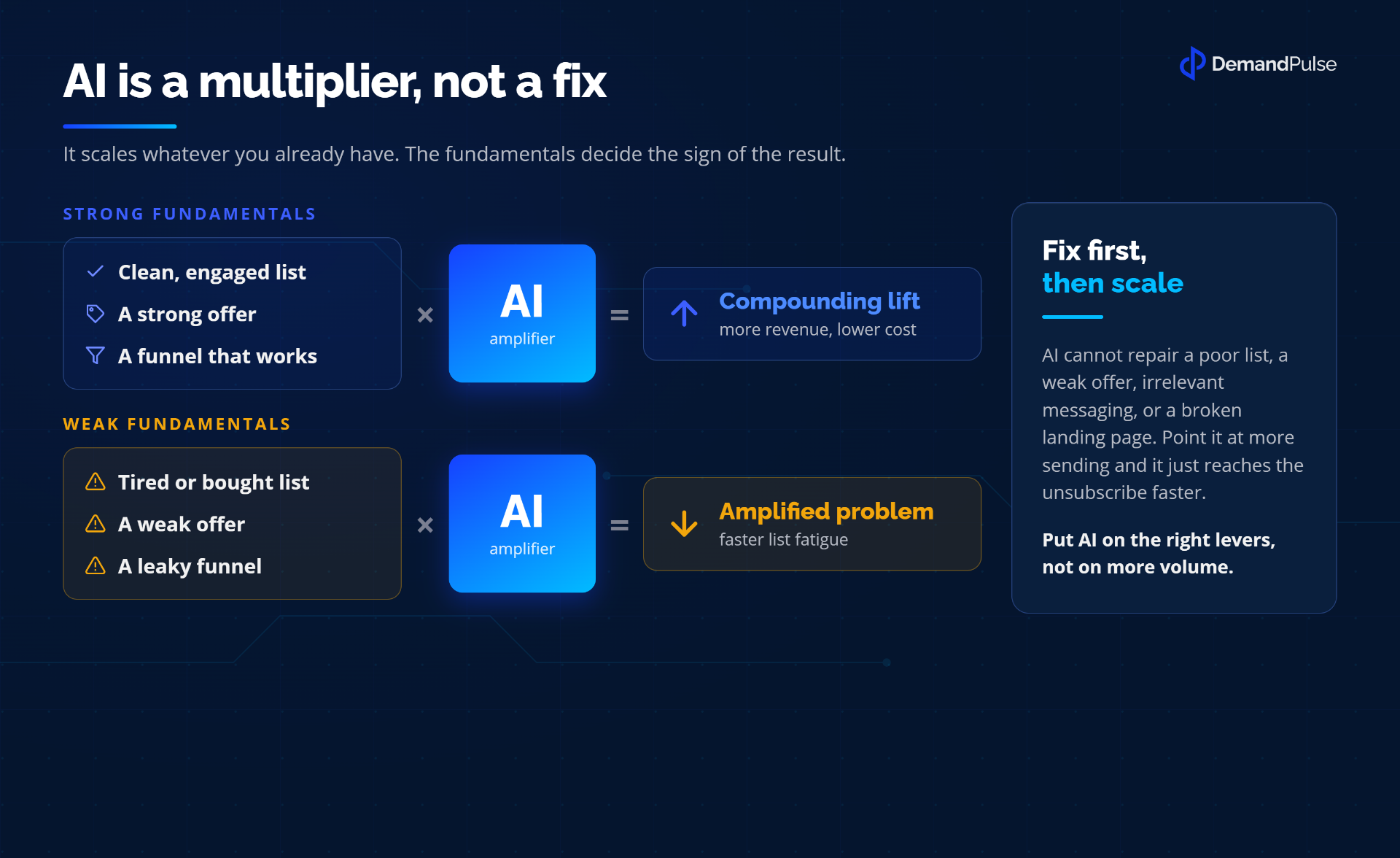
Here is the honest version, the one worth forwarding to a skeptical executive. AI is a multiplier. It scales whatever you already have. Aim it at a strong program and it compounds the strength. Aim it at a weak one and it compounds the weakness, faster and at higher volume.
A few things it genuinely cannot fix. A poor or cold list: personalizing to people who aren't listening is still shouting into an empty room. A weak offer: a well-timed email just exposes it to more people. A broken funnel: AI can win the click, but if the landing page is slow or off message, the click dies on arrival. Email ROI is never stronger than the page it lands on.
So, treat AI as the second move, not the first. Get the fundamentals right, then let AI scale what's working. In that order the model above is conservative. Reversed, you just fail more efficiently.
More Sending Is Not More ROI
Cheap production quietly tempts teams into sending more, and that's the shortest path to list fatigue. Every low relevance send teaches subscribers to ignore you, pushes unsubscribes and spam complaints up, and drags deliverability down for the whole list, including the people who did want to hear from you. Since Gmail and Yahoo tightened their sender rules in 2024, a climbing complaint rate can route your mail to spam with no bounce to warn you.
The counterintuitive part is that better AI usually means sending less. Sharper targeting means mailing the 8,000 people likely to care instead of the full 40,000. Engagement rises, complaints fall, deliverability holds, and revenue per send goes up. Volume feels like progress. Relevance is what gets paid.
Where to Start
Before AI can help, it must see. The most common reason AI email underperforms has nothing to do with the model. It has disconnected data: the CRM, the website, and the email platform can't see each other, so the AI personalizes on a fraction of the picture. Connecting them into one clean view is the unglamorous project that makes everything downstream work.
After that, a simple order beats an ambitious plan:
Connect and clean your data
Then set up SPF, DKIM, and DMARC so your mail reaches the inbox at all.
Switch on two or three triggered flows
Start where intent is clearest. Those usually pay for the whole effort.
Hand segmentation and send timing to AI
Both lift results with no new copy.
Prove it
Set a baseline first, then measure the incremental lift in conversions and revenue per send, not last-click opens.
Only then scale
Send less to more of the right people, rather than more to everyone.
Why This Looks Different for SaaS and E-Commerce Teams
Everything above applies to email broadly. Two things change with the business model.
Fast, repeatable money
A conversion is an order today, so the highest-return AI work is behavioral: cart recovery, browse abandonment, replenishment, and product recommendations built on real purchase history. Watch lifetime value and repeat rate, and the model above maps almost directly onto your store.
Slower money through a pipeline
A conversion is rarely a same-day purchase; it's a demo booked, a trial activated, or an opportunity influenced weeks later. Swap revenue-per-order for revenue-per-lead or pipeline influenced, and point AI at lead scoring, lifecycle nurture, and timing tuned to long buying cycles.
The through-line is the same one behind our guide to cold email that actually gets replies and our deeper look at AI email personalization at scale: craft and relevance beat volume, and the system underneath decides the result.
Turn the Levers That Move the Number
ROI comes from pointing AI at the right levers, not at more sending. That is the line between a program that compounds and one that just gets louder.
DemandPulse builds the targeting, personalization, and testing engine behind the numbers that move, and reports the ones that prove it, so the lift shows up in revenue and cost rather than only on a dashboard. If email is a channel you want to work harder, that's the work we do.
Want to skip the trial and error?
We'll build you a free custom AI email assistant tuned to your firm and practice area. Tell us what you do and who you're reaching — we'll send you the tool.
Related Articles
AI Email Personalization at Scale: Beyond "Hi {First Name}"
First-name merge tags are the floor, not the ceiling. Real personalization at scale.
Cold Email for Law Firms: What Actually Gets Replies
What 85M+ cold emails reveal about earning replies in the first send.
Marketing Automation for Law Firms
Choose the right growth path: HubSpot vs. Clio Grow in 2026.
AI Email Marketing for Law Firms
Get a custom AI email assistant tuned to your practice area.
Subscribe for Insights That Drive Growth
Practical tips to help you grow your business and build a great team, sent to your inbox.