AI Email Personalization at Scale: Beyond "Hi {First Name}"

Did you know that around 64 percent of marketers now use AI in their email programs?
Most law firms treat email personalization as a find-and-replace problem. Drop the contact's first name into the greeting, maybe the practice area into the subject line, and hit send. That was clever in 2015. Today it is the floor, not the ceiling.
If you read our guide on cold email for law firms, you already know how to earn a first reply. This is the next problem. Once someone is in your world, a form fill, a past client, a referral who has not booked, the question becomes how you talk to thousands of people as if you are talking to one. That is what ai email personalization solves, and almost nobody does it well.
Real personalization is a data and systems problem wearing a copywriting costume.
Fix the data and the copy gets easy. Skip the data and no amount of clever wording will save you.
What AI Email Personalization Means
AI email personalization is the practice of using a person's real data and behavior to decide what an email says, who it goes to, and when it sends, without a human hand-writing each message. Instead of one blast with a name swapped in, the system assembles a relevant message for each recipient from rules, models, and live signals.
That is different from the merge tags most firms use, which just insert a value you already stored. Personalized email marketing ai goes further: it predicts what a contact needs next, groups people by behavior rather than by a spreadsheet column, and changes the body of the email based on what that person has done. The name in the greeting is the least interesting part.
Why "Hi {First Name}" Quietly Stopped Working
First-name personalization stopped being persuasive the moment it became universal. When every firm does it, it signals nothing, and a familiar greeting on a generic pitch reads as a mail merge, not a relationship.
The bar has moved because clients moved it. McKinsey research found that 71% of consumers now expect personalized interactions and 76 percent get frustrated when they do not get them. Your prospective clients carry that expectation from Amazon and their bank straight into your inbox. A greeting with their name does not meet it. Content that reflects their actual situation does.
The payoff for closing that gap is not small. The same body of McKinsey work found that faster-growing companies generate roughly 40% more of their revenue from personalization than slower-growing peers. For a firm, that revenue shows up as more booked consultations and fewer leads that quietly go cold.
The Personalization Depth Ladder
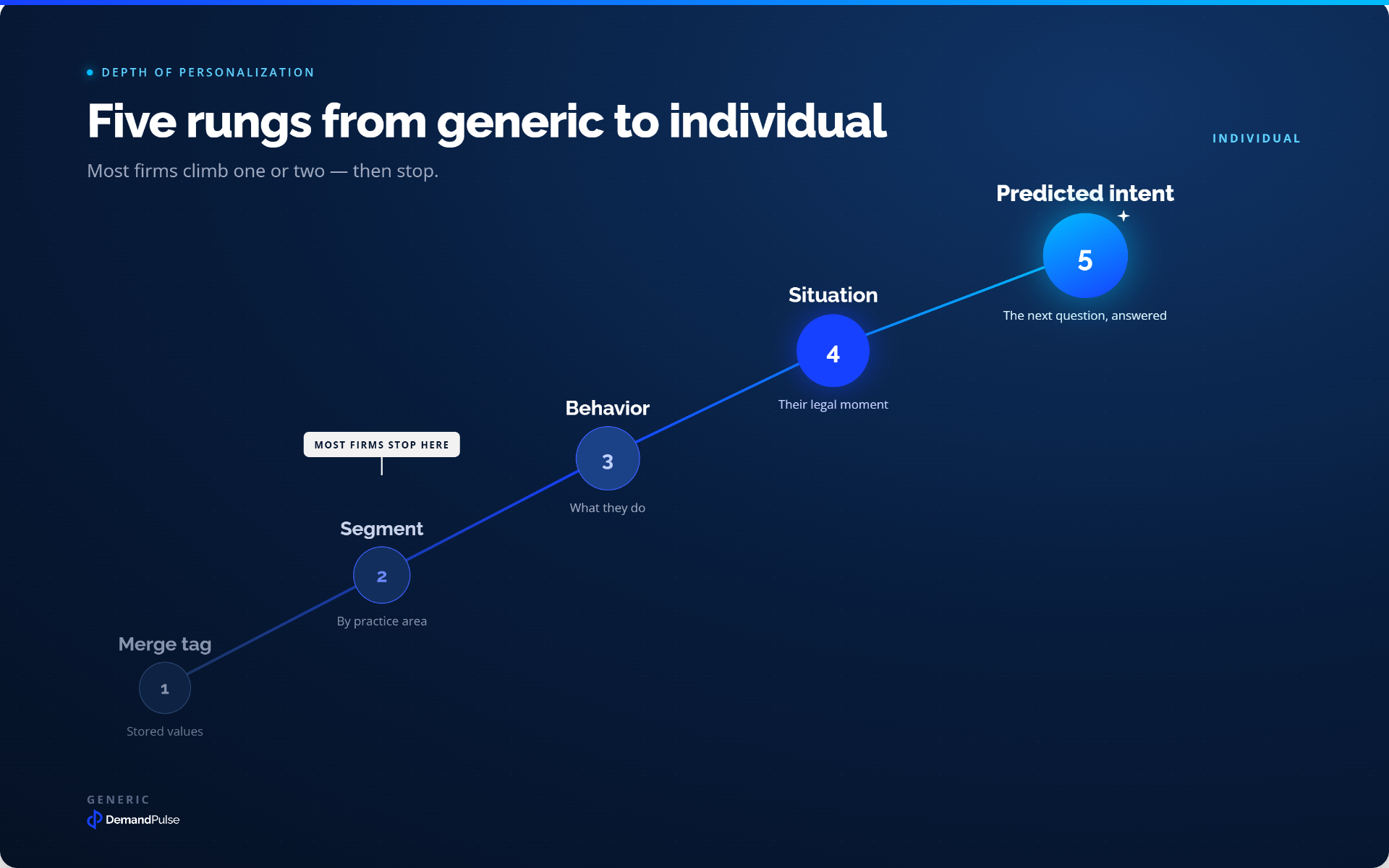
Think of personalization as a ladder with five rungs, from generic to genuinely individual. Most firms climb one or two rungs and stop, which is exactly why their email feels the same as everyone else's.
Merge tag
You insert stored values like first name or city. Table stakes.
Segment
You group contacts by a fixed attribute, usually practice area or client type, and send each group its own campaign. Most firms live here.
Behavior
You react to what people actually do: pages viewed, links clicked, guides downloaded, emails opened. The content responds to signals, not just labels.
Situation
You personalize to the legal moment a person is living through right now, which is the single most important variable in legal marketing and the one merge tags cannot capture.
Predicted intent
Models anticipate the next question before the person asks it, so the right message is already waiting when they are ready.
The reason the ladder matters is that depth compounds. Behavior plus situation plus timing is not three times better than a merge tag, it is a different category of experience. Each rung you climb also filters out people who are not ready, which protects your deliverability and your reputation.
Personalize the Situation, Not the Demographic
Here is a mental model that changes how legal marketers write email: a legal client is defined by a moment, not a persona.
Most personalization borrows from ecommerce, where a persona is a durable identity, the bargain hunter, the loyal repeat buyer. Legal does not work that way. Nobody is permanently a "divorce client." They are a person who, for a specific and often painful window, needs a specific kind of help. Personalize to that window.
This is why segmentation by practice area alone underperforms. Two people both tagged "personal injury" can be in opposite situations. One was in an accident yesterday and needs reassurance and speed. The other is six weeks in, frustrated with an insurer, and needs to know you handle the fight. Same practice area, opposite messages. The situation is the real segment, and behavioral data is how you detect it.
A practical rule: for every practice area, write down the three to five moments a client passes through, then map one core message to each moment. That map, not a persona doc, is the backbone of a personalization program that feels human.
Start With Data, Not AI
The unglamorous truth is that AI personalization is mostly a data project. Models can only personalize on what they can see, so the work starts with getting the right data into one place where it can be used.
Three kinds of data drive almost everything worth doing:
Identity data
Who they are and what matter they came in for. Name, practice area, source, referral.
Behavioral data
What they do. Site pages, form fills, downloads, email opens and clicks, call activity.
Contextual data
The situation and timing. Where they are in the intake or client journey, how urgent the matter is, how recently they engaged.
The mistake firms make is buying a tool before unifying these. If your website analytics, intake form, CRM, and email platform cannot see each other, your AI is personalizing on a fraction of the picture. Connecting those systems is the real project, the kind of marketing and revenue operations work that makes everything downstream possible. Garbage in, generic out.
Can You Personalize Without a Big List?
Yes. The cold-start problem, too few contacts and too little history, is the most common reason legal marketers assume AI personalization is not for them, and it is usually wrong. You do not need thousands of contacts. You need the right signals from the ones you have.
Most personalization advice is borrowed from ecommerce, where brands have years of purchase history across huge lists. A firm might have a few hundred contacts and a handful of touchpoints each.
That is enough, because in legal the most predictive signal is not a long history, it is a single high-intent action taken recently. One fees-page visit or a completed intake form tells you more than months of newsletter opens.
Start with rules, not models. Rules-based triggers, if this action then this email, work on day one with almost no data and capture most of the value. Add propensity scoring later, once you have enough history for a model to learn from. Firms that wait for "enough data" to begin usually never begin. Firms that trigger the obvious moments now build the data they need as they go.
AI-Powered Segmentation That Goes Beyond Static Lists
Email segmentation ai is the use of models to group contacts by predicted behavior and intent, rather than by fixed rules a human typed into a filter. A rule says "everyone tagged estate planning." A model says, "people who behave like they are about to book, regardless of their tag."
This matters because static lists go stale the moment someone's situation changes. Behavior-based segments update themselves. Instead of one "newsletter list," you get living micro-segments: contacts warming up, contacts gone quiet, past clients showing renewed activity, referrals who visited the fees page but never called. Each one deserves a different message, and the system sorts people into them automatically as signals change.
Two capabilities do most of the heavy lifting. Propensity scoring ranks who is most likely to act, so your best follow-up energy goes where it converts. Send-time optimization learns when each contact opens email and delivers at that person's moment rather than at 9 a.m. for everyone. Neither requires you to write a single new email. They just make the emails you already have land better.
Dynamic Email Content That Adapts to the Reader
Dynamic email content is a single email whose blocks change based on the recipient's data or behavior, so one send becomes many tailored versions. Rather than building five campaigns for five segments, you build one email with rules that swap the sections that should differ.
In practice, the intro, the example, the resource link, and the call to action can each adapt. A prospect who downloaded a guide on business formation sees a founder-focused example and a link to your business services page. Someone who came in through a family law form sees a calmer tone, a different resource, and a softer next step. Same template, same send, two experiences.
The guardrail is restraint. Dynamic blocks should change what is relevant and leave everything else stable. Over-engineer it and emails feel stitched together, and the reader senses it. Change the parts that matter to the situation and keep the voice consistent so it still sounds like your firm wrote it, because it did.
Behavioral Triggers: The Highest Leverage Move You Can Make
If you do only one thing from this article, build behavior-triggered emails. A triggered email fires automatically off a real action, which means it arrives when the person is already thinking about the problem. That timing is why triggered messages consistently beat scheduled blasts.
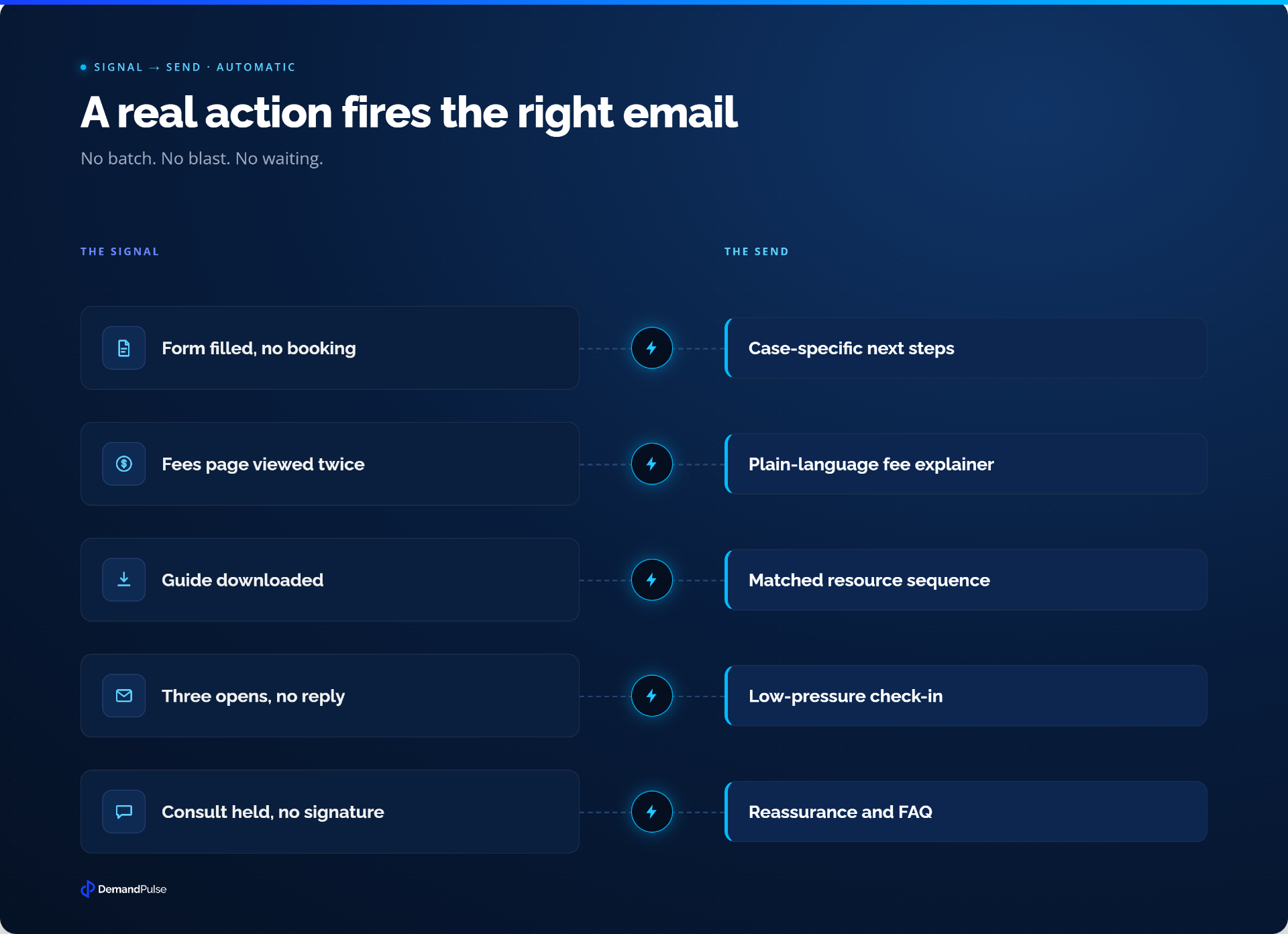
For a law firm, the highest-value triggers are intake and consideration moments. Someone submits a form but does not book. Someone reads the fees page twice in a week. Someone attends a consult but has not signed. Each of those is a signal, and each signal should fire a specific, relevant email without anyone remembering to send it.
Speed matters as much as relevance. In legal intake, the firm that responds first usually wins the client, and the window is measured in minutes, not days. A triggered email that fires the instant a form is submitted, while the person is still deciding, beats a perfect message sent tomorrow. Automation is how a firm answers every single lead within minutes without asking a human to watch the inbox around the clock.
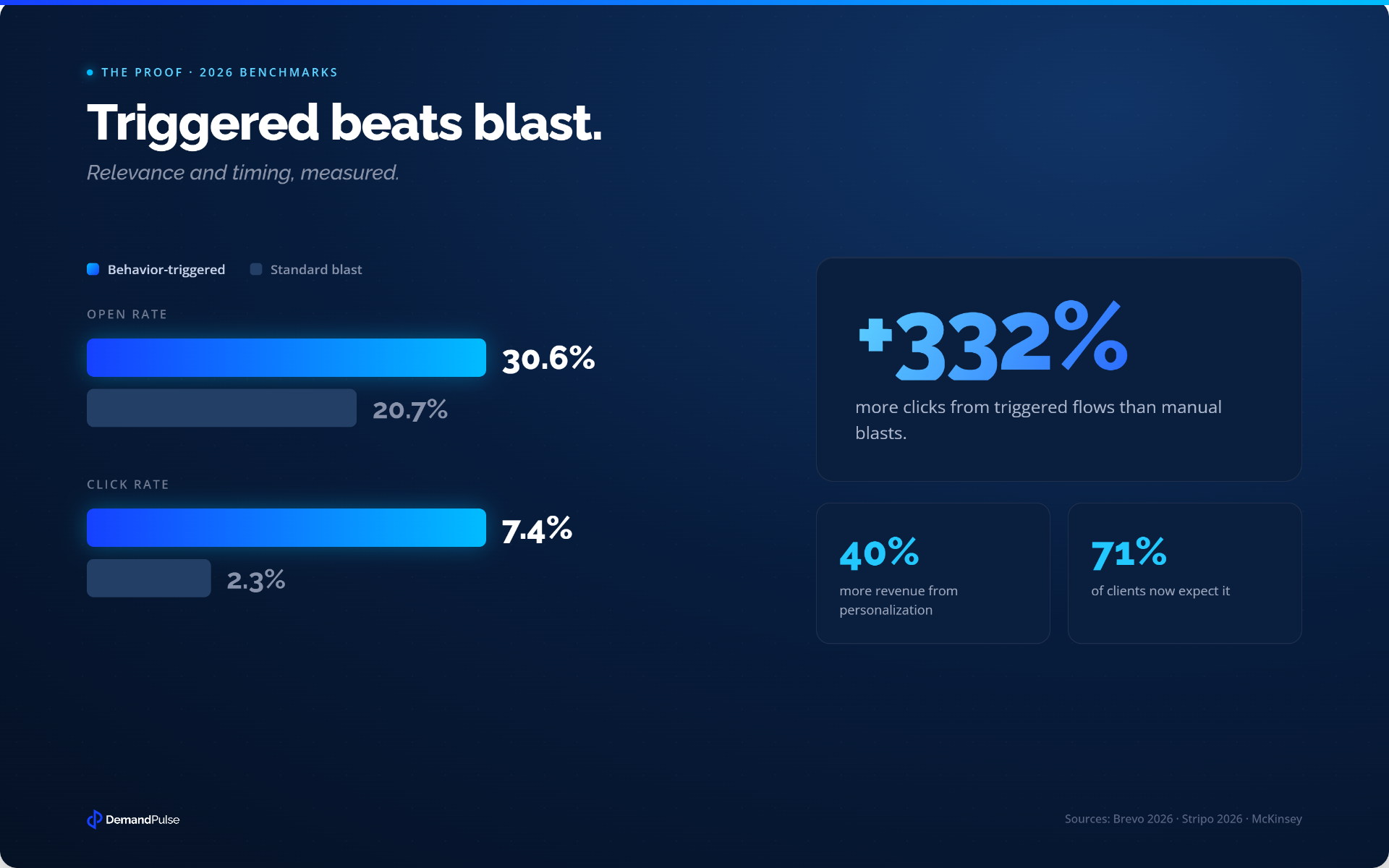
The performance gap is well documented. In Brevo's 2026 benchmark, automated and behavior-triggered emails averaged a 30.6 percent open rate and a 7.4 percent click rate, versus roughly 20.7 percent and 2.3 percent for standard campaigns.
Separately, Stripo's 2026 data found triggered flows earned about a 5.4 percent click rate against 1.25 percent for manual blasts, a 332 percent difference, precisely because the message responds to what the recipient just did.
Fast fact: Around 64 percent of marketers now use AI in their email programs, and those applying it to personalization report meaningfully higher revenue per send than teams still sending the same message to everyone.
The Personalization Nobody Reads: Deliverability
The best personalized email in the world is worthless if it lands in spam or the Promotions tab. Deliverability, whether inbox providers trust you enough to place your mail in the primary inbox, is the invisible ceiling on every personalization program, and smaller firms hit it constantly without realizing it.
Two things move deliverability more than anything else: authentication and list hygiene. Since 2024, Gmail and Yahoo require senders to authenticate with SPF, DKIM, and DMARC and to keep spam complaints low.
If your domain is not set up correctly, your carefully triggered emails can vanish into spam with no bounce to warn you. This is a one-time technical setup that most firms skip, then blame the copy.
List hygiene is the other half. Emailing contacts who never open trains inbox providers to treat you as noise, which drags down delivery for everyone else on your list. This is where the Depth Ladder pays off twice: the same behavioral signals that let you personalize also let you suppress the truly disengaged, so you send less and land more. Personalization and deliverability are the same discipline seen from two angles.
Personalization When Clients Don't Come Back
Most personalization playbooks assume repeat purchases. Personal injury, criminal defense, and divorce are usually one and done. For those firms, the real return on personalization is not lifetime value, it is reviews, referrals, and reactivation, the three engines that actually grow a legal practice.
When a client will not buy again, the personalized program changes its job. The highest-value automation becomes the post-matter sequence: a situation-aware review request sent when satisfaction peaks, right after a good outcome, not weeks later when the moment has passed. Reviews are among the strongest drivers of new legal clients, and timing is most of the battle.
Referrals are the second engine. A personalized nudge to past clients, and separately to referral sources like other attorneys, keeps your firm top of mind for the next matter you will never see coming.
Reactivation is the third: a former client whose situation changes, a new business or a second dispute, is far easier to win back than a stranger is to acquire. Behavioral data tells you when to reach out. Practice-area context tells you what to say.
What This Looks Like for a Law Firm Specifically
Everything above applies to marketing broadly. Law changes four things: sensitivity, ethics, accuracy, and register.
Sensitivity comes first. Your contacts are often in a hard moment, an injury, a divorce, a criminal charge, a business dispute. Personalization that shows off how much you know about their situation reads as intrusive, not helpful. The rule is to use data to be relevant, never to be visibly surveillant. "Since you were looking at our DUI page" is creepy. A calm, well-timed email about what to expect after a first offense is useful. Same underlying trigger, opposite feeling.
Ethics comes second. Bar advertising rules vary by state and govern testimonials, guarantees, and how you describe results. Automated content must respect the same rules a human draft would, so review has to cover triggered and dynamic emails, not just campaigns. Confidentiality matters too, since intake details are far more sensitive than a retail purchase history.
Accuracy comes third, and it is the fear most attorneys name first. When a model helps write email, it can state something as legal fact that is wrong, drift off your brand voice, or edge toward advice that reads like an attorney-client relationship. The guardrail is simple: AI drafts, a human approves, always. Keep automated sends to logistics, resources, and reassurance rather than case-specific counsel, and let nothing touching legal substance go out without a person signing off.
That human-in-the-loop step also solves the bottleneck every firm knows that partners must approve marketing. Build approval once, at the template level, so a partner signs off on the pattern rather than every individual send. You get scale and control at the same time.
Register comes fourth. A criminal defense follow-up and an estate planning nurture should not sound alike. The situation-based map from earlier is what keeps each practice area's tone appropriate as you scale.
Mistakes Law Firms Make With AI Personalization
Buying a tool before fixing the data
The platform is not the project. Unified, clean data is. Most disappointing results trace back to this.
Confusing segmentation with personalization
Sending the same generic email to a slightly smaller list is not personalization. It is a smaller blast.
Personalizing the wrong variable
Practice area is easy to tag and weak to target. Situation and behavior are harder to capture and far more persuasive.
Over-personalizing until it feels creepy
Referencing specific pages a person viewed crosses a line in legal contexts. Be relevant, not surveillant.
Skipping the review layer
Dynamic and triggered emails still have to clear advertising and confidentiality rules. Automation is not an exception to compliance.
Ignoring deliverability
Flawless personalization in the spam folder converts no one. Authenticate your domain and suppress the disengaged before you scale sends.
Measuring opens instead of matters
With privacy features inflating open rates, the metrics that matter are replies, booked consults, and signed engagements.
A 90-Day Path to Real Personalization
You do not need to boil the ocean. Climb the ladder in order.
Connect and clean
Get your website, intake forms, CRM, and email platform talking to each other, and standardize practice-area tags. Set up SPF, DKIM, and DMARC so future sends reach the inbox, and agree a template-level approval process with the partners so nothing stalls later. You are building the foundation, not sending anything new yet.
Trigger obvious moments
Launch three behavior-triggered emails where the intent is clearest: form filled but no booking, fees page viewed but no call, consult held but no signature. Fire them fast, within minutes. These usually pay for the whole effort.
Deepen and retain
Turn your best campaign into one dynamic email that adapts by situation, add propensity scoring so follow-up goes to the people most likely to act, and switch on a post-matter review request. Now you are on rungs three and four, ahead of nearly every firm you compete with.
Turn Your Data Into Email That Converts
Personalization at scale lives or dies on your data and your setup. Most firms have the leads and the CRM but never connect them, so their email stays generic and their best prospects go cold.
That connection is what DemandPulse builds. We unify your intake, website, CRM, and email data, then stand up the dynamic, behavior-triggered emails that generic blasts cannot match, tuned to your practice areas and your clients. If you want email that responds to what each person does, see how we help Law Firms.
Ready to Personalize Email That Actually Converts?
Tell us about your firm. We'll show you where personalization will move the needle first, and how to build the data and automation to make it happen.
Related Articles
Cold Email for Law Firms: What Actually Gets Replies
What 85M+ cold emails reveal about earning replies in the first send.
Marketing Automation for Law Firms
Choose the right growth path: HubSpot vs. Clio Grow in 2026.
The Definitive Guide to CRM for Law Firms
Compare intake tools to full-stack CRM platforms for legal practices.
AI Email Marketing for Law Firms
Get a custom AI email assistant tuned to your practice area.
Subscribe for Insights That Drive Growth
Practical tips to help you grow your business and build a great team, sent to your inbox.