How to Build an AI Knowledge Base That Powers Accurate Customer Support in 2026

of AI support failures trace back to the knowledge layer, not the model. The hallucination rate is a content quality metric.
When an AI support agent gives a confidently wrong answer, the instinct is to blame the model. Most of the time, the model did exactly what it was told. It pulled an article from your help center, trusted it, and passed it along word for word.
The catch is that the article described a version of your product that deployed three releases ago. This is the uncomfortable reality behind most AI support failures. An AI knowledge base is a content operations problem first and a technology problem second.
"Get the content right, and the AI quietly gets better. Let it decay, and the AI repeats every mistake at machine speed."
Did you know that 92% of customers across the globe say that they would use an online knowledge base for self-support if it were available.
What Is an AI Knowledge Base?
An AI knowledge base is the structured collection of help articles, policies, and product documentation that an AI support agent retrieves from to answer customer questions. Unlike a traditional help center written for people to skim, an AI knowledge base is built to be parsed, retrieved, and cited by a model, which makes its accuracy and structure mission critical.
The mechanics matter here. Modern AI support runs on retrieval augmented generation, or RAG. When a customer asks a question, the system searches your articles, pulls the most relevant passages, and uses only that retrieved content to write its reply. The model is not inventing answers from thin air.
It is grounding them in whatever it finds. That design is exactly why your content quality sets the ceiling on your AI quality. A brilliant model retrieving a stale article will produce a stale answer, delivered with the calm authority that makes customers believe it.
Not sure how much of your help center your AI is quietly getting wrong?
Start with a free knowledge base audit. We will flag the stale and contradictory articles that are costing you resolutions, and show you where to fix the content first.
Run Your Free AI ScorecardWhy Your AI Knowledge Base Decays Faster Than You Think
Every help center decays. Products ship, prices change, settings move, and the article describing the old flow sits untouched while the screenshots quietly go out of date. For human readers, a slightly stale article is a minor annoyance. For an AI knowledge base, it is a fault line.
The faster your product team ships, the faster your documentation falls behind, and the more aggressively your AI amplifies that gap to every customer who asks.
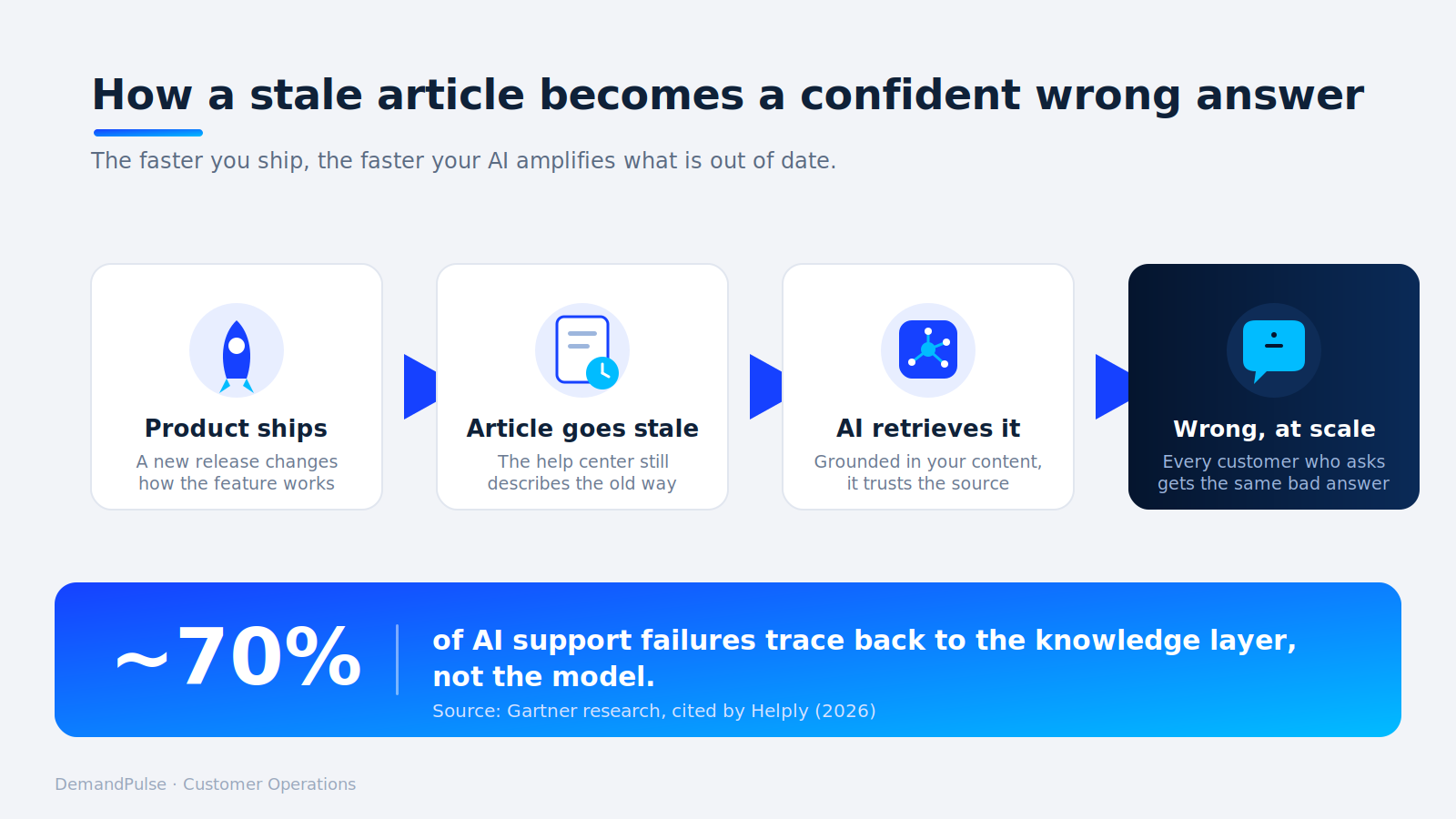
The decay chain: one shipped release can turn a trusted article into a wrong answer served to every customer who asks.
The scale of the problem is well documented. Gartner research finds that roughly 47% of knowledge articles inside enterprise support systems are outdated, duplicated, or contradicted by a newer article somewhere in the same instance.
Zendesk's 2025 knowledge base health report adds that about 30% of a typical enterprise help center contains articles more than 12 months old. A retrieval system pointed at that kind of corpus does not need to hallucinate to be wrong. It simply repeats the contradictions already sitting in your content.
Getting AI Into Your Support Team Without the Overwhelm
The hardest part of an AI knowledge base is rarely the technology. It is knowing where to start. Most support leaders look at a help center with hundreds of articles, imagine cleaning all of them, and quietly put the project off for another quarter. That instinct is the real blocker, and the fix is to stop trying to boil the ocean.
Customers are already asking for self-service. 92% of consumers say they would use an online knowledge base for self-support if it were available.
The opportunity is real, but so is the failure mode: Gartner reports that 43% of self-service failures happen because customers cannot find relevant content. The starting move is not a platform decision. It is a content decision. Pick the small slice of your knowledge base that handles the most volume, make it excellent, and let the AI prove itself there first.
How to Build an AI Knowledge Base in 6 Steps
This is the practical sequence we use when we stand up an AI knowledge base for a SaaS or LegalTech support team. It works because it treats content discipline, not model selection, as the core of the project.
Pull your top 20 recurring questions from the last quarter of tickets. These usually account for a large share of total volume, which means fixing them first gives the AI knowledge base the fastest path to real deflection. Write or rewrite those 20 articles to be accurate and complete, then point the AI at them. You get a credible win in weeks instead of a cleanup project that never ends.
Retrieval rewards clarity. Lead each article with a direct, self-contained answer in the first paragraph, use plain headings that match how customers phrase questions, and keep one idea per section. Avoid burying the resolution three scrolls down under preamble. A well-structured article is easier for the model to retrieve the right passage from, and easier for a human to verify when something looks off.
Content decays silently when it belongs to everyone, which means it belongs to no one. Assign a named owner to each knowledge area: billing, integrations, onboarding, security. That owner is accountable for keeping their articles current when the product changes. Ownership is the single cheapest control you can add, and it is the one most teams skip.
If you ship weekly, a quarterly content review is not a cadence, it is a backlog. Match audit frequency to how fast your product moves. Review your highest-traffic articles monthly and the full AI knowledge base quarterly.
This is the step that turns a static help center into a living AI knowledge base. Every time the AI gives a wrong or low-confidence answer, treat it as a signal pointing at a specific article. Capture the bad answer, trace it to the source passage, and fix the underlying content so the same mistake cannot happen again. Failed searches and escalations are not noise. They are a free, continuous audit telling you exactly where your content has gaps.
Most teams watch deflection rate and stop there. To keep an AI knowledge base healthy, measure at the article level: which articles close tickets, which ones get cited in low-confidence answers, how many articles are past their review date, and your hallucination rate over time. When a number slips, you want to know which piece of content is responsible, not just that the bot felt off this week.
The payoff is concrete: Zendesk's knowledge base health data shows that curation alone reduces grounded-but-wrong answers by 20% to 30%, purely by removing stale and duplicate source material.
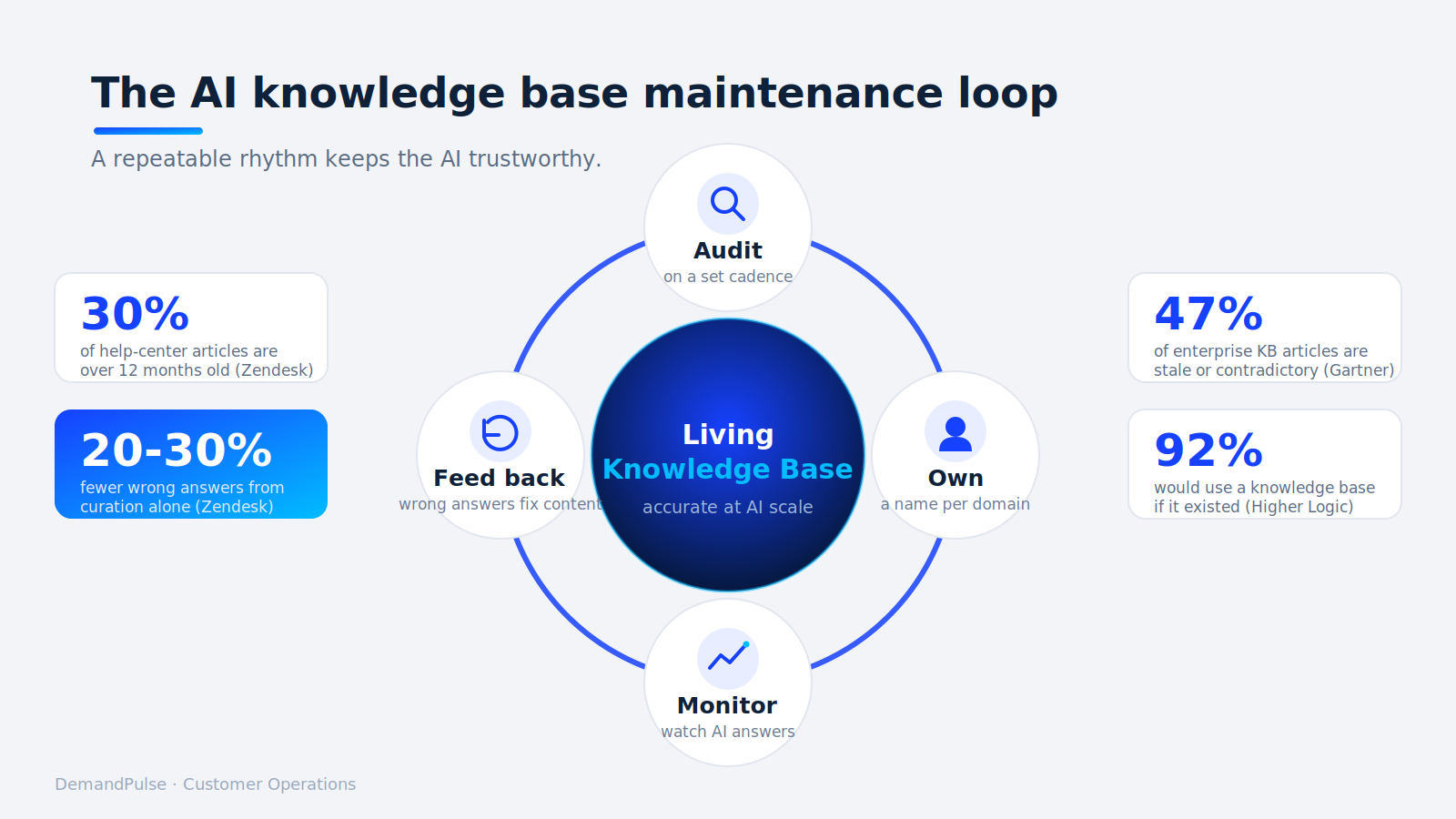
Audit, own, monitor, and feed back. The maintenance loop is what separates an AI knowledge base that compounds in value from one that quietly rots.
Traditional Knowledge Base vs AI Knowledge Base
The shift from a human help center to an AI knowledge base changes what "good content" means. A page that reads fine to a person can still produce a bad AI answer if it is ambiguous, contradictory, or out of date.
Common Mistakes to Avoid
Blaming the model for content problems.
If the AI is confidently wrong, check the source article before you switch platforms.
Launching against the entire help center.
Breadth at launch dilutes quality. Depth on your top questions builds trust.
Treating the AI knowledge base as set-and-forget.
Without an audit cadence and an owner, accuracy decays release by release.
Ignoring low-confidence answers.
They are the cheapest content audit you will ever get. Route them back into the documentation.
Your AI Knowledge Base Is Only as Good as Your Content Discipline
The teams that win with AI support are not the ones with the most advanced model. They are the ones whose content stays accurate as the product moves. An AI knowledge base rewards discipline and punishes neglect, and it does both at scale.
Start small, structure for retrieval, assign owners, audit on a cadence that matches your release speed, and close the loop from every wrong answer back into the documentation. Do that, and the AI quietly becomes one of the most trusted members of your support team.
And if running that rhythm in-house is not where you want your team spending its time, that is exactly the work DemandPulse takes off your plate.
How DemandPulse Helps You Grow Support With AI
DemandPulse builds, staffs, and runs customer support operations for SaaS and LegalTech companies. We are not a chatbot vendor and not a generic BPO. We put a US-based support lead and an in-office, product-trained team around your customer support operations, then run your AI knowledge base as a living system, so your AI agent and your customers always get answers that match the product you shipped this week, not last quarter.
Everything in the six steps above is ongoing operational work. Here is what we own for you:
Build and structure your knowledge base.
We document your highest-volume tickets and rewrite articles for clean AI retrieval (Steps 1 and 2).
Run the maintenance rhythm.
We assign ownership across every knowledge domain and run the audit cadence that matches your release speed (Steps 3 and 4).
Close the feedback loop.
We trace every wrong or low-confidence AI answer back to the article that caused it and fix the source (Step 5).
Pair AI with trained humans.
AI resolves the repeatable volume; our agents own the complex, high-stakes cases your customers care most about.
The result is faster first responses, higher first-contact resolution, a lower cost to serve, and renewals protected by a support function that catches problems early. DemandPulse keeps your knowledge base, and the AI that depends on it, accurate as your product moves.
Request a Free Support Audit
We will sketch where your AI knowledge base is leaking accuracy and where to fix it first. No commitment.
Subscribe for Insights That Drive Growth
Practical tips to help you grow your business and build a great team, sent to your inbox.