Scaling Customer Support with AI: Strategies and Benefits
Scaling customer support with AI means using conversational AI for customer service to handle unlimited first responses, deflect high-volume routine questions, and power a self-serve help layer, so growing volume no longer forces you to grow your team in lockstep.
The four core strategies are instant first-touch coverage, tiered ticket deflection, a self-serve onboarding layer, and AI-assisted human agents. The hard part is rarely the technology. It is knowing where to start, in what order, and where to keep humans, so the rollout works instead of stalling.
If you lead support at a growing SaaS or LegalTech company, you already know AI can help. The real question keeping you up at night is different: how do you actually get started with AI in your support team without breaking the experience you have today?
Most leaders are not short on conviction. They are short on a clear first step. Which tickets do you point it at first? How do you keep customers from feeling fobbed off onto a bot? What do you keep human? That uncertainty is the thing that stalls most teams, not the price tag.
This guide is built to remove that uncertainty. It lays out conversational AI for customer service in plain terms: the four strategies that actually move the needle, the benefit behind each, a sequenced way to begin, and an honest map of where AI helps and where it does not. The goal is a rollout you can start with confidence, not another project that quietly stalls after the demo.
Why Getting Started with Conversational AI for Customer Service Feels Hard
The technology is not the blocker anymore. Capable AI is a click away. What makes leaders hesitate is the fear of getting the rollout wrong: a bot that frustrates good customers, a half-finished project that nobody owns, or an AI that confidently gives a wrong answer to a paying account. Those are real risks, and they are exactly why a sequenced approach matters more than the tool you pick.
We have watched teams get past this. When SurePoint, a legal tech company, hit the classic growing pains of scale, rising volume, long ramp times, and product knowledge trapped in a few people's heads, the answer was not "buy a chatbot."
We rebuilt their support around a tiered model that paired automation with a trained team, documented the knowledge, and gave every layer a clear owner. Resolution got faster, onboarding got consistent, and the team scaled from four agents to eighteen in a year without losing quality. The lesson: a rollout works when it has structure, not just software.
That structure is what most "just turn on AI" attempts are missing. Anyone can switch on Intercom, Zendesk AI, or an off-the-shelf bot this afternoon. What separates a support operation that scales from one that quietly bleeds CSAT is the work around the bot: the playbooks, the QA rubric, the escalation paths, and the trained humans who own everything the AI cannot. AI is now the easy part. The operation around it is where the real work, and the real advantage, lives.
The 4 Strategies for Scaling Support with Conversational AI
The leverage is not in "buying a chatbot." It is in deploying AI across four distinct strategies, each tied to a specific benefit. Below is the framework we use when we help SaaS and LegalTech teams put AI to work in support.
1. Instant First-Touch Coverage
The strategy: AI responds the moment a ticket lands at 2 a.m., on a Sunday, during a holiday your team does not cover. There is no queue and no "your estimated wait is 14 minutes." Every customer gets an acknowledgment and, for routine issues, a complete answer immediately.
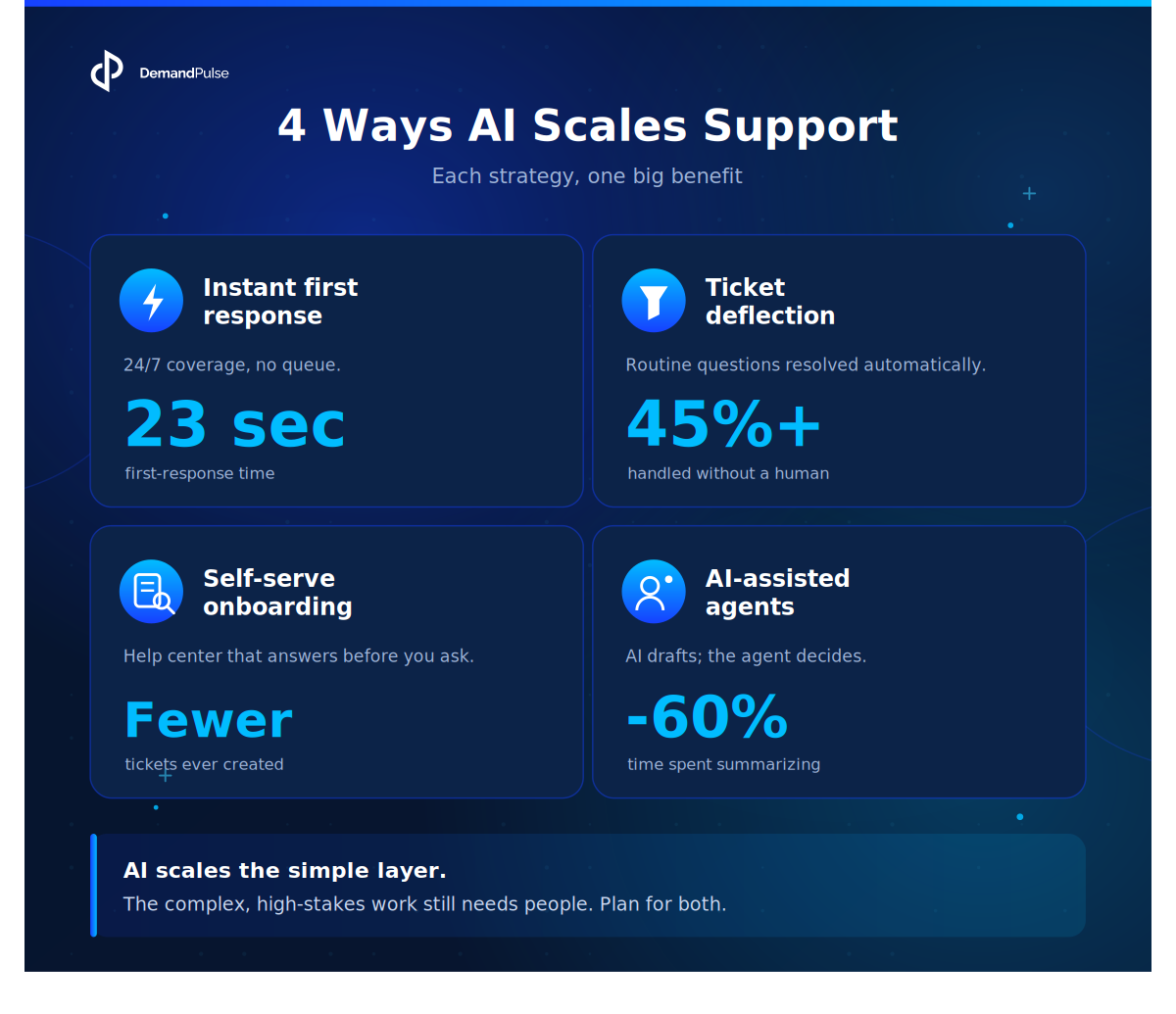
The benefit, speed. This is where AI genuinely outperforms humans, because it has no breaks and no hold times. Best-in-class deployments have pushed first-response time down to roughly 23 seconds from a starting point of 15 minutes, a 97% reduction. For B2B SaaS and LegalTech buyers who expect quick, actionable support, that responsiveness is often the entire reason they stay.
2. Tiered Ticket Deflection
The strategy: Not every ticket needs a human. Password resets, "where do I find X," billing-status checks, and the same onboarding question asked 400 times a month can all be resolved automatically. Customer support automation routes these to AI and reserves your agents for the tickets that actually require judgment. This is usually the safest place to start, because it is high volume and low risk.
The benefit, capacity that scales without new hires. Industry-wide, AI agents now deflect over 45% of incoming customer queries, with some verticals clearing 50%. Because the AI layer absorbs that volume without adding people, growth stops translating directly into headcount. This is the single biggest reason the volume-equals-hiring link finally breaks.
3. The Self-Serve Onboarding Layer
The strategy: The easiest ticket to handle is the one that never gets created. By turning your help center into an active, conversational assistant, one that guides new users through setup, answers in-app questions, and surfaces the right doc at the right moment, you absorb demand before it becomes a ticket at all.
The benefit, demand absorbed early. Traditional static FAQ pages resolve only a sliver of issues on their own. A conversational self-serve layer changes the slope of your entire volume curve, especially during onboarding, when new-customer questions cluster and predictably spike. There is a bonus effect too: new users often treat the assistant as free, self-paced training, asking dozens of basic "how do I…" questions in a single session to learn the product. That is volume your team never has to touch.
4. AI-Assisted Human Agents
The strategy: For the tickets that do reach a person, AI works alongside the agent rather than replacing them. It drafts replies, summarizes long conversation histories, suggests the right macro, and pulls relevant account context, so the agent spends time on the resolution, not the research.
The benefit, higher capacity per agent. AI can reduce the time needed to summarize customer conversations by up to 60%, according to McKinsey. New hires also ramp faster when the system is doing the heavy lifting on context. The result is the same team resolving meaningfully more, without burning out.
Not sure where AI actually fits in your support team? Talk to DemandPulse and we will map exactly where to start, what to automate first, and what to keep human.
Start the Conversation →How the Strategies Stack: The Tiered Deflection Model
These four strategies are not a menu. They are a stack. Demand flows from the top, and each layer absorbs what it can before passing the rest down. By the time a ticket reaches a human, it has already been filtered to the work that genuinely needs one.
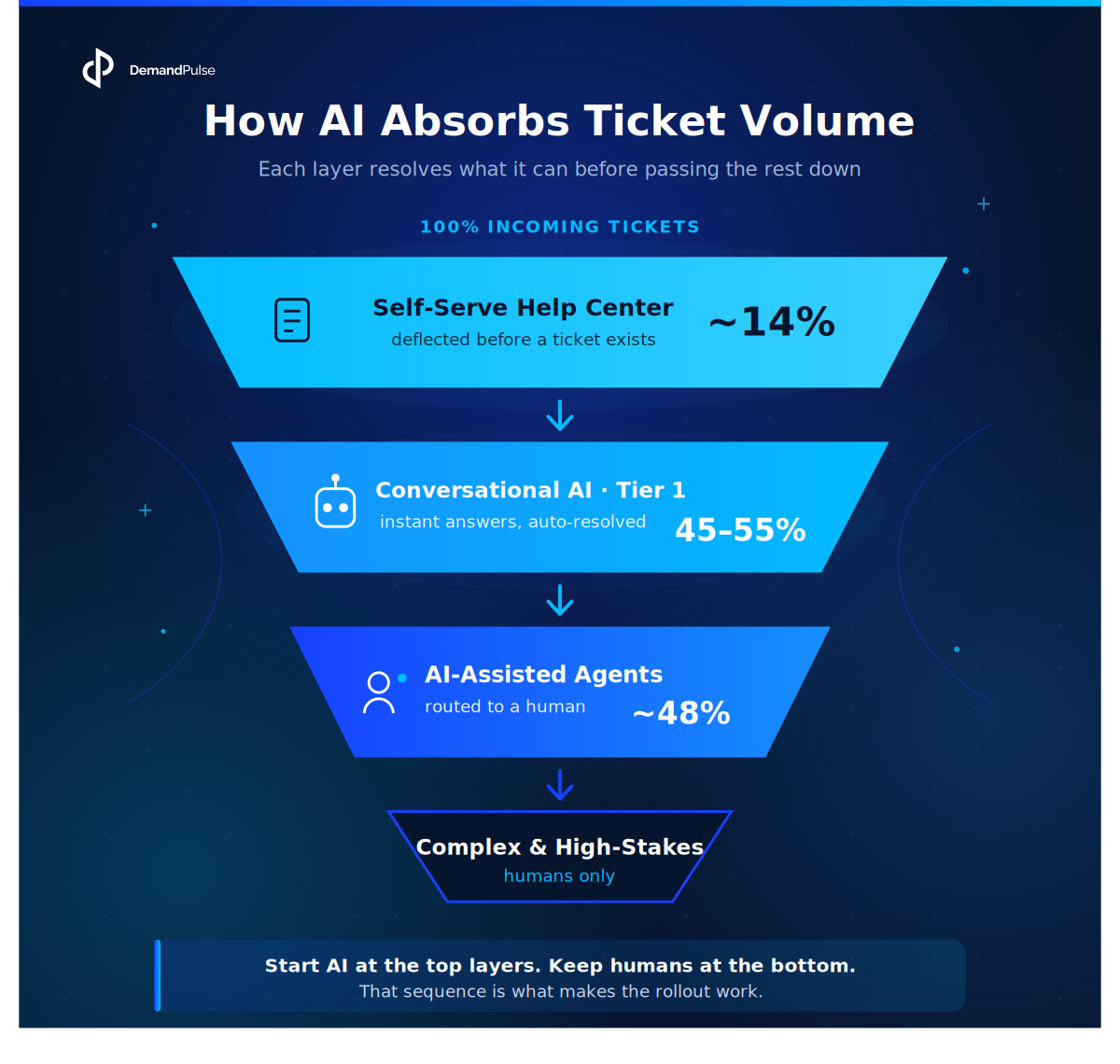
The model works because it is honest about where AI adds value at each level. Self-serve and Tier 1 AI handle the predictable, repetitive volume. AI-assisted agents take the middle. And the top layer, escalations, confidential matters, multi-system bugs, churn-risk accounts, stays human by design. Knowing which layer a given ticket belongs to is the whole game, and it is exactly what a sequenced rollout sorts out for you.
The Benefits of AI in Customer Service (and the One Limit That Matters Most)
The upside is real and well-documented. The benefits of AI in customer service include faster response times, more capacity without more hires, 24/7 coverage without 24/7 staffing, more consistent answers, and agents freed to do higher-value work.
There are two benefits leaders consistently underestimate, too. First, retention: when AI absorbs the repetitive, draining tickets, your best agents stop burning out on password resets and start doing work worth staying for, and support attrition is one of the most painful problems in the function. Second, institutional knowledge capture: building the knowledge base and macros that power your AI forces you to get the product expertise out of your senior agents' heads and into a system, so it survives turnover and trains the next hire automatically.
The clearest way to plan a rollout is to map which work belongs to AI and which belongs to people:
But the limit is just as real, and ignoring it is how rollouts fall apart. Despite years of "AI replaces agents" headlines, a Gartner survey of 321 support leaders found that only 20% had actually reduced agent headcount because of AI. Most kept their teams the same size and simply served more customers. The lesson is not that AI underdelivers. It is that AI scales the simple layer and humans still own the hard one. Plan to automate everything, and the first complex ticket exposes the gap.
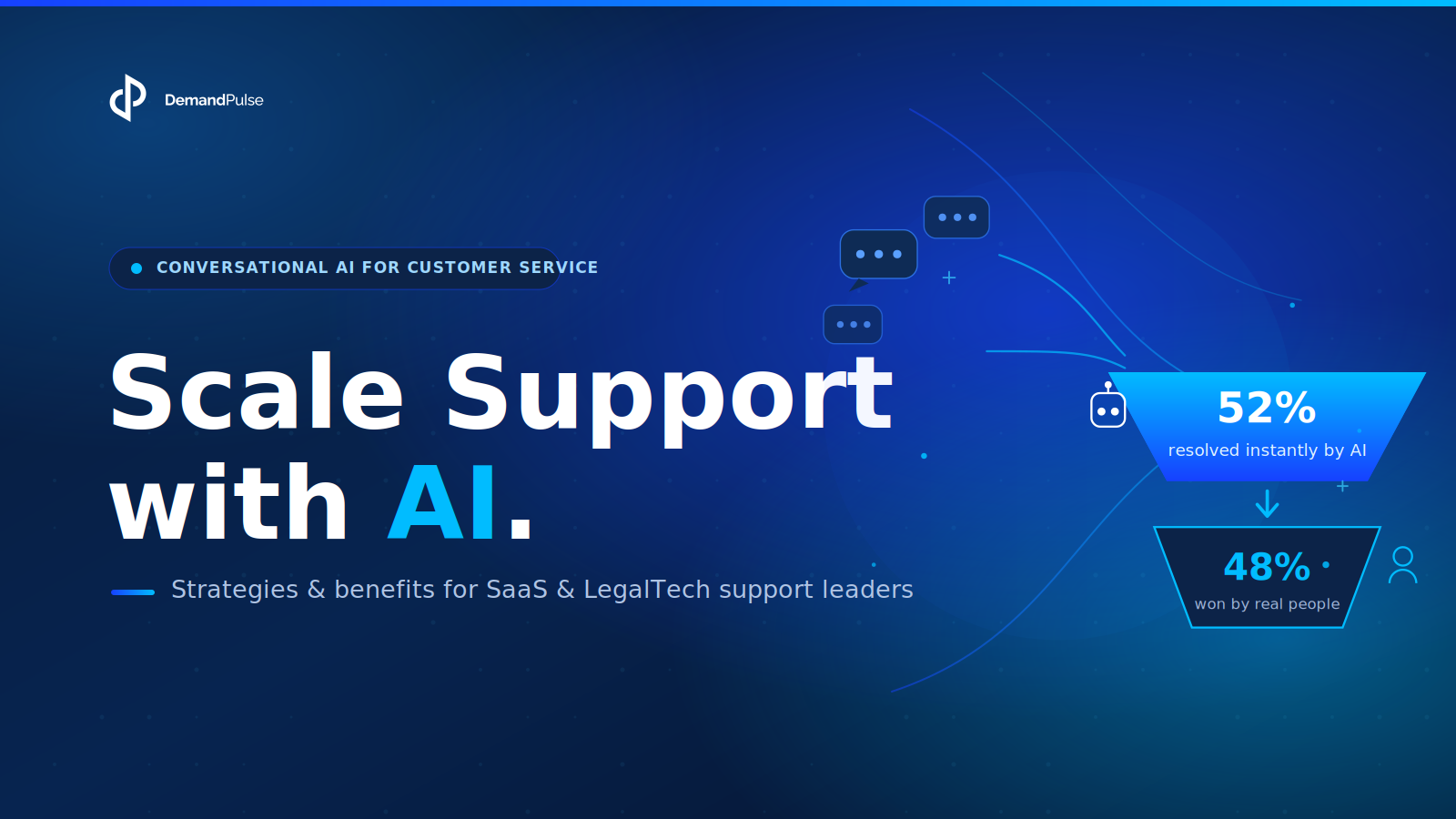
We see this in our own data. On one support engagement, roughly 52% of conversations route to and resolve directly with AI, while 48% still come to a human, even months into deployment. Customers actively seek out a person for anything they want to explain in their own words.
The single biggest reason for that 48% is something most buyers do not anticipate: AI retrieves information, but it cannot log into a customer's account and investigate. It can tell you which report to run, but it cannot see why your filters are returning the wrong data, diagnose a bug, or check a permission setting on the back end. In one of our engagements, the majority of tickets needed exactly that kind of account-level investigation, which is work only a human can do today.
That 52/48 split is the whole strategy in one number. AI absorbed half the volume instantly. The other half, the conversations that needed nuance, reassurance, or judgment, went to people who could actually deliver it. Plan for both, and the model holds. Plan for only one, and it breaks.
How DemandPulse Helps You Get Started with AI in Support and Success
Most teams do not stall because AI is too expensive. They stall because nobody owns the rollout, the knowledge base is thin, and there is no clear plan for what stays human. DemandPulse builds, staffs, and runs the customer support and customer success operations that make AI actually work.
We do not just hand you a tool and wish you luck. We design the tiered operation around it: a U.S.-based support lead embedded with your team, in-office Centers of Excellence running Tier 1 through Tier 3, and the playbooks, macros, escalation trees, and QA rubrics that make conversational AI for customer service perform instead of frustrate.
We point the deflection layer at the right tickets first, build the self-serve knowledge base, and pair trained human agents with AI assistance, so your team scales without the six-month hiring cycle. With SurePoint, that approach lifted CSAT above 90% and made agent onboarding 30% faster while the team grew from 4 to 18.
The same logic extends to customer success. The high-volume, predictable touchpoints, onboarding nudges, adoption check-ins, renewal reminders, usage alerts, are exactly the work AI can carry, freeing your CSMs to focus on the strategic relationships, QBRs, and churn-risk accounts where human judgment protects revenue.
We architect that split for you: AI handling the scalable motions, embedded specialists owning the conversations that win renewals and expansions.
For Sales Playbook Builder, an AI-first sales technology company, we placed a single foundational CSM inside an AI-enabled success framework, and they grew onboarding volume without adding headcount, held delivery to two-to-three weeks, and averaged 4.9/5 NPS on onboarding while hitting 100% of new-client targets. That is one person operating like a team, because the operation around them was built right.
How to Get Started with AI in Your Support Team: A Step-by-Step Approach
The hardest part is knowing where to begin without breaking the experience you already have. Here is how to scale customer support with AI in a safe, sequenced rollout:
- Baseline your tickets. Pull 30 to 90 days of ticket data and tag the top recurring intents. The questions asked most often are your first automation candidates.
- Start with deflection, not replacement. Point AI at the highest-volume, lowest-risk intents first (password resets, status checks, "where do I find X"). Measure containment before expanding scope.
- Build the self-serve layer in parallel. Every well-written help article makes both your AI and your humans faster.
- Add agent assist before agent autonomy. Let AI draft and summarize for your team before it answers customers unsupervised. Trust is earned on internal tooling first.
- Define the human escalation path on day one. Decide which intents always route to a person, and make the "talk to a human" option obvious. This single decision protects CSAT more than any model tuning.
You do not need to automate everything at once. You need to automate the right first layer and keep a clean handoff to people for the rest. If you would rather not build all five steps in-house, this is exactly the rollout DemandPulse stands up for SaaS and LegalTech teams.
What to Track: Metrics That Prove AI Support Is Working
Once you are live, a few metrics tell you whether the rollout is actually working. Track them before and after launch:
- Deflection / containment rate: the share of conversations the AI resolves with no human involvement. Your headline efficiency number.
- First-response time (FRT): how fast a customer gets an initial answer. AI should crush this.
- First-contact resolution (FCR): how often an issue is solved in one interaction, AI or human.
- CSAT, split by channel: measure AI-resolved and human-resolved satisfaction separately. A blended score hides problems.
- Escalation rate: how often AI hands off to a human. Rising escalations mean your scope or content needs work.
- Time to human (escalation lag): how long a customer spends with the bot before reaching an agent. Watch this closely. If customers loop with the AI for several minutes before it hands off, your total resolution time can actually go up even when every step looks fast.
- Reopen rate: how often a "resolved" ticket comes back. The fastest signal that AI is closing things it should not, especially if your bot auto-closes chats after a short silence.
The trap is optimizing deflection at the expense of CSAT. A bot that "contains" a frustrated customer by refusing to escalate is not deflecting, it is churning. Watch the two together.
The Pitfalls to Avoid When Scaling Support with AI
The teams that get burned are not the ones who move too slowly. They are the ones who skip the guardrails. Three pitfalls account for most failed rollouts:
- Stale or thin documentation. Your AI is only as good as the help center it reads from. The most common failure is not the bot inventing answers, it is the bot faithfully citing an outdated article and confidently sending the customer in the wrong direction. The question was about X, the article is about Y, and the customer ends up more confused than before. Before you scale AI, get your help docs current, and keep them that way. Plan for someone to audit AI conversations every week, flag the wrong ones, and update the underlying articles, because fixing the article is what fixes the AI. Also set the AI to escalate, not improvise, when it is not sure, and QA its conversations against the same rubric you use for humans.
- Ignoring data security and compliance. Customer tickets contain sensitive data, and for LegalTech that can include privileged or confidential matter details. Before you pipe tickets into any AI, confirm how the vendor handles data: require SOC 2, clear and retention terms, and no training on your customers' data without consent. Route confidential and high-stakes matters to vetted humans in a controlled environment, not to a general-purpose model. The right answer is rarely "automate everything." It is "automate what is safe to automate."
- Treating AI as set-and-forget. AI support degrades without upkeep. Help content goes stale, products change, and new ticket types emerge, so someone has to review transcripts, retrain on misses, and keep the knowledge base current. Assign that ownership from day one, or hand it to a partner who runs it for you.
Frequently Asked Questions
Final Word: Start Small, Keep Humans on the Hard Part
Scaling customer support with AI is not about choosing between bots and humans. It is about getting started the right way: point conversational AI for customer service at the predictable volume first, build the structure around it, and keep skilled people on the complex, high-stakes work.
Begin with one safe layer, prove it, and expand. Do that, and growth stops translating directly into headcount. Skip the structure, and the first hard ticket exposes the gap.
Start the Conversation →
About DemandPulse
DemandPulse is a customer operations partner for B2B SaaS and LegalTech companies. We design, build, and run customer support and customer success operations, combining AI-powered deflection architecture with dedicated, in-office specialist teams trained on SaaS and LegalTech workflows. Clients get 24/7 coverage, lower cost-per-ticket, and CSAT improvement without proportional headcount growth, typically going live in 2-3 weeks. DemandPulse is headquartered in Austin, Texas, and serves scaling companies across the United States.