
A Fractional CMO (Chief Marketing Officer) is a senior marketing leader who works with companies on a part-time, contract, or retainer basis, offering strategic, high-level marketing leadership without the cost or commitment of a full-time executive hire.
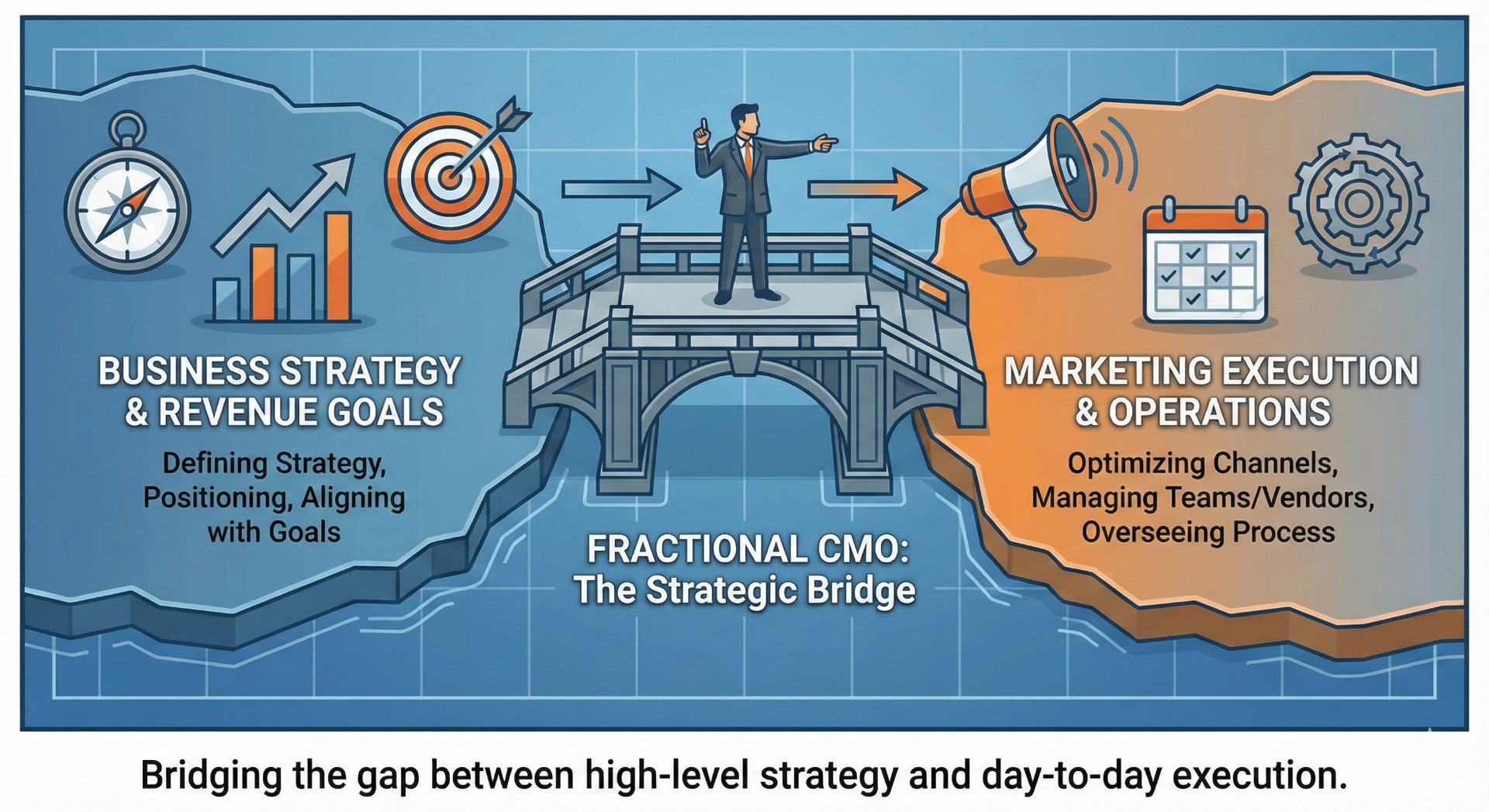
Unlike a consultant who offers advice occasionally, or a marketing agency that executes tactics, a fractional CMO is embedded—they help define marketing strategy, align it with business goals, oversee teams and vendors, and hold accountability for outcomes.
They bring cross-industry insights, vetted vendor networks, and marketing playbooks from prior engagements.
In the broader corporate world, fractional executives are part of a trend where companies seek high-level skills without full-time cost. As Wikipedia notes:
"Fractional executives … offer their management services to organizations on a for-hire, part-time basis … they differ from business consultants … as fractional management can be seen as a specialized evolution of interim and temporary management."
In short, a Fractional CMO bridges strategy and execution—you can think of a fractional CMO as a "C-level on demand" solution, giving you access to broad skills without the full-time overhead.
Why Companies Hire a Fractional CMO
Here are some common drivers:
- You're scaling but can't yet justify a full-time CMO.
- Your marketing lacks senior leadership or coherence.
- You need to build a marketing engine, but don't want to delegate strategy to external agencies alone.
- You want flexibility—the ability to dial engagement up or down.
- You prefer paying for outcomes, not just salary and benefits.
Many growth-stage B2B or SaaS firms fall into this zone. With a fractional model, companies gain executive-level insight, leadership, and discipline more affordably.
What Does a Fractional CMO Do?
A fractional CMO's role spans multiple areas. Some core responsibilities include:
Defining Marketing Strategy & Positioning
They help clarify market segmentation, buyer personas, value proposition, positioning, messaging, and competitive strategy.
Aligning with Business Goals & Revenue
They ensure marketing is tightly connected to revenue metrics and organizational objectives.
Overseeing Marketing Operations & Processes
This includes marketing automation, dashboards, KPIs, attribution models, tools, and workflows.
Coordinating Internal Teams and External Vendors/Agency Partners
They don't necessarily execute every task, but they steer internal staff and manage or vet agencies.
Optimizing Channels & Budget Allocation
They test, measure, and reallocate budgets across channels according to ROI.
Hiring, Coaching & Building Structure
They may help you recruit marketing staff or contractors, build SOPs, and establish repeatable processes.
Ongoing Measurement, Iteration & Accountability
They track performance, course correct, and report to leadership or the board.
Because the fractional CMO is an integrated part of your organization (not just external advising), they can pivot with you as needs evolve.
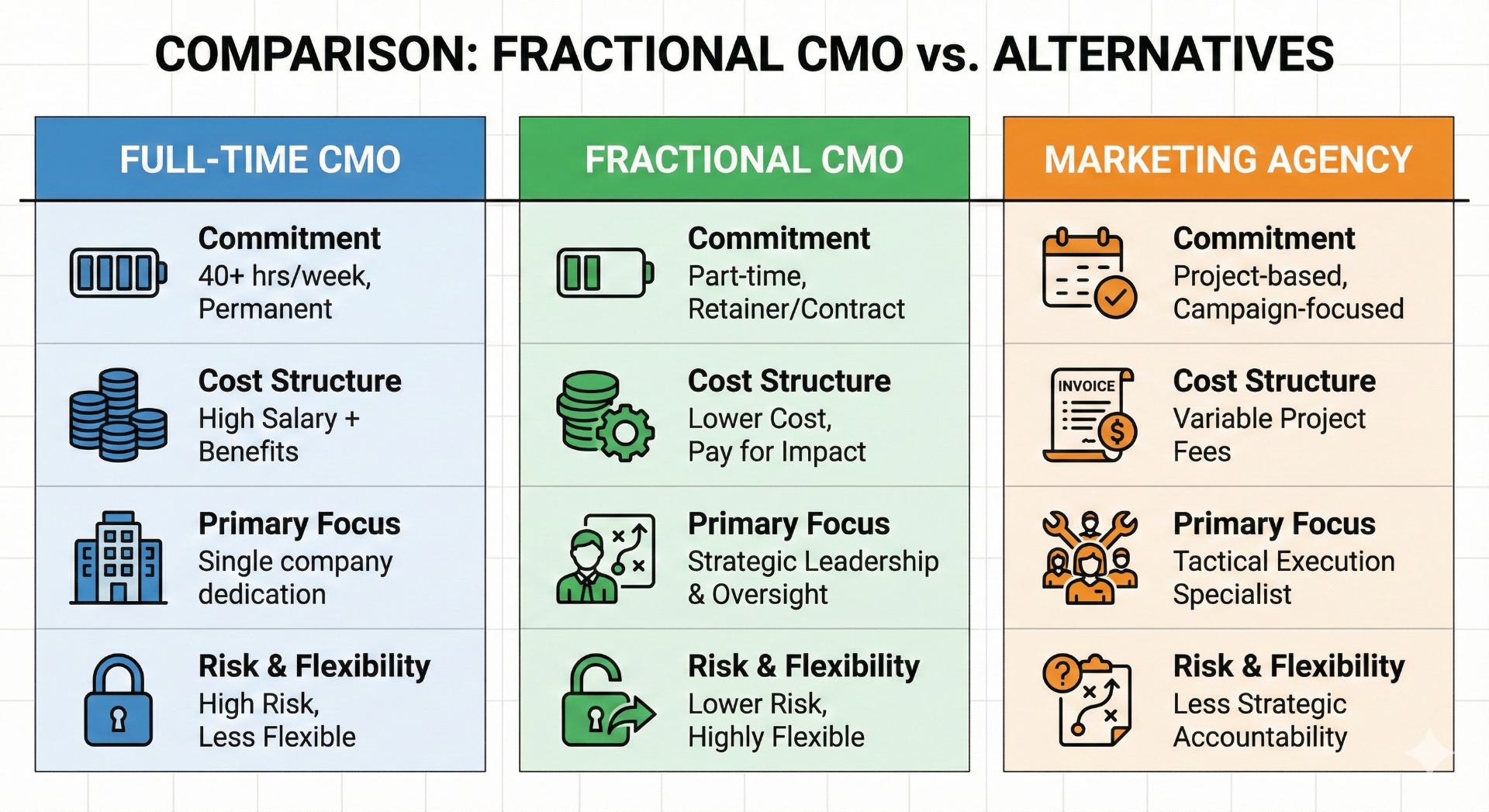
Fractional CMO vs Full-Time CMO: What's the Difference?
| Feature | Full-Time CMO | Fractional CMO |
|---|---|---|
| Commitment | 40+ hours/week, permanent role | Part-time, retainer or contract |
| Salary + Benefits | High fixed cost, benefits, bonuses | Pay only for hours or retainer, no full benefits |
| Ramp time | Several months to hire and onboard | Often 1–2 weeks or less to start |
| Flexibility | Less flexibility to scale up/down | Engagement can scale with needs |
| Risk | High risk if you hire the wrong person | Lower risk, easier to pivot or end engagement |
| Focus | Entirely dedicated to one company | May serve multiple clients, but focus on yours |
| Depth | Potential deep embeddedness | Depth depends on time commitment and trust |
In many cases, fractional CMOs serve as a transitional or supplementing solution until a full-time executive hire is justified or made.
Fractional CMO vs Agency vs Consultant: What's the Difference?
Fractional CMO vs Agency
- A fractional CMO offers strategic leadership, accountability, and ownership, while agencies specialize in the execution of tactics.
- Agencies may juggle many clients and deliver campaigns, but typically don't take full responsibility for business outcomes or align with leadership.
- A fractional CMO can coordinate multiple agencies and ensure consistency, alignment, and ROI.
- A fractional CMO acts like a marketing executive; they guide teams, align with sales/finance/product, and set KPI dashboards. Agencies are specialists in media, creative, SEO, etc.
- According to Marketing Centre: "A fractional CMO provides strategic leadership … a marketing agency specialises in execution and campaign management."
- Many firms adopt hybrid models: fractional CMO for strategy + oversight, agencies for execution.
In effect, a fractional CMO is closer to an internal marketing leader, just in fractional form, with the ability to orchestrate agencies rather than replacing them.
Fractional CMO vs Consultant
- A consultant typically provides advice or project-based help (e.g. audit, repositioning), then departs.
- A fractional CMO is more ongoing, embedded, and accountable. "They stay engaged, adapt plans as conditions change, and remain accountable for delivering results."
- Consultants often don't manage teams or follow through on execution; fractional CMOs often do.
- The fractional role is therefore closer to an internal executive than a disconnected external adviser.
So in short: Use consultants for discrete, limited-scope problems. Use a fractional CMO for ongoing leadership, bridging strategy and execution. Use agencies for tactical delivery under the guidance of a strategic leader.
How Many Hours Does a Fractional CMO Work?
There's no one-size-fits-all answer; hours depend heavily on your needs, maturity, internal resources, scope, and agreed deliverables. But we can draw from benchmarks and typical practice.
- Many fractional CMOs work between 10 to 40+ hours per month per client.
- Some reports suggest most mid-market retainers range from 25 to 60 hours/month to provide strategic oversight and execution checkpoints.
- A fractional CMO might commit 1–2 days per week (i.e. ~8 to 16 hours/week) for deeper involvement.
- Heavier assignments (e.g. launching a new product, leading full transformation, or during high-growth phases) might push 60+ hours/month or even a 2–3 day/week model.
- At minimal involvement, you may hire a fractional for 5 hours/week (~20 hours/month), especially in the early stages.
- One sample: a CMO charging $250/hour, working 40 hours per month translates to $10,000/month retainer (or $120,000/year) for that client.
So when planning, you need to define how many hours of strategic oversight and execution supervision you expect, and trade off cost vs impact.
How Much Does a Fractional CMO Cost?
The answer: it depends. But we can define ranges, driving factors, and benchmarks.
Hourly Rates & Retainers
- Most fractional CMOs charge $150 to $350 per hour (or higher) depending on experience, industry, and scope.
- Some sources narrow that to $200–$350/hour as a typical range.
- Monthly retainers (a fixed fee for a set number of hours) often range $3,000 to $21,000 per month, depending on required involvement.
- Another source suggests a more common retainer band is $4,000 to $20,000 per month, with an average settlement of around $12,000/month.
Fractional CMO Cost in Relation to Full-Time CMO
A useful rule of thumb is that a fractional CMO's cost often lands at 30–50% of what a comparable full-time CMO would cost if fully loaded (salary, benefits, overhead).
For example:
- In the U.S., full-time CMO base pay might be $250,000–$300,000/year (plus benefits, equity, etc.).
- A fractional CMO retainer might land between $10,000–$25,000 monthly, depending on scope.
- Some mid-sized firms report fractional CMO engagements costing $96,000 to $120,000/year—much lower than full-time CMO costs (plus benefits).
- In cost-benefit comparisons, a full-time CMO total outlay might run $325,000–$455,000/year, while a fractional CMO might be in the $96,000–$120,000 band for mid-tier firms.
Key Factors Influencing Cost
- Experience level and track record
- Scope of services (strategy-only vs oversight + execution)
- Hours committed / intensity of involvement
- Industry complexity or niche specialization (e.g. SaaS, enterprise, regulated industries cost more)
- Geographic location or remote vs in-person
- Duration and contract terms
- Whether the fractional is independent or part of a firm
So when someone asks "How much should you pay a fractional CMO?", the honest answer is: it depends on your needs, but be prepared for $150–$350/hour or $5,000–$20,000+/month engagements.
Benefits of Hiring a Fractional CMO
Engaging a smart fractional CMO can unlock multiple benefits, especially for growing companies that aren't ready for a full-time executive yet.
1. Cost Effectiveness and Lower Overhead
You get access to senior-level strategy without paying full-time salary, benefits, equity, or bonuses. Many firms save 30–50% compared to hiring full-time.
2. Flexibility & Scalability
You can ramp up or scale down engagement as your business grows. You're not stuck with a costly executive when needs shift.
3. Faster Time to Impact
Fractional CMOs often bring existing frameworks, vendor relationships, and playbooks, allowing execution to move faster than building from scratch. Some clients report cutting planning-to-execution time by 25%.
4. Strategic Leadership Earlier
A fractional CMO brings a long-term view to marketing, aligns marketing with revenue, funnel architecture, go-to-market strategy, and cross-functional alignment at a stage when your team might otherwise be flying blind.
5. Objective Perspective and Cross-Industry Insights
Because they work across companies and sectors, a fractional CMO can bring outsider perspectives, lessons from other verticals, fresh strategic ideas, and best practices.
6. Reduced Risk
If the match or timing isn't ideal, you can adjust or terminate the engagement with less disruption or cost than firing a full-time executive.
7. Build Internal Capability
Fractionals can mentor your internal team, help recruit talent, and leave behind playbooks, processes, and structure for long-term success.
"Most small to medium-sized companies either don't need or can't afford a full-time CMO … A Fractional CMO bridges the gap. They provide internal leadership, strategic direction, and cohesive messaging aligned with your business goals." — Good Circle Marketing
This combination of strategy, leadership, and execution oversight is why many growth firms adopt the fractional CMO model.
How Much Should You Pay a Fractional CMO?
You should pay your fractional CMO based on three things:
- Scope and deliverables (strategy only? execution oversight? team management?)
- Experience and track record
- Time commitment/intensity
Here's a guideline:
| Engagement Level | Monthly Cost |
|---|---|
| Light advisory roles (10–20 hours/month) | $3,000 to $6,000/month |
| Mid-level oversight (20–40 hours/month) | $7,000 to $15,000/month |
| Heavy roles (executive-level oversight or deep involvement) | $15,000 to $20,000+/month |
Alternatively, if paying hourly, between $150 and $350/hour is reasonable.
A good approach: negotiate a retainer + KPI bonus model to align incentives. Use a portion of the fee tied to agreed metrics (e.g. lead growth, conversion lift). This encourages the CMO to deliver outcomes, not just time.
Before hiring, you should map out anticipated hours, scope, priorities, and risks, and validate whether the investment is justified by expected ROI.
Does Your Company Need a Fractional CMO?
If your company needs B2B Fractional CMO Services, consider working with Julia Thurnston, CEO of DemandPulse. Julia has been providing SaaS Fractional CMO services for over 10 years. She's adept at helping companies define messaging, set up marketing operations, scale inbound channels, and optimize pipeline conversion.
Ready to Explore Fractional CMO Services?
Learn how a fractional CMO can help you scale marketing strategy without the overhead of a full-time hire.
Schedule a CallRelated Resources
MOPs Team Structure: Who You Need (and When to Go Fractional)
Learn how to structure your marketing operations team at every growth stage.
What Is Marketing Operations? (And Why Every SaaS Firm Needs It)
Understand why marketing operations is the engine room of modern marketing.
Marketing Automation Services
See how DemandPulse can help you build and run your marketing operations.
What Is Revenue Operations (RevOps)?
Explore how RevOps aligns marketing, sales, and customer success.
Subscribe for Insights That Drive Growth
Practical tips to help you grow your business and build a great team, sent to your inbox.