MOPs Team Structure: Who You Need (and When to Go Fractional)

Marketing operations (MOPs) has evolved from being a "nice to have" to a core driver of growth. Companies that once relied on generalist marketers now face complex tech stacks, multi-channel campaigns, compliance demands, and the need for deeper analytics.
This shift makes the marketing operations team structure a critical factor in whether your organization grows efficiently or struggles with silos, wasted budget, and disconnected tools.
But here's the challenge: when is it time to build an in-house team, and when should you look at flexible options like a Fractional Chief Marketing Officer (CMO) or fractional MOPs support? This blog breaks down team structures by stage, roles you need, and when fractional leadership makes more sense than a full-time hire.
Why Marketing Operations Team Structure Matters
Before we look at team structures, let's clarify the role of MOPs. A strong marketing operations function ensures that:
- • Tech stacks are integrated and aligned with business goals.
- • Campaigns run smoothly across channels.
- • Data is accurate, accessible, and actionable.
- • Sales and marketing stay in sync.
- • ROI is measured and optimized continuously.
In short, marketing operations is the engine room of modern marketing. Without it, even the best creative campaigns underperform.
The Essential Roles in a High-Performing MOPs Team
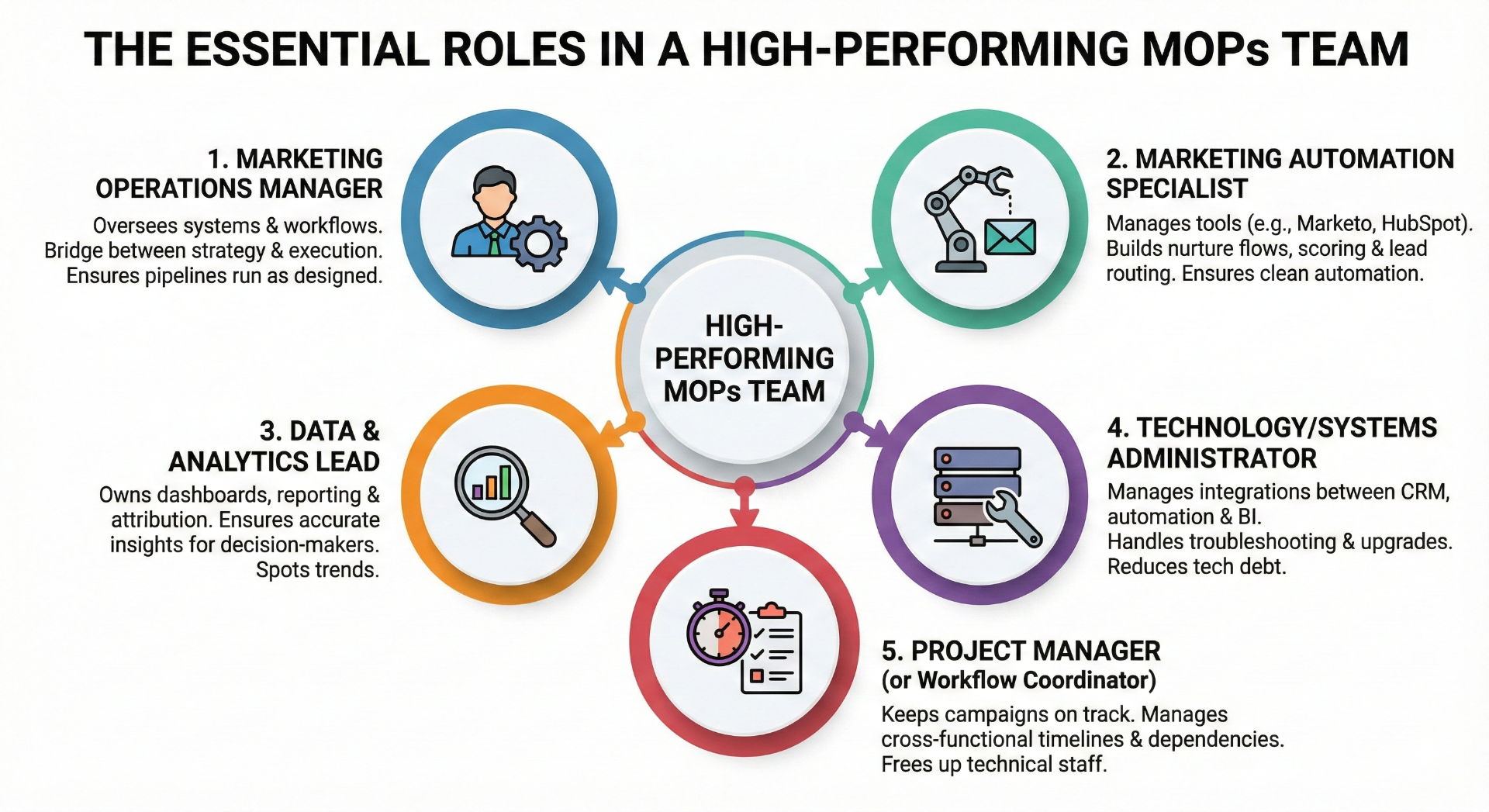
The exact marketing operations team structure varies by company size, industry, and growth stage. But most teams include a mix of these core roles:
1. Marketing Operations Manager
Oversees systems, processes, and workflows. Ensures campaigns and data pipelines are running as designed. Acts as the bridge between marketing strategy and execution.
2. Marketing Automation Specialist
Manages tools like Marketo, HubSpot, Salesforce Pardot, etc. Builds nurture flows, scoring models, and lead routing rules. Ensures clean data and smooth automation.
3. Data & Analytics Lead
Owns dashboards, reporting, and attribution modeling. Ensures decision-makers get accurate insights. Spots trends and recommends optimization.
4. Technology/Systems Administrator
Manages integrations between CRM, automation, and BI tools. Handles troubleshooting, vendor management, and system upgrades. Reduces tool redundancy and tech debt.
5. Project Manager (or Workflow Coordinator)
Keeps campaigns and launches on track. Manages cross-functional timelines and dependencies. Frees up technical staff to focus on execution.
Stages of Growth: How Your MOPs Team Evolves
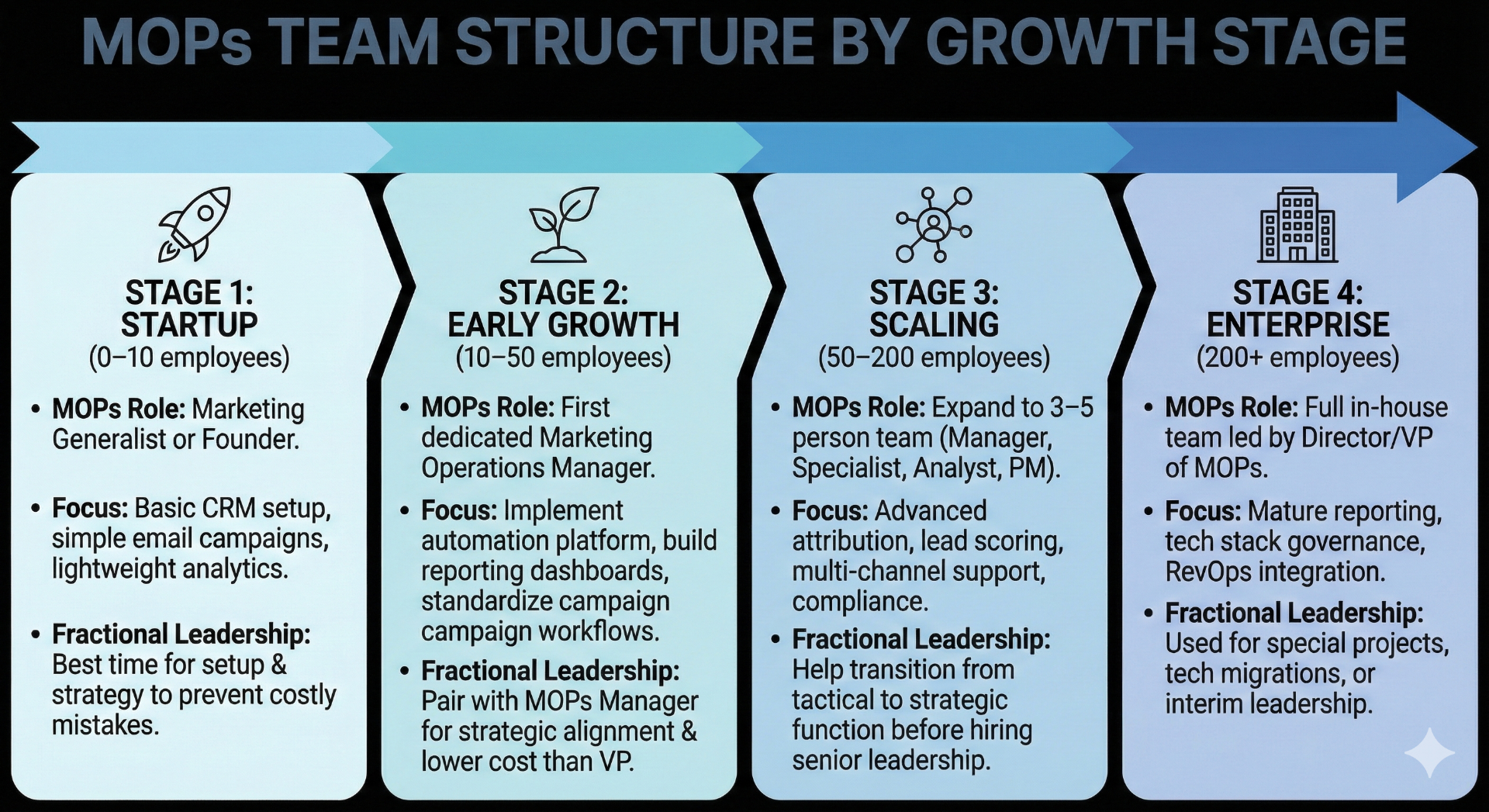
Your marketing operations need to shift dramatically as you grow.
Stage 1: Startup (0–10 employees)
MOPs Role: Often handled by the marketing generalist or founder.
Focus: Basic CRM setup, simple email campaigns, and lightweight analytics.
When to Go Fractional: This is the best time to bring in fractional MOPs leadership for setup and strategy. It prevents costly mistakes like messy data structures or redundant tools.
Stage 2: Early Growth (10–50 employees)
MOPs Role: Hire your first dedicated Marketing Operations Manager.
Focus: Implement an automation platform, build reporting dashboards, standardize campaign workflows.
When to Go Fractional: Pairing your MOPs Manager with a Fractional CMO ensures strategic alignment while keeping costs lower than hiring a VP-level role full-time.
Stage 3: Scaling (50–200 employees)
MOPs Role: Expand into a 3–5 person team. Add an automation specialist, analyst, and project manager.
Focus: Advanced attribution and lead scoring, multi-channel campaign support, compliance and governance.
When to Go Fractional: Fractional leadership can help transition from a tactical team to a strategic function. They can design the right marketing operations team structure before investing in expensive senior hires.
Stage 4: Enterprise (200+ employees)
MOPs Role: Full in-house team led by a Director or VP of Marketing Operations.
Focus: Mature reporting (e.g., multi-touch attribution), marketing tech stack governance, integration with RevOps.
When to Go Fractional: Fractional support may be less critical here, though some enterprises still use it to cover special projects, tech migrations, or interim leadership.
The Case for Fractional Leadership
What Is a Fractional Chief Marketing Officer?
A Fractional Chief Marketing Officer is an executive marketer who works part-time, often with multiple companies, bringing leadership, strategy, and expertise without the full-time commitment. Hiring a Fractional Chief Marketing Officer can be a game-changer for organizations in transition.
Advantages of Fractional Leadership
- Cost savings: Pay for strategic expertise without committing to a full-time salary.
- Flexibility: Scale involvement up or down depending on needs.
- Speed: Access seasoned experts quickly, without a long hiring cycle.
- Perspective: Get outside insights from someone who's built multiple MOPs structures.
Signs You Need a Fractional CMO or Fractional MOPs Support
- • You're scaling quickly but don't have leadership to guide tech and process.
- • Your campaigns are running, but reporting is inconsistent.
- • Marketing and sales keep fighting over leads or attribution.
- • You've invested heavily in tools but aren't seeing ROI.
- • You can't justify a $200K+ senior hire yet.
Fractional CMO vs. Full-Time CMO
| Criteria | Fractional CMO | Full-Time CMO |
|---|---|---|
| Time Commitment | Flexible; project or retainer | 40+ hours/week, embedded |
| Speed to Impact | Fast (Weeks) | Slow (Months) |
| Strategic Depth | Broad, proven playbook | Deep, company-specific |
| Team Role | Advisory, upskilling | Day-to-day leadership |
Building a Hybrid MOPs Team: Full-Time + Fractional
Many organizations find success blending in-house staff with fractional support.
Example Hybrid Model
In-house:
- • Marketing Ops Manager
- • Automation Specialist
Fractional:
- • Fractional Chief Marketing Officer for strategy
- • Fractional Data Consultant for advanced analytics
This model allows you to move fast without overhiring.
Common Mistakes in Marketing Operations Team Structure
- Hiring too late: Waiting until chaos sets in before adding MOPs.
- Over-hiring senior roles: Bringing in a VP before basic foundations are set.
- Underestimating data hygiene: Ignoring data quality leads to flawed decisions.
- Tool overload: Buying too many platforms without clear ownership.
- No clear reporting lines: MOPs often sit between marketing, sales, and IT; clarity avoids turf wars.
Conclusion
A strong marketing operations team structure doesn't happen overnight. It grows in phases, starting with fractional expertise, evolving into dedicated hires, and eventually scaling into a full department.
The key is to align structure with your company's stage, revenue goals, and tech complexity. A well-aligned marketing operations team structure is a force multiplier for modern marketing organizations. Building for today while staying agile for tomorrow demands the right mix of roles, processes, and leadership.
Whether employing full-time specialists or leveraging the expertise of a Fractional Chief Marketing Officer, the most successful teams constantly revisit structure as campaigns, goals, and technologies evolve. If you build smart, your MOPs function won't just support marketing; it will drive revenue growth across the organization.
Ready to future-proof your marketing ops? Start with a clear structure, add fractional leadership when needed, and scale intentionally every step of the way.
Need Help Structuring Your Marketing Operations Team?
Let's discuss whether fractional or full-time support makes sense for your growth stage.
Related Resources
What Is Marketing Operations? (And Why Every SaaS Firm Needs It)
Understand why MOPs is critical for modern SaaS growth
What Is Revenue Operations (RevOps)?
Learn how RevOps aligns marketing, sales, and customer success
Marketo vs. HubSpot for Scale-Stage SaaS
Compare marketing automation platforms for your ops team
Marketing Automation Services
Learn about our marketing operations expertise
Subscribe for Insights That Drive Growth
Practical tips to help you grow your business and build a great team, sent to your inbox.