
On this page
For scale-stage SaaS companies, the marketing automation platform isn't just about sending emails. It's the backbone of your entire revenue operations strategy. Your ops team needs a platform that can handle complex lead routing, multi-touch attribution, sophisticated nurture campaigns, and seamless sales handoffs without breaking a sweat.
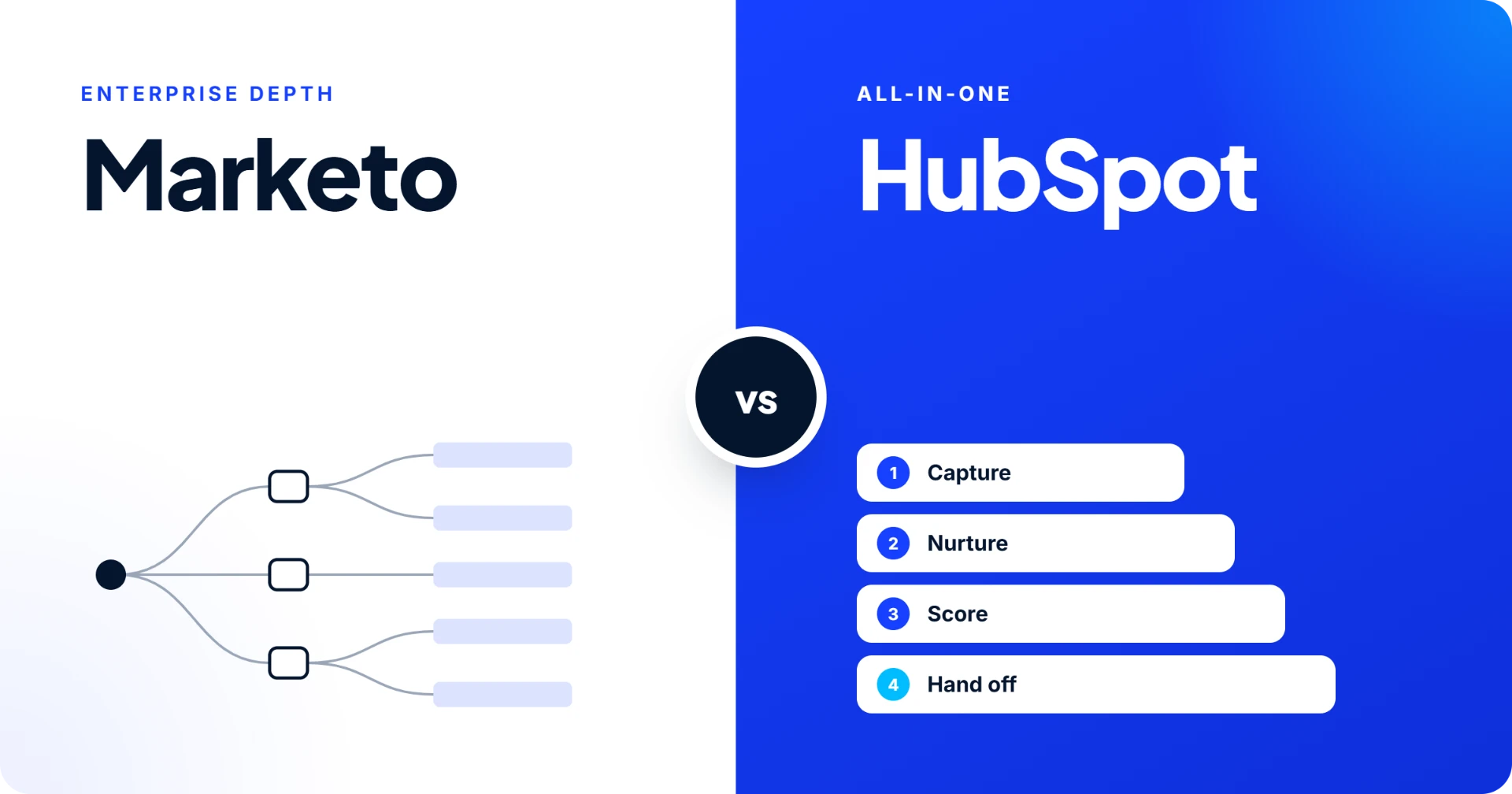
The debate usually comes down to two powerhouses: Marketo and HubSpot. Both platforms have their devoted followers, but they approach marketing automation from fundamentally different philosophies. Marketo (now Adobe Marketo Engage) built its reputation on enterprise-grade complexity and customization. HubSpot carved out its niche with an all-in-one, user-friendly approach that promises to eliminate the need for multiple tools.
Your choice will shape how your marketing, sales, and ops teams work together for years to come. This guide cuts through the marketing fluff to give you the tactical insights your ops team needs to make the right call.
Quick Intro: What Are Marketo and HubSpot?
What is Marketo (Adobe Marketo Engage)?
Marketo is the enterprise marketing automation platform that built its reputation on handling complex B2B scenarios. Originally designed for large enterprises with dedicated marketing ops teams, Marketo excels at sophisticated lead nurturing, advanced attribution modeling, and deep CRM integrations.
Adobe acquired Marketo in 2018, adding it to their Experience Cloud suite. The platform is known for its powerful automation capabilities, extensive customization options, and ability to handle millions of contacts without breaking a sweat.
What is HubSpot Marketing Hub?
HubSpot started as an inbound marketing platform and evolved into a comprehensive growth stack. Marketing Hub is part of HubSpot's broader ecosystem that includes CRM, Sales Hub, Service Hub, and Operations Hub, all designed to work together seamlessly.
HubSpot's philosophy centers on user-friendly design and eliminating the need for multiple tools. Their marketing automation sits within a broader platform that handles everything from lead generation to customer success, making it particularly attractive for growing SaaS companies that want to avoid integration headaches.
At a Glance
| Category | Marketo | HubSpot |
|---|---|---|
| Time to productivity | 2-3 months before new users feel confident | 2-3 weeks for new team members |
| Who runs it | Dedicated marketing ops person or team | Non-technical marketing teams |
| Integrations | Deep Salesforce + Microsoft Dynamics 365 sync | 1,000+ App Marketplace integrations |
| Automation | Smart Campaigns, intricate decision trees | Visual workflows covering 90% of use cases |
| Reporting | Revenue Cycle Analytics + Marketo Measure | Intuitive dashboards, revenue attribution |
| Scale | Workspaces for brands, regions, product lines | Pricing tiers that align with growth |
Ease of Use & Onboarding
HubSpot's User Experience
HubSpot built its reputation on making marketing automation accessible to non-technical users. The interface feels intuitive from day one, with drag-and-drop workflow builders and clear visual representations of your automation logic.
Most marketing teams can start building campaigns within their first week. The learning curve is gentle, and the platform guides you through best practices with built-in suggestions and templates.
New team members typically reach productivity within 2-3 weeks. This matters more than you might think when you're scaling fast: you can't afford to have new hires stuck in training limbo for months.
Marketo's Learning Curve
Marketo assumes you have a dedicated marketing operations person (or team) who can handle complexity. The interface is powerful but dense, with multiple ways to accomplish the same task.
The platform rewards deep expertise. Once your team masters Marketo's intricacies, they can build sophisticated campaigns that would be impossible in simpler tools. But getting to that point takes time. Expect 2-3 months before new users feel truly confident.
Marketo's onboarding typically requires professional services or dedicated training. This isn't necessarily a weakness; it's a reflection of the platform's enterprise-grade capabilities.
Integration Ecosystem
HubSpot's Connectivity
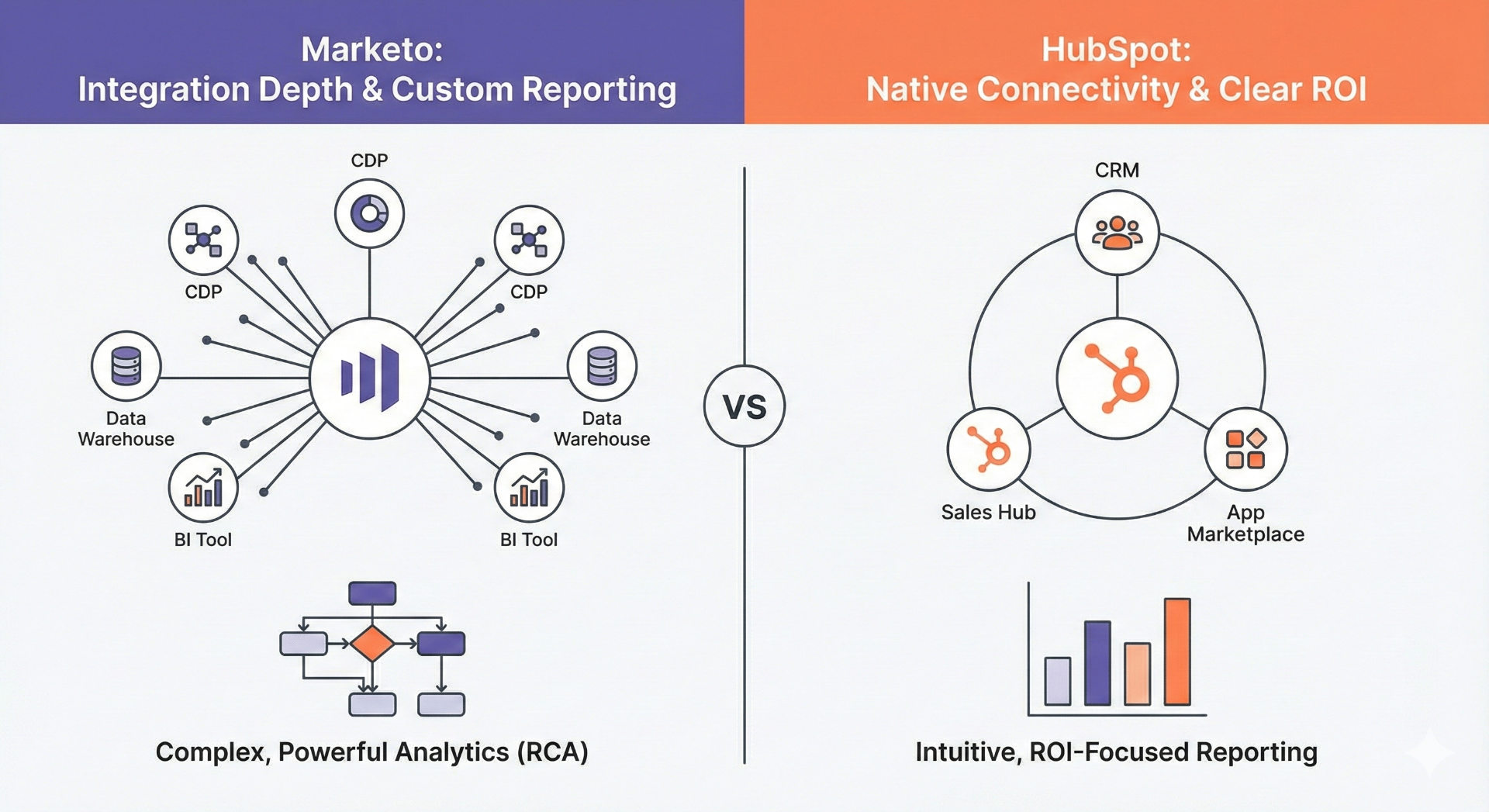
HubSpot's App Marketplace includes over 1,000 integrations, covering everything from Slack to Salesforce to specialized SaaS tools. The native HubSpot CRM integration is seamless: no data sync delays or mapping headaches.
For scale-stage SaaS companies, HubSpot's Operations Hub provides additional integration capabilities, including custom objects, data sync, and workflow automation that spans across the entire customer journey.
API limitations become apparent at enterprise scale. While HubSpot's API is comprehensive, it's not as flexible as Marketo's for complex, custom integrations.
Marketo's Integration Depth
Marketo was built for complex enterprise environments with multiple systems. The Salesforce integration is particularly deep, with bidirectional sync that handles complex field mappings and custom objects.
Beyond Salesforce, Marketo also offers robust integration with Microsoft Dynamics 365. This integration supports advanced lead management, opportunity tracking, and custom field synchronization, making it a strong choice for enterprises already invested in the Microsoft ecosystem.
The platform excels at connecting with CDPs, data warehouses, and custom analytics tools. If your SaaS company has a sophisticated data stack, Marketo's integration capabilities will likely serve you better long term. Third-party integration options are extensive, with a mature ecosystem of middleware providers and custom integration specialists.
Automation Capabilities
HubSpot's Workflow Philosophy
HubSpot's visual workflow builder makes it easy to create and modify automation sequences. The drag-and-drop interface lets you build complex nurture campaigns without coding knowledge.
Branch logic is straightforward: you can create if/then scenarios based on contact properties, behaviors, or engagement levels. For most SaaS companies, HubSpot's automation capabilities cover 90% of use cases.
The platform excels at persona-based nurturing and behavior-triggered sequences. If your SaaS has distinct user segments or product-led growth motions, HubSpot's automation feels natural.
Marketo's Automation Depth
Marketo's automation engine is designed for complex, enterprise-grade scenarios. You can create intricate decision trees that account for dozens of variables and trigger conditions.
The platform shines with advanced use cases like account-based marketing, complex lead scoring models, and multi-touch attribution campaigns. If your SaaS sells to enterprise customers with long sales cycles, Marketo's sophistication becomes essential.
Smart Campaigns in Marketo can handle complex suppression lists, advanced timing controls, and sophisticated personalization logic that goes beyond basic merge tags. Also, if your roadmap includes M&A or multi-brand rollouts, Marketo's automation depth is hard to beat.
Reporting & Attribution
HubSpot's Analytics Approach
HubSpot's reporting dashboard is user-friendly and provides clear visibility into campaign performance. The attribution reports show how different touchpoints contribute to conversions, making it easier to optimize your marketing spend.
Custom dashboard creation is intuitive: you can build reports that matter to your stakeholders without needing a data analyst. This is crucial for scale-stage SaaS companies where the ops team wears multiple hats.
Revenue attribution in HubSpot connects marketing activities directly to closed deals, giving you clear ROI visibility. The reporting feels designed for marketing teams who need to justify their budget to executives.
Marketo's Reporting Complexity
Marketo's reporting capabilities are incredibly powerful but require more setup and expertise. Revenue Cycle Analytics (RCA) provides deep insights into how leads move through your funnel, but it's not intuitive for casual users.
For even more sophisticated attribution needs, Marketo Measure (formerly Bizible) offers advanced multi-touch attribution modeling. Marketo Measure tracks the entire customer journey across all touchpoints, providing detailed insights into which marketing activities drive revenue. This is particularly valuable for SaaS companies with complex sales cycles and multiple product lines.
The platform excels at complex attribution modeling, especially for enterprise SaaS companies with multiple product lines or complex sales processes. You can track attribution across multiple touchpoints and campaigns with granular detail. Custom reporting in Marketo often requires SQL knowledge or dedicated business intelligence tools. While powerful, it's not as accessible as HubSpot's approach.
Lead Management & Scoring
HubSpot's Lifecycle Management
HubSpot's lead lifecycle stages are built into the platform, making it easy to track prospects from visitor to customer. The contact timeline shows every interaction, giving sales teams full context when they engage.
Lead scoring in HubSpot includes both traditional rule-based scoring and predictive scoring powered by machine learning. The predictive scoring learns from your existing data to identify high-value prospects automatically.
Sales handoff workflows in HubSpot are seamless, especially if you're using HubSpot's CRM. Notifications, task creation, and lead routing happen automatically based on your defined criteria.
Marketo's Scoring Sophistication
Marketo's lead scoring is incredibly flexible and can accommodate complex business models. You can create multiple scoring models for different products, regions, or customer segments.
The platform's Revenue Cycle Modeler lets you define custom lifecycle stages that match your exact sales process. This is particularly valuable for SaaS companies with complex sales motions or multiple product lines.
Marketo's integration with Salesforce enables sophisticated lead routing based on territory, product interest, company size, and dozens of other criteria.
Scalability & Customization
HubSpot's Growth Trajectory
HubSpot scales well for most SaaS companies, handling millions of contacts without performance issues. The platform's pricing tiers align with company growth, making it easier to budget for expansion.
Custom objects in HubSpot Enterprise allow you to model complex business relationships. While not as flexible as Marketo, it covers most SaaS use cases effectively.
Team management in HubSpot is straightforward, with clear permission controls and user roles. As your team grows, you can maintain data security without complex access management.
Marketo's Enterprise Readiness
Marketo was built for enterprise scale from the ground up. The platform handles complex data models, multiple business units, and sophisticated permission structures without breaking a sweat.
Custom objects and fields in Marketo are extensive, allowing you to model virtually any business scenario. If your SaaS has complex product relationships or multi-tenant architectures, Marketo's flexibility becomes essential.
The platform's workspace functionality lets you manage multiple brands, regions, or product lines within a single instance: crucial for SaaS companies with multiple products or market segments.
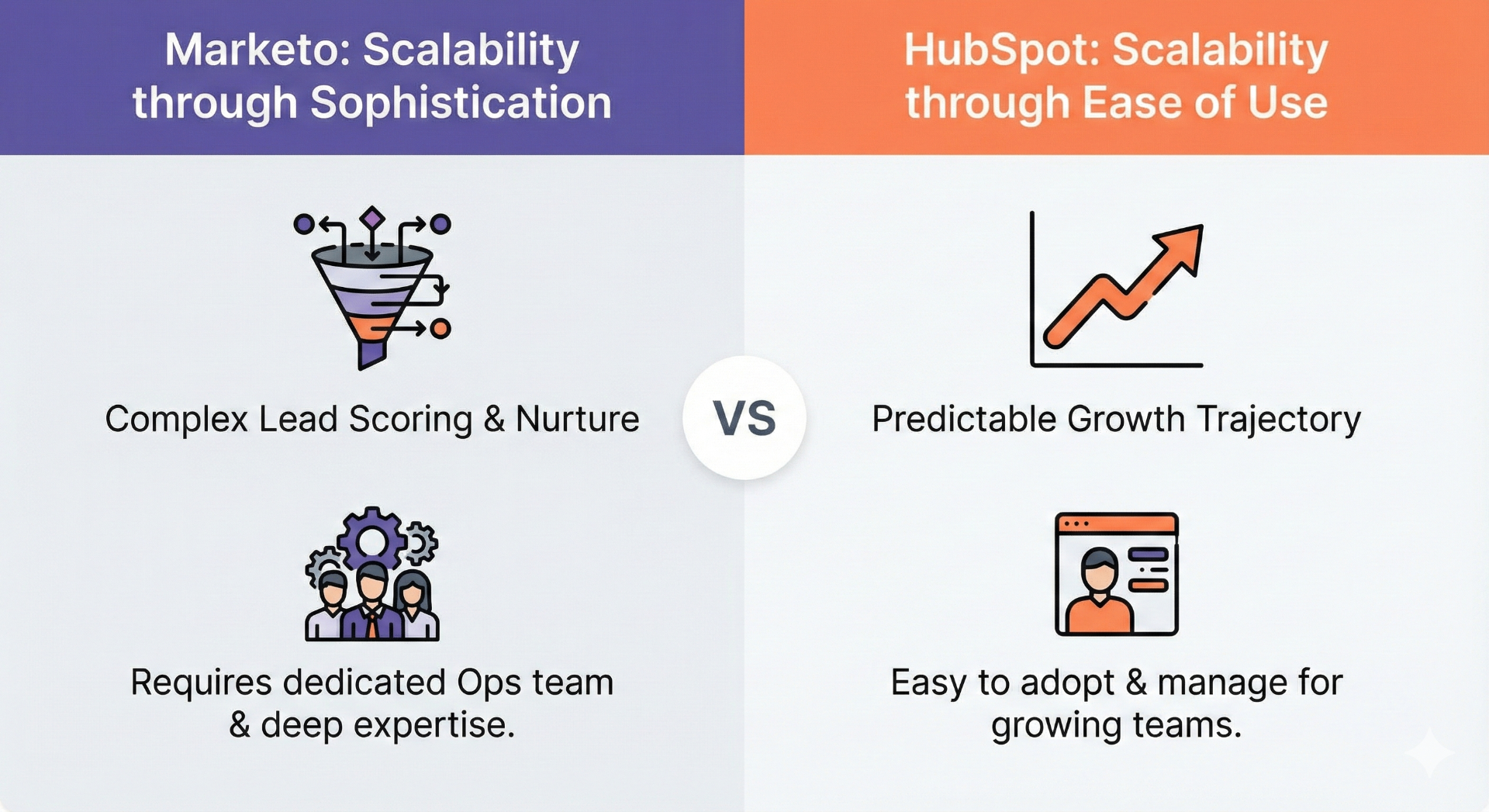
When to worry: If your ops team is lean, the admin lift for Marketo can drain time. Many companies solve this with a partner or a fractional admin.
Support, Training & Community
HubSpot's Support Ecosystem
HubSpot Academy is widely regarded as one of the most accessible learning libraries in Martech. It provides free, high-quality training on everything from marketing fundamentals to advanced automation, with content that is consistently updated to reflect new features.
Customer support varies by plan. Professional users receive chat support while Enterprise clients are assigned a dedicated customer success manager. HubSpot's user community is broad and active, featuring user groups, live events, and online forums that offer peer guidance across a wide range of use cases.
For fast moving teams, HubSpot's plug and play templates and documentation help marketers launch quickly. However, the material prioritizes general accessibility over deep platform specialization.
Marketo's Training Resources and the DemandPulse Advantage
Marketo University offers structured training paths and certifications that are widely respected in the Marketing Ops community. The material is thorough but assumes a high level of technical fluency, which can slow down onboarding or execution for leaner teams.
This is where DemandPulse becomes a force multiplier.
For SaaS companies adopting or scaling Marketo, we provide a comprehensive 8-week Marketo Certification Accelerator. This program blends technical learning with hands-on execution. Participants work through live instruction, campaign walkthroughs, and real platform builds aligned with Adobe's certification standards.
The goal is not just certification. It is operational confidence. Your team masters platform fundamentals while building workflows, scoring models, and reporting frameworks that they can apply immediately.
Clients working with DemandPulse also benefit from:
Combined with Marketo's formal support and highly engaged expert community, this training approach ensures your team becomes a true driver of marketing automation, not just a user.
Who Should Use What? (Use Cases + Recommendations)
Scenario 1: Series B SaaS with Sales-Led Motion
Your company has 50-200 employees, a dedicated sales team, and deals that typically involve multiple stakeholders and longer sales cycles.
Marketo's sophisticated lead scoring, advanced attribution modeling, and deep CRM integration make it ideal for complex B2B sales processes. The platform's ability to handle multiple touchpoints and complex nurture sequences will serve you well as you scale.
Final Verdict
The choice between Marketo and HubSpot isn't about which platform is "better." It's about which platform aligns with your SaaS company's specific needs, growth trajectory, and team capabilities.
Choose Marketo if:
- You have dedicated marketing ops resources or plan to hire them
- Your sales process is complex with multiple touchpoints and long cycles
- You need sophisticated customization and advanced automation capabilities
- You're already heavily invested in the Salesforce ecosystem
- You're planning for enterprise-scale growth from the start
Choose HubSpot if:
- You value ease of use and quick time-to-value
- Your team needs to move fast without deep technical expertise
- You prefer an all-in-one solution over best-of-breed tools
- You want transparent, predictable pricing
- You're focused on inbound marketing and content-driven growth
Both platforms can scale with your SaaS company, but they'll shape how your team works and what's possible as you grow. Consider your team's current capabilities, your growth plans, and your tolerance for complexity.
The best platform is the one your ops team can fully leverage. Choose for the next 3 years, not just the next 3 months.
Your future self will thank you for making the decision that serves your long-term growth, not just your immediate needs.
Ready to make your choice? Start with a clear audit of your current marketing processes, define your must-have features, and run pilot programs with both platforms if possible. The right marketing automation platform will become the foundation of your revenue operations. Choose wisely.
Need Help Choosing or Implementing Your Marketing Platform?
Our team specializes in both Marketo and HubSpot implementations. Let's discuss which platform is right for your SaaS company.
Schedule a Call