How to Train an AI Chatbot That Doesn't Drift

According to Gartner, agentic AI will autonomously resolve 80% of common customer service issues, cutting operational costs about 30% by 2029.
Everybody tells you the hard part of an AI chatbot is developing one. Is it? Not really.
You point it at your help documents, pick a model, write a few instructions, and it will demo like a dream. Your boss is happy, the launch email goes out, and for a couple of weeks it feels like you finally bought yourself some breathing room.
Then the questions start coming in weirder than anything in the demo. A customer asks something a little off-script, and the AI answers anyway, sounding completely sure of itself and getting it flat wrong.
So, you go looking for the fix, and that's when it hits you: none of the guides that walked you through setup said a single word about this part. The part where you must keep the thing honest, week after week, long after everyone else has moved on.
Training an AI customer service chatbot is not the setup. The setup is an easy afternoon. The training is everything that happens after go-live, and here is the part almost nobody says out loud: almost none of it involves the model.
According to Zendesk, only about 37% of organizations can currently explain the reasoning behind their AI's decisions, even though 80% of CX leaders say transparency is about to become non-negotiable for customer-facing AI.
What "Training" Actually Means Here
When people say, "train the AI," they usually picture something happening inside the model, the way a machine learning system chews through labeled data. For customer service, that picture is misleading.
The model already writes fluent English. It's already polite, it can summarize, it knows how to ask a follow-up question. What it doesn't know is your refund policy, the weird edge cases in your product, the lines you're not allowed to cross legally, and the exact moment it should stop talking and get a human.
So, training a support chatbot has very little to do with the model. It's about the things wrapped around it: the knowledge it reads, the instructions it follows, the guardrails that keep it in bounds, the tests that catch its mistakes, and the people reviewing its work. Sharpen those and the same model you started with starts giving noticeably better answers.
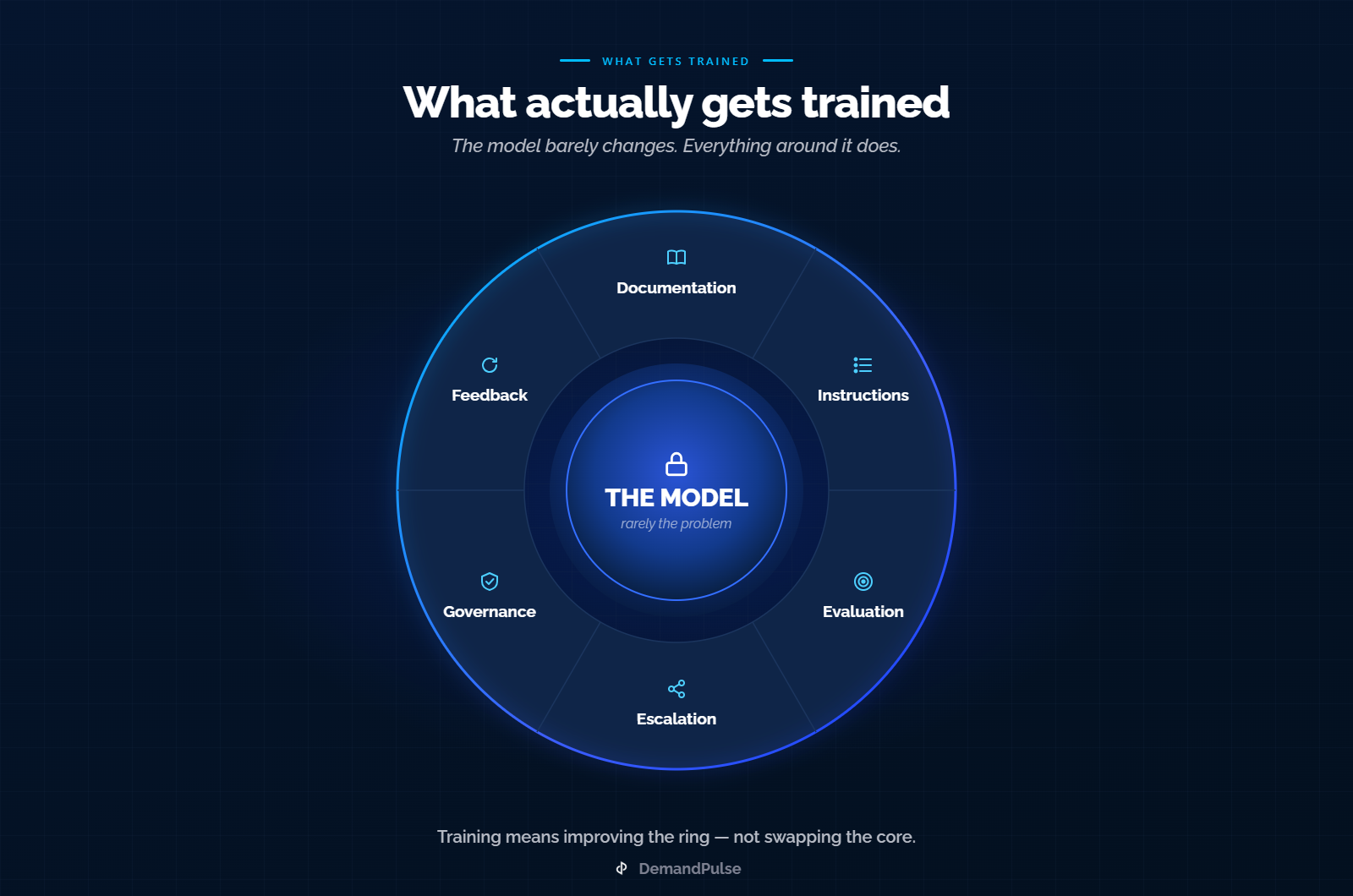
In a real deployment, the model is the most stable thing in the stack. The layers around it are what you train, and they never stop moving.
"You are not really training the AI chatbot. Your team is getting better at running it."
Keep that line in your head, because it changes how you read everything below. Wrong answer? Bad handoff? Off-brand tone? Every one of those gets fixed by changing something other than the model. And every one of those changes is a habit you repeat, not a switch you flip once.
Before You Train Anything: Five Things to Get in Place
For most teams the hard part isn't the AI. It's knowing where to start. If you are looking at your help center and a vendor demo wondering how to begin, sort out these five things before you so much as think about prompts. They're what make training possible at all.
Single Source of Truth
The bot answers from your documentation. If knowledge is scattered across two help centers, a Notion wiki, and one senior agent's memory, the bot inherits the mess. Pick one canonical source. Put a name next to it.
A Scope You Can Defend
Don't try to automate everything on day one. Pick three to five common, low-stakes things the bot can resolve end to end. A bot that quietly nails five boring things earns trust. One that whiffs on fifty loses the room.
A Way to Read What Happened
You can't fix what you can't see. Make every conversation logged, searchable, and flaggable before launch. If you can't pull "every chat where the bot talked about refunds last week" in thirty seconds, you're flying blind.
A Handoff Path, Written Down
Decide in advance when the bot stops and a person takes over: frustrated customers, billing or legal disputes, three failed attempts. Escalation isn't a safety net you add later. It's part of the design.
One Person Who Owns Performance
Not "the AI team." Not "we'll all keep an eye on it." A person, or a small pod, whose actual job includes reading transcripts, updating docs, and running tests.
More than 42% of companies abandoned most of their AI projects in 2025, up from just 17% a year earlier. Technology usually isn't the problem. Projects ship without an owner or a maintenance rhythm and stall between pilot and production.
What If Your Docs Are a Mess, Or Don't Exist Yet?
Most guides quietly assume you already have a clean knowledge base to plug in. Plenty of teams don't, and it's the most common reason a launch stalls before it starts. Your documentation is thin, out of date, or barely exists, so you freeze, convinced you must write the perfect knowledge base first. You don't, and honestly you can't, because you don't yet know what customers will ask.
Start from what you already have. Your past tickets and chat transcripts are a map of every question customers ask, in their own words, ranked by how often they come up. Pull the last few months, group them by topic, and you'll see the same ten or fifteen issues drive most of your volume. Those become your first articles.
Write short answers to the most frequent ones, ship the bot on that narrow slice, and let the gaps it hits tell you what to document next. The bot becomes the thing that reveals what your knowledge base was missing.
The Layers You Train
Once the foundation is in place, here's what you're really tuning over time. Not one of these is the model. All of them move.
Documentation
Where most failures are born. A wrong answer almost always traces to stale or fuzzy content. Chatbot quality and knowledge base management are the same project wearing two names.
Instructions
The behavior rules: how to open a conversation, how hard to try before escalating, brand voice, and the hard "never" list. When facts are right but handling is off, this is the lever.
Evaluation & Testing
A test set of real questions with known answers. Every real failure becomes a permanent test case, so you never ship the same mistake twice.
Escalation Logic
Decide handoffs by confidence and stakes, not topic. Low confidence + high stakes = hand off every time. Money, legal, security, cancellations sit on the high-stakes side by default.
Governance
What the bot can say, what data it can see, how decisions get logged. For SaaS and LegalTech, not optional. Explainability is becoming non-negotiable.
Feedback Loops
Thumbs, agent corrections, the same question asked five ways: all training signals. Every flagged conversation is a tiny assignment. What doc, rule, or instruction must change?
Write Documentation an AI Can Use
If documentation is what you're really training, then how you write it is a core skill, not a side task. Content that reads fine to a human can be poison to a bot. People skim around contradictions and infer what you mean. A bot takes your words literally and confidently repeats whatever's there.
Keep each article about one thing. Spell out edge cases instead of leaving them implied. Kill cross-references like "see the section above" and "click here." Hunt down contradictions between articles. Put a last-reviewed date on everything. Good documentation for AI is just unusually disciplined documentation. The bot punishes sloppiness faster than a human reader ever would.
The clearest public example is New York City's MyCity chatbot. The city launched it in late 2023 to answer small-business questions, trained on its own official web pages. Within months, reporters at The Markup found it telling owners they could pocket workers' tips, refuse to take cash, and that landlords could turn away tenants paying with housing vouchers. All of it illegal.
The city's response is the part worth sitting with: it left the AI bot running and leaned harder on a disclaimer. The lesson isn't "AI can't be trusted." It is that an AI bot only ever reflects the knowledge and guardrails behind it, and a disclaimer does not hand the risk back to the customer.
Teach the AI Chatbot to Say "I Don't Know"
Ask any support leader what scares them about AI, and you'll hear some version of the same thing: I'm afraid it'll make something up. They're right to worry. A bot that confidently invents a policy is worse than no AI chatbot at all, because it does real damage before anyone catches it.
The fix isn't a better model. It's design. Ground the bot's answers in your approved sources. Give it explicit permission to admit uncertainty. "I'm not certain about that, let me connect you with someone who can confirm" is a feature, not a failure. Draw a hard line around anything involving someone's specific account, money, or legal standing: on those, the bot confirms from a real source or hands off.
Treat Changes Like Code, Not Edits
This is the habit that separates the teams who improve from the teams who spin. Most people edit their bot the way they'd edit a document: open it, change the wording, save, move on. That works right up until a Tuesday tweak to the billing instructions quietly degrades the cancellation flow and nobody notices for a week.
Borrow the discipline from engineering. Keep a version history. Test a meaningful change in the background before it goes live. If it makes things worse, roll it back the way you'd revert bad code, without drama.
What Good Looks Like, Week to Week
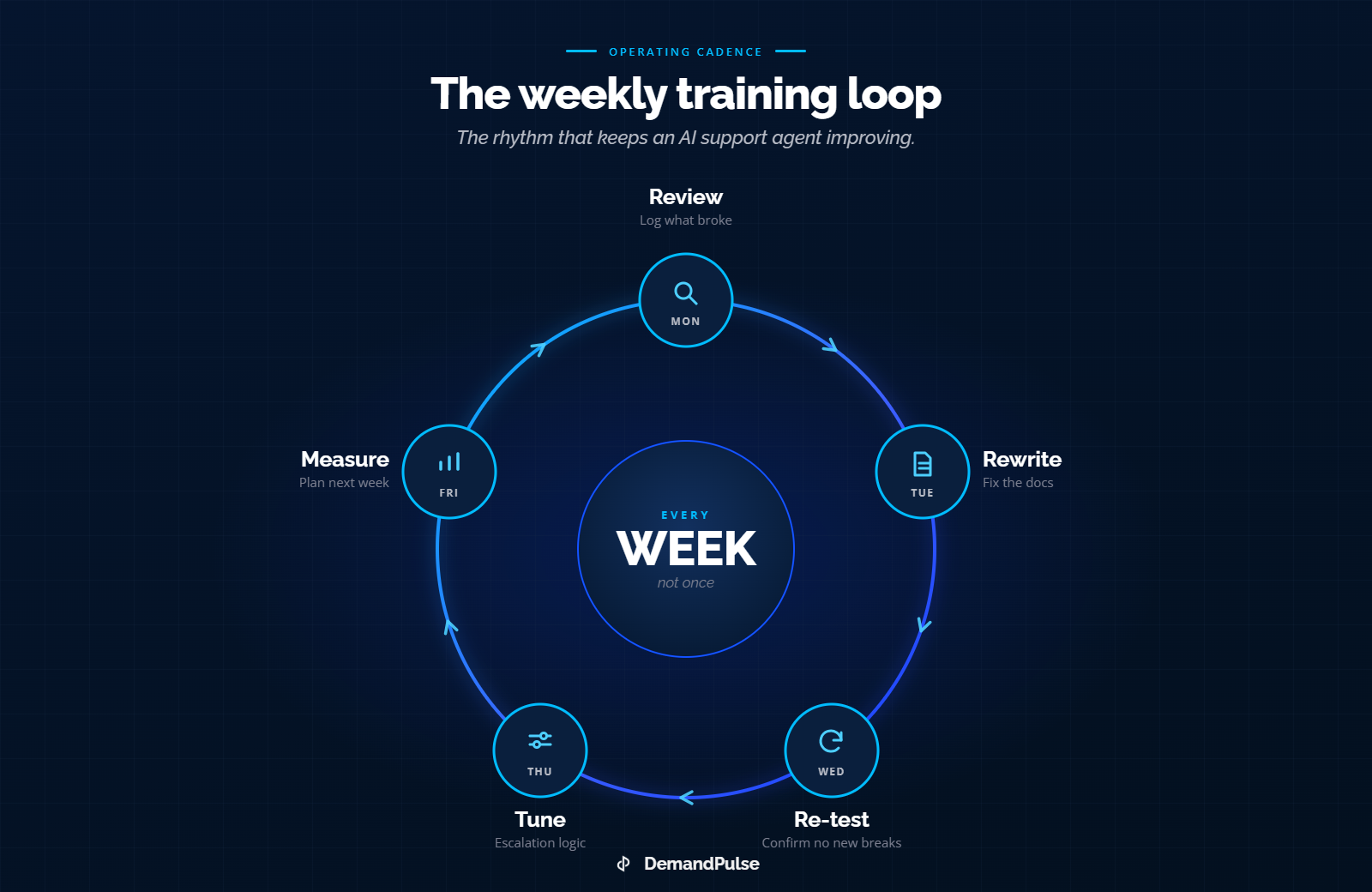
Great support AI isn't the payoff of a brilliant launch. It's the payoff of a boring weekly rhythm almost nobody talks about, and the teams whose bots keep getting better run some version of it every single week.
Your Agents Are the Best Teachers for AI Chatbots
A quiet mistake teams make is treating the bot and the agents as separate worlds, with the bot replacing headcount and the agents working around it. In the teams that get the most out of AI, it's the opposite. Every time an agent picks up an escalation and resolves it, they've just shown the bot the correct answer to a question it couldn't handle. That correction is gold, if you capture it.
Bring agents into the loop. Give them a fast way to flag a bad bot answer and suggest the right one. Feed those corrections into the weekly review. Be honest with the team about what the AI is for: clearing the repetitive volume that burns people out, so they can spend their judgment on the cases that need a human.
Where It Usually Goes Wrong
After enough of these deployments, the failure modes start to rhyme. A handful show up again and again.
Treating launch as the finish line.
The most expensive one. Everyone celebrates go-live, the team gets reassigned, and the chatbot is left to fend for itself. That's the operational gap hiding behind the 42% abandonment number, not a technology failure.
Blaming the model and shopping for a new one.
Answers are wrong, so the instinct is to swap vendors. It rarely helps, because the real culprit is documentation or rules, and those follow you to the next tool.
Fixing without testing.
Issues get patched one at a time with no test set, so wins and regressions cancel out and quality flatlines.
Letting the knowledge base go stale.
The bot exposes every gap and contradiction in your docs instantly, at scale. If nobody owns the content, the chatbot decays the day your product changes.
Where Most AI Chatbots Get Stuck
It helps to know which stage you're actually in, because the work to get unstuck is different at each one.
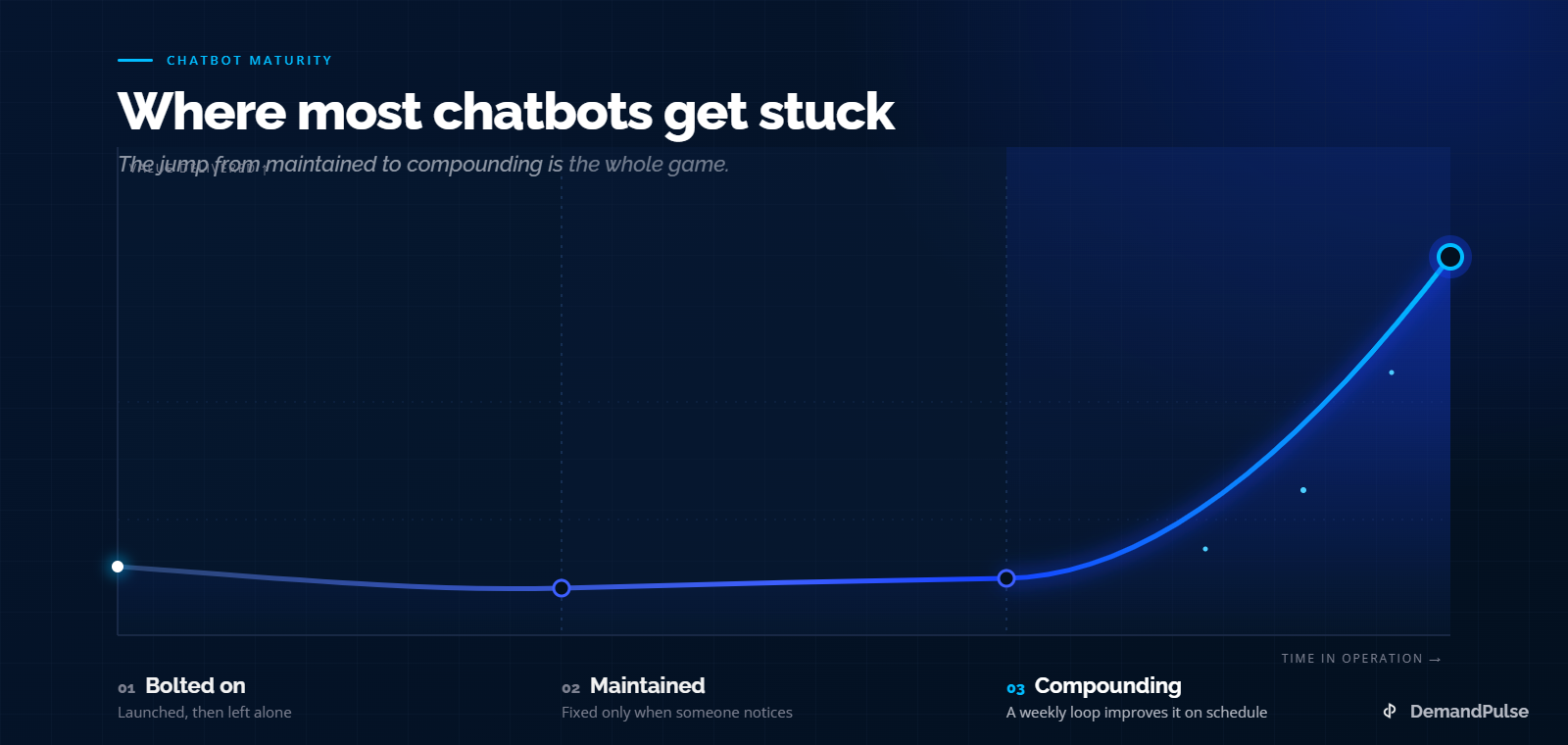
Bolted On
It launched, it works in the demo, and nobody's tending it.
Maintained
Someone fixes problems when they happen to notice them.
Compounding
A real weekly loop, versioned changes, and a clear owner mean the AI chatbot gets measurably better on a schedule instead of by luck.
The jump from one to two costs you almost nothing but a named owner and a recurring calendar hold. The jump from two to three is where the payoff lives, and it's the one most teams never make.
How To Tell It's Actually Working
"Better" must be measurable or the weekly loop turns into busywork. A handful of signals tell you most of what you need, and decent chatbot analytics make them easy to pull.
Setup Mindset vs. Operating Mindset
If you take one table away from this guide, take this one. It's the line between the bots that compound and the ones that stall.
Doing This Without a Dedicated AI Team
Most support organizations don't have spare people to read transcripts on Monday, rewrite documents on Tuesday, and run regression tests on Wednesday while still clearing the queue. That's the honest reason so many promising bots stall after launch. The work isn't hard. It's relentless, and it always loses the calendar fight to whatever is on fire today.
Be honest with yourself about capacity before you decide who runs the loop. If you can carve out a person, or a real slice of one, and defend that time when the quarter gets busy, keep it in-house. If you can't protect that time, don't pretend you can. A loop that runs for six weeks and then lapses is exactly how a bot drifts into the abandonment statistics. That is the case for handing the discipline to a team that does nothing else, like DemandPulse.
How DemandPulse Helps You Grow Customer Support Using AI
DemandPulse doesn't hand you a chatbot and wave goodbye. We run the weekly loop this guide describes as a managed service, so your AI keeps improving instead of going stale the moment your product moves.
In practice, that's a hybrid U.S. and global team reading real conversations, maintaining the knowledge base behind the bot, and building the support automation that deflects repetitive questions before they ever reach a person. The bot takes the volume. Trained agents take the complex and sensitive cases. A U.S. support lead owns the standards, the QA rubric, and the escalation design, all of it inside the tools you already run, including Zendesk, Intercom, and Help Scout.
The result is the thing most teams struggle to pull off alone: automation and satisfaction rising at the same time, with clean Tier 1 to Tier 3 escalation and QA calibration happening continuously instead of once.
Launch day doesn't decide your chatbot's quality. The week-after-week loop does.
The boring, repeatable maintenance, reading conversations, fixing docs, tuning escalation, re-testing, is exactly what DemandPulse owns. Start with a free support audit and we'll show you where AI is ready to help and where it isn't.
Subscribe for Insights That Drive Growth
Practical tips to help you grow your business and build a great team, sent to your inbox.