How to Know If Your SaaS Company Is Ready to Hire a Remote Customer Success Manager

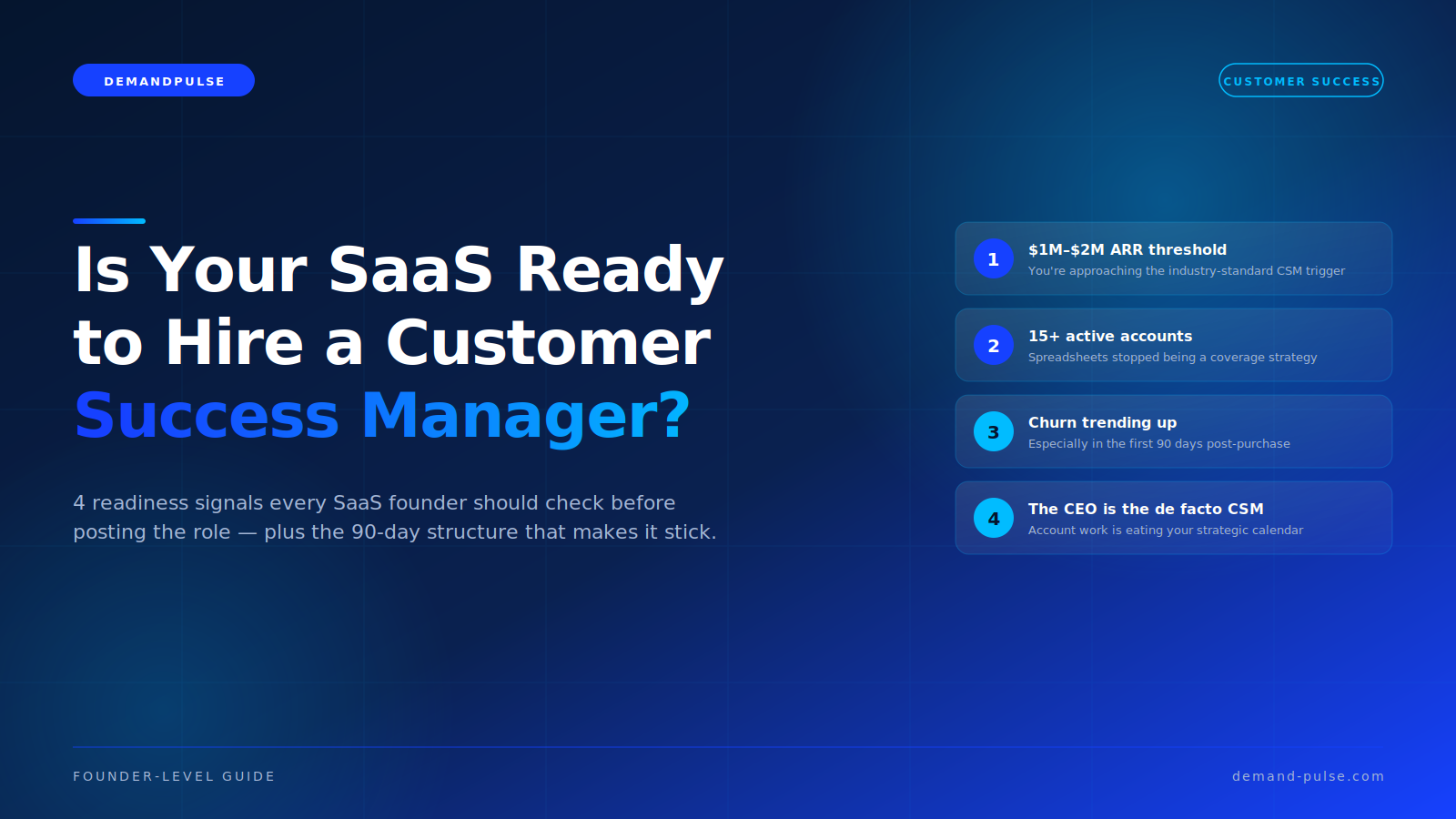
It's 9:47 p.m. and you're answering an onboarding question from a customer who signed last week. Your top three accounts haven't heard from you in six weeks. A renewal you swore you'd protect is silent. You know what comes next: you need to hire a Customer Success Manager.
The harder question is whether you're actually ready - and whether a customer success remote hire is the right shape for the role when you're still scaling lean. Hire too late and you'll lose the customers funding your runway. Hire too early - or without the operating structure underneath - and you'll watch a six-figure salary fail in 90 days.
Did you know that the average B2B SaaS churn rate in 2025 was 3.5% per month? But the real alarm is when customers leave. However, 43% of all SMB customer losses occur within the first 90 days post-purchase.
What Does a Customer Success Manager Do at a SaaS Startup?
A quick reframe before the signals. Customer success managers at a SaaS startup aren't account managers or support reps - though they end up doing both in the early days. They own the customer from sales handoff through every renewal: onboarding to first value, monitoring health signals before churn, owning renewals, surfacing expansion opportunities, and feeding product the field reality nobody else hears.
Done right, the CSM is the second-most important post-sale hire after the founder. Which is exactly why timing matters.
4 Signals Your SaaS Is Ready for a Customer Success Remote Hire
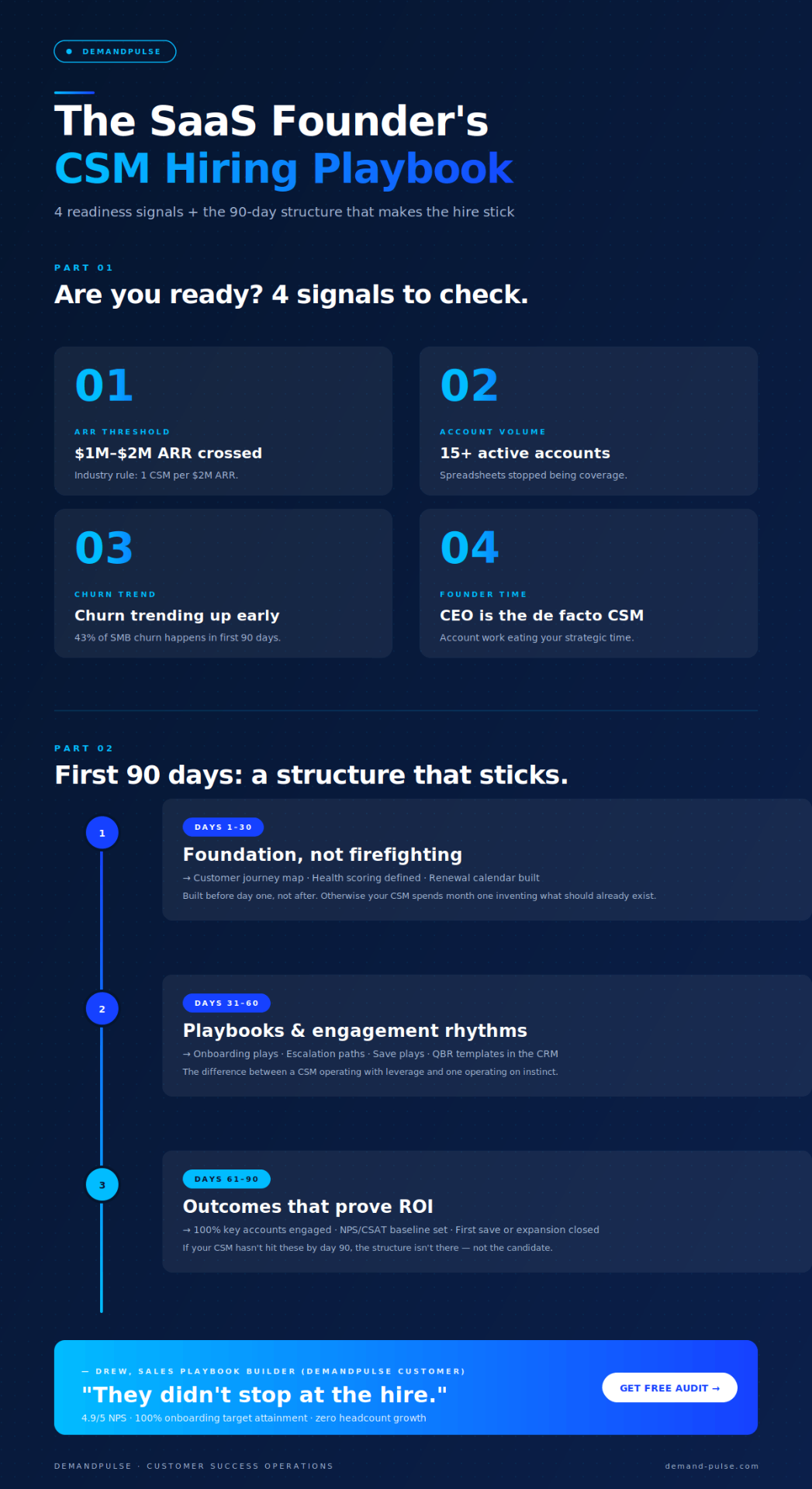
Signal 1: You've Crossed $1M-$2M ARR
The industry rule is established: most CSMs manage $2-5M in ARR across 10-500 accounts, and Jason Lemkin's long-standing benchmark is one Customer Success Manager per $2M ARR. But the actual trigger is the leading edge - around $1M ARR, or the moment a founder can no longer personally manage every customer relationship.
Signal 2: You Have 15+ Active Accounts to Manage
An industry survey found that 33% of B2B SaaS companies run a 1 CSM to 10-25 customer ratio - the most common configuration reported. If you're past 15 active accounts and tracking them by hand, you've already missed the window. Math doesn't get easier as you grow.
Signal 3: Your Churn Is Trending Up - Early
This is the most predictive signal. The average B2B SaaS churn rate in 2025 is 3.5% monthly - but the real alarm is when customers leave. 43% of all SMB customer losses occur within the first 90 days post-purchase. Early churn is rarely a product problem. It's an onboarding and engagement problem - which is the exact problem a Customer Success Manager exists to solve.
Signal 4: You - the CEO - Are the De Facto CSM
Nobody wants to admit this one. If your week is customer check-ins, onboarding calls, and Slack fires from three top accounts, you are the CSM. Fine at customer 10. Painful at customer 30. A growth ceiling at 50. That's the wall hiring a CSM (often a vetted remote one if your unit economics demand it) is designed to break through.
Free Team Audit - Find Out What Structure Your CSM Actually Needs
Not sure what structure your CSM needs to land well? Start with a free 20-point team audit and we'll walk you through exactly where to focus first.
Start the Conversation →First 90 Days of a Customer Success Remote Hire: The Structure That Sticks
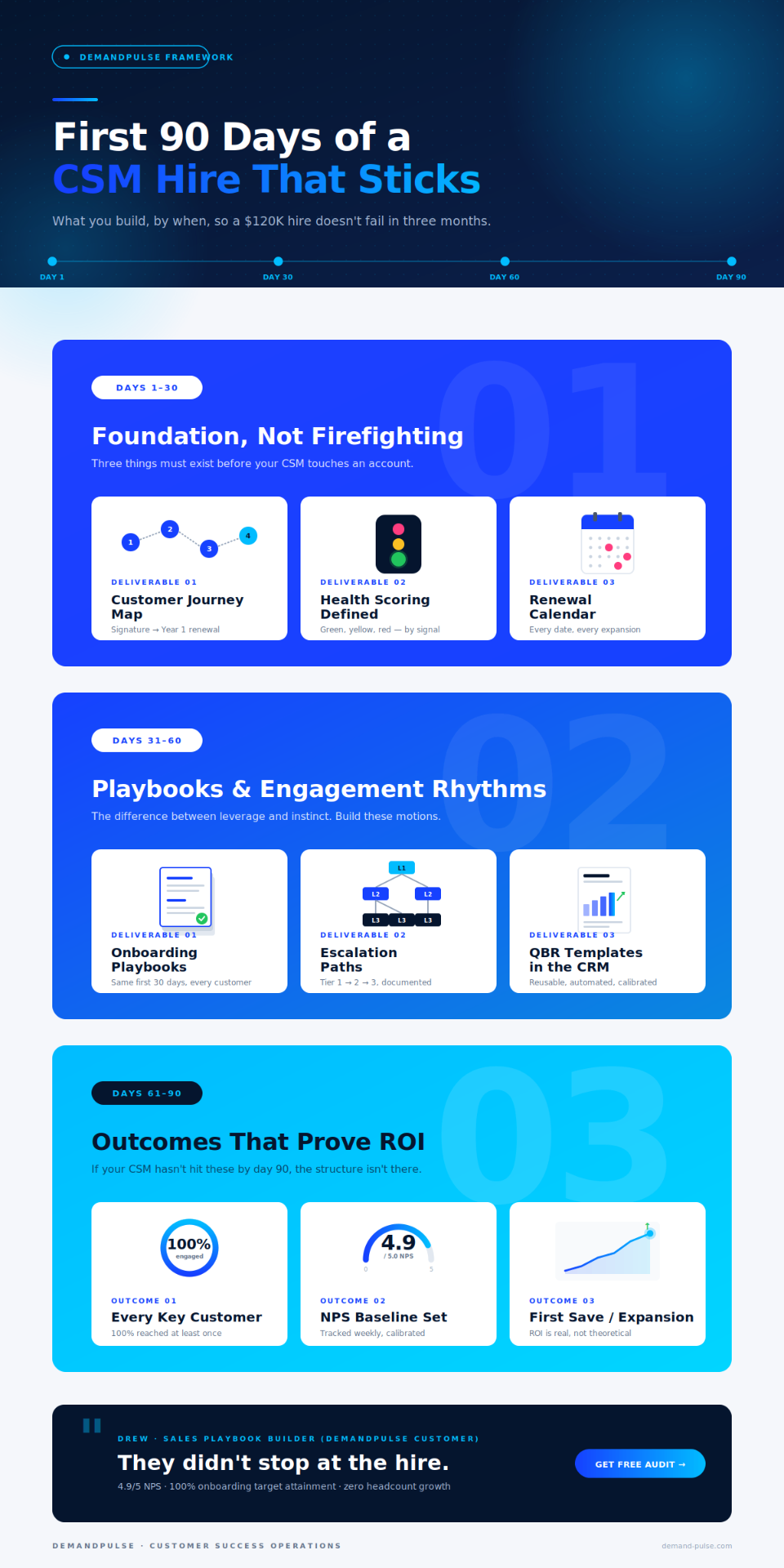
Hiring the CSM is the easy part. Building the operating system around them is what separates a productive customer success remote hire from a $120K mistake.
Drew, founder of Sales Playbook Builder - a DemandPulse client who scaled customer onboarding without growing internal headcount - put it bluntly: "They didn't stop at the hire."
Days 1-30: Foundation, Not Firefighting
Before your CSM touches a single account, three things should already exist: a documented customer journey from contract signature through Year 1 renewal, defined health scoring (what makes an account green, yellow, or red), and a renewal calendar with every customer, every date, every expansion opportunity. Without these, your new hire spends month one inventing what should have been built before they walked in the door.
Days 31-60: Playbooks and Engagement Rhythms
Onboarding plays, escalation plays, QBR plays, save plays. These aren't optional. They're the difference between a CSM operating with leverage and one operating on instinct. Industry research confirms it: the largest churn improvement at SaaS companies ( 5.7% → 3.9%) happens between early and growth stages, coinciding with the moment companies hire dedicated customer success managers instead of relying on founders.
Days 61-90: Outcomes That Prove ROI
By day 90, your CSM should be hitting the early indicators that prove the role is working: 100% of key customers engaged at least once, a baseline NPS or CSAT measured and tracked weekly, and one save story or one expansion story closed. For our client Sales Playbook Builder, the CSM connected one-on-one with 100% of key customers, took over end-to-end onboarding, and held NPS at 4.9/5 - all within 90 days, without growing headcount.
Why Most Customer Success Manager Hires Fail in 90 Days
These hires fail for the same reason most operational hires fail: there's no system underneath them. Founders post the role, hire someone smart, hand them a list of accounts, and expect retention to improve. It doesn't. The CSM gets reactive, plays defense on whichever account is loudest, and burns out by month four.
The fix isn't a better candidate. It's the operating structure around them - the playbooks, the dashboards, the segmentation, the escalation paths - built before day one.
How DemandPulse Builds Customer Success Operations That Scale
DemandPulse doesn't just place Customer Success Managers - we build the operating structure around them. We start with a free team audit that maps your customer journey, scores your retention risk, and identifies where your current motion is leaking.
From there, we source vetted, global, AI-fluent customer success managers who operate like a small team from day one, at a cost structure traditional hiring can't match. Whether you need a high-touch enterprise CSM or a leaner customer success remote model for scaling lower-ACV accounts efficiently, we build the team and the system around them.
What separates DemandPulse engagements is what made the Sales Playbook Builder engagement work: the operating system underneath the hire. We build the playbooks, the health dashboards, the onboarding flows, the QBR templates, and the escalation logic before your CSM ever touches a live account. Result: 4.9/5 NPS, 100% onboarding target attainment, and a Customer Success function that scales without scaling headcount.
You Saw Yourself in 2+ of the Signals. Now What?
You're at the inflection point. The question stops being whether to hire a customer success remote talent and becomes whether you'll hire with the structure to make it stick. Most founders skip the structure, lose the hire, and conclude "customer success doesn't work at our stage." It works. They just hired without scaffolding.
DemandPulse Doesn't Just Place CSMs - We Build the Operating Structure Around Them
Start with a free team audit. We'll map your customer journey, score your retention risk, and show you exactly where to focus first.
Start the Conversation →Subscribe for Insights That Drive Growth
Practical tips to help you grow your business and build a great team, sent to your inbox.