What Does a Customer Success Manager Actually Do in a SaaS Startup?

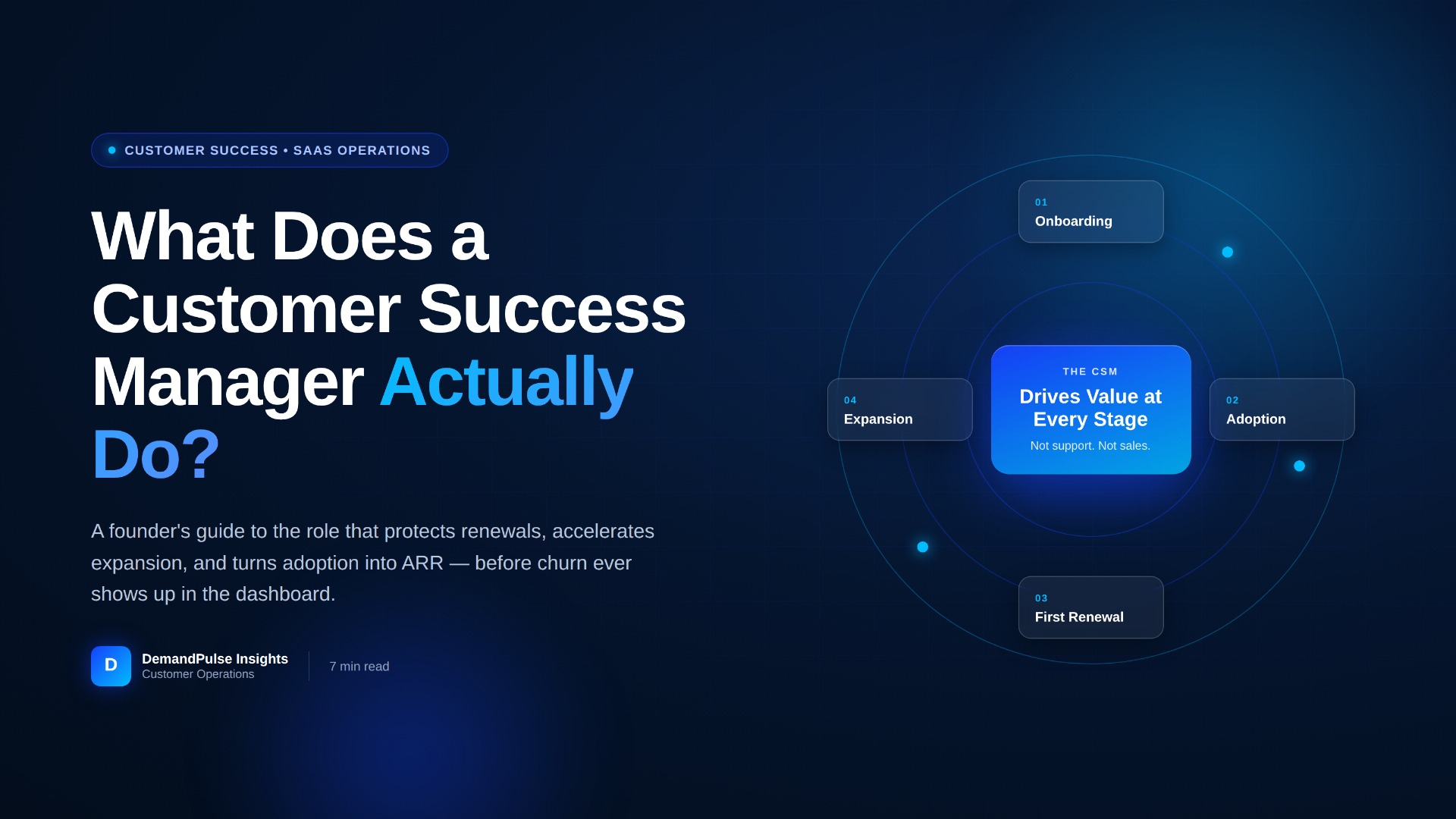
Most SaaS founders don't ask "what does a customer success manager do" until churn already hurts. By then, a renewal you assumed was safe has gone dark, a power user has quietly switched to a competitor, and you're scrambling to define a role that should've been built six months ago.
This guide is the answer before it costs you a renewal. We'll define what a customer success manager actually does in a SaaS startup - what they own, what they don't, and how their work maps to the moments in the customer journey where value is made or lost.
What Is a Customer Success Manager? A Definition That Holds Up
A Customer Success Manager (CSM) is the role accountable for whether your customers actually achieve the outcome they bought your product for - and renew because of it. That's the job description, condensed.
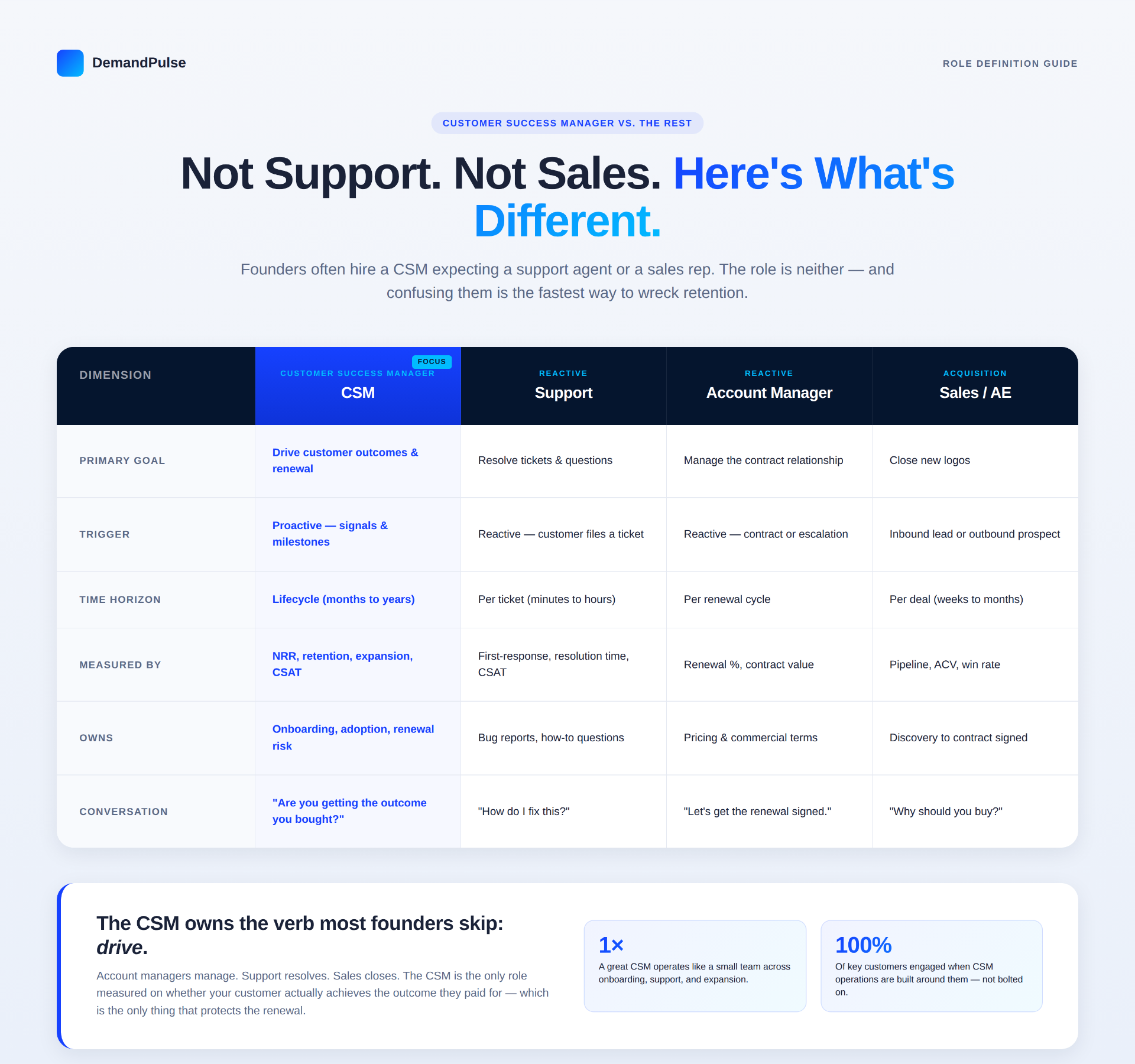
The confusion comes from what the role isn't:
A CSM is not Support. Support resolves tickets when something breaks. A CSM prevents the breakage by getting customers to value before friction shows up.
A CSM is not an Account Manager. AMs manage commercial terms and contract logistics. CSMs drive adoption, expansion signals, and renewal risk before any of that hits the AM's desk.
A CSM is not Sales. Sales closes the new logo. CSMs make sure that logo is still a customer 12 months later - and worth more than when it signed.
If support is reactive ("someone filed a ticket") and sales is acquisition ("we don't have this logo yet"), customer success is proactive: it operates on signals, milestones, and outcomes - not on whoever happened to email today.
What Does a Customer Success Manager Do, Day to Day?
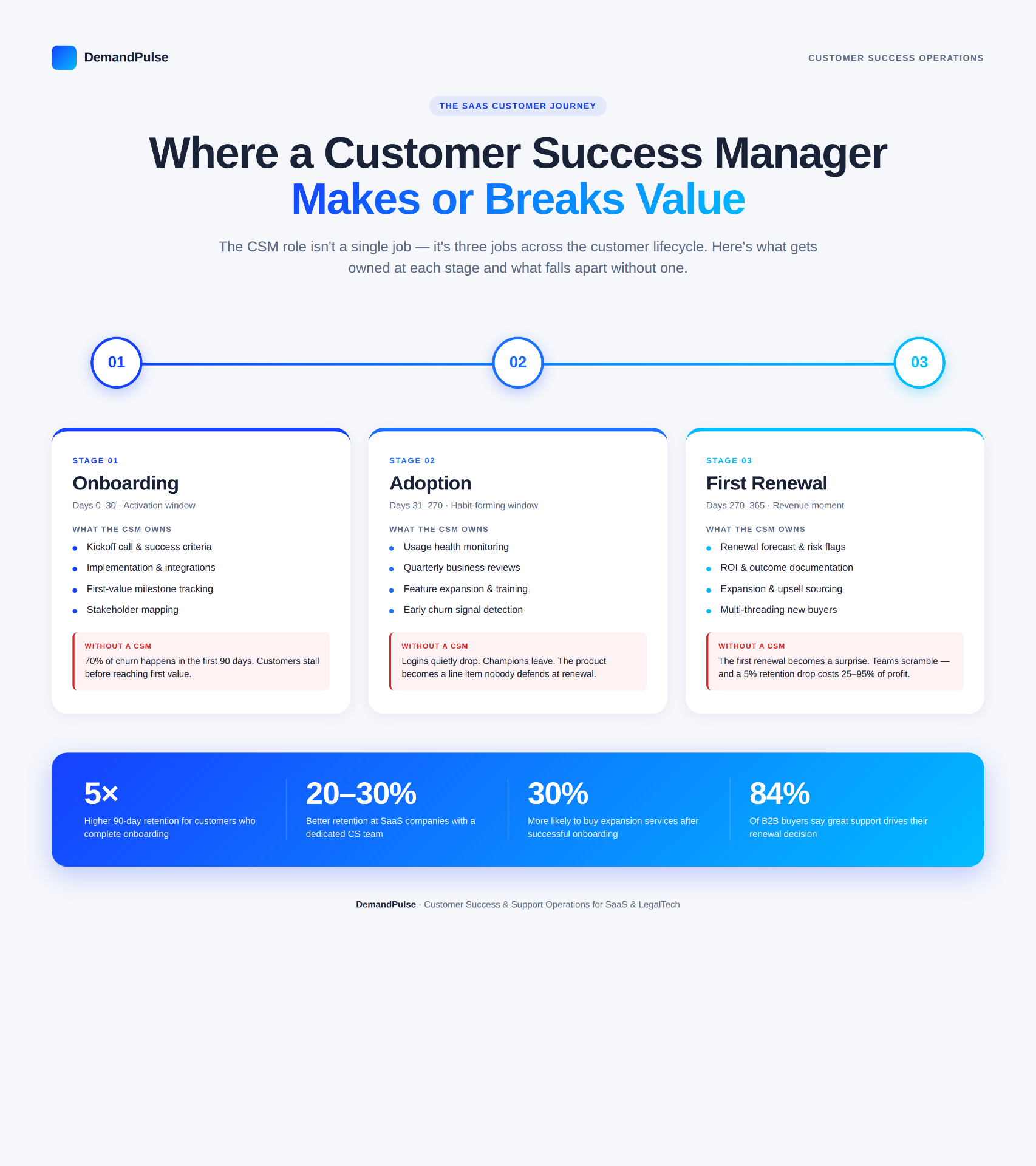
The clearest way to answer "what does a customer success manager do" is to map the work to the SaaS customer journey. Customer success managers don't run a function in isolation - they run a relay race across three distinct value moments. Skip any one and the whole engagement slips.
1. Onboarding (Days 0-30): Get the Customer to First Value
This is the most fragile window in the entire SaaS customer lifecycle. Roughly 70% of SaaS customers who churn do so within the first 90 days due to poor onboarding, and customers who complete onboarding are 5x more likely to remain past the 90-day mark.
The CSM owns the kickoff call, defines success criteria in writing, drives the implementation, and maps the buying committee against the actual end users. Their job is to compress time-to-value: integrations finished, first workflow live, first measurable outcome inside 30 days. This is where the renewal is won or lost - most founders just don't see it that way until 11 months later.
2. Adoption (Days 31-270): Turn the Product Into a Habit
Once onboarded, customers don't "just use" your product - they drift. CSMs spend the bulk of their time monitoring usage health (which seats are logging in, which features are sticking, which integrations have gone dark) and intervening before the dashboard turns red.
This is also where CSMs run quarterly business reviews, route feature gaps to product, and document the ROI customers will need at renewal. The work is invisible until it isn't: when the champion leaves, a CSM with multi-threaded relationships saves the account. Without one, the renewal walks out with the champion.
3. First Renewal (Days 270-365): Convert Outcomes Into Revenue
The first renewal is the moment the CSM's entire year shows up in a single number. By this point, a good CSM has documented outcomes, surfaced expansion opportunities, and flagged risk months ahead of procurement. The renewal isn't a negotiation - it's a foregone conclusion.
The math here is unforgiving. A 5% increase in customer retention can boost profits by 25% to 95%, and SaaS companies with dedicated customer success teams see 20-30% better retention than those without. Expansion compounds it: customers who complete onboarding successfully are 30% more likely to purchase additional services.
CSMs Who Manage vs. CSMs Who Drive
Here's the distinction most founders miss when they hire their first CSM: relationship management is not customer success.
A CSM who manages is friendly, responsive, and good in QBRs. The customer likes them. But usage is what it is, expansion conversations don't happen organically, and renewals get negotiated on price.
A CSM who drives outcomes operates from a different model. They've built a customer journey playbook tied to product milestones. They know which usage signals predict churn 60 days out. They source expansion before the customer asks - and the customer's CFO can name the ROI in a single sentence at renewal.
The difference shows up in the operating model, not the personality of the hire.
Ready to build a CSM function that drives renewals - not just relationships?
Start the ConversationWhat Great Customer Success Operations Look Like at the Startup Stage
This distinction played out in a recent DemandPulse engagement. Sales Playbook Builder, an AI-powered sales technology company, needed to scale onboarding without scaling internal headcount.
We helped them define the CSM role as an operator - not a relationship manager - then sourced the hire and built the operating system around them: customer journey mapped end-to-end, AI orchestration anchoring workflow automation, scorecards tied to engagement and revenue.
The result wasn't just a good hire. The CSM engaged 100% of key customers, took full ownership of onboarding, and held delivery timelines steady at 2-3 weeks even as volume grew. NPS averaged 4.9/5, and the team consistently hit 100% of new client onboarding targets - all while leadership stayed focused on growth instead of post-sale firefighting.
That's the difference between a CSM hire and a customer success function. It tracks with the broader buyer signal: 84% of B2B software buyers say excellent customer support and success are deciding factors at renewal.
Stop Hiring Reactively. Build the Function Before Churn Forces You To.
If you're still asking "what does a customer success manager do," the better question is: where in my customer journey am I losing value I already paid to acquire?
Hire a CSM before you can answer that and you'll get an expensive support agent. Build the operating model first - then hire into it - and you get a renewal engine.
Ready to Shift From Reactive to Proactive?
DemandPulse helps SaaS startups hire and structure their first Customer Success function - not just the hire, but the whole operating model around it. We map your customer journey, build the playbooks and QA, source the right talent, and stand up the systems that let one CSM operate like a small team.
How DemandPulse Helps You Grow Customer Success and Support Operations
DemandPulse staffs, builds, and runs customer success and customer support operations for SaaS and LegalTech companies scaling faster than their internal teams can hire.
On the customer success side, we partner with founders to define what a healthy CS function looks like for your product and customer profile - then we source globally, onboard against a 30/60/90 scorecard, build the runbooks and QA rubrics inside your existing tech stack, and embed an operating cadence that protects renewals from day one.
The outcome is a CSM (or team) who acts like an extension of leadership, not a vendor checking boxes - exactly the model that took Sales Playbook Builder from reactive onboarding to 100% of key customers engaged with a 4.9/5 NPS.
On the customer support side, we run the same operator-led model: 24/7 follow-the-sun coverage, omnichannel staffing across email, chat, phone, and in-app, native integration with Zendesk, Intercom, or Help Scout, and Tier 1-3 escalation paths with QA calibration on the floor.
We also build shift-left deflection - help center content, in-app guidance, and AI-powered automation - so ticket volume stops scaling linearly with your customer base. Whether you need to stand up your first CSM or restructure a support operation hemorrhaging margin, the result is the same: faster resolutions, lower cost to serve, and a customer experience that protects revenue instead of leaking it.
Request a Free CS & Support Audit
We'll map where your customer journey is leaking value - and exactly what a CSM (or team) needs to own to fix it.
Start the Conversation →Subscribe for Insights That Drive Growth
Practical tips to help you grow your business and build a great team, sent to your inbox.