How to Implement AI Powered Customer Service in 2026

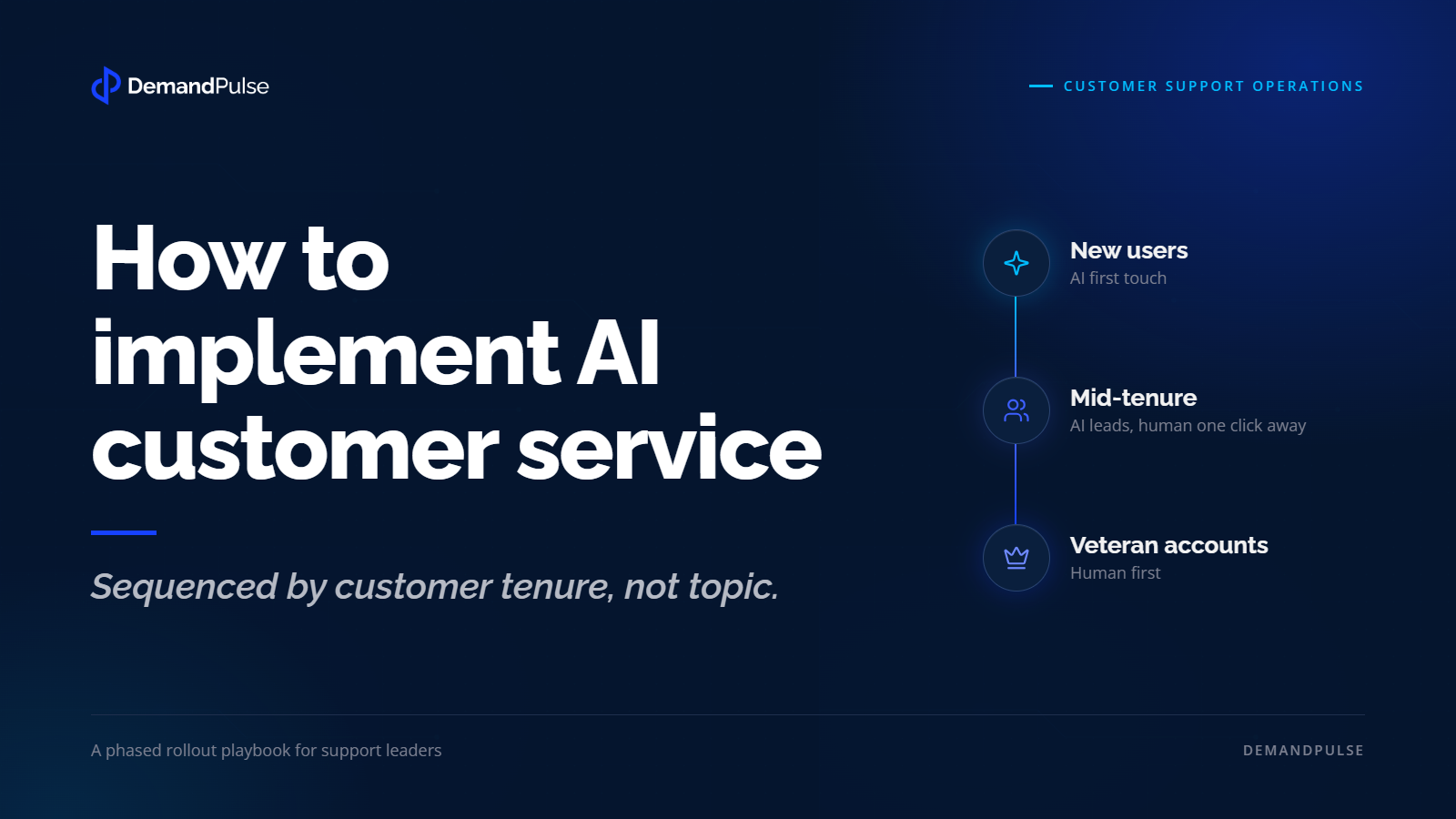
More than 75% of customers say that they prefer a human for support, while 56% said that AI chatbots frustrate them.
The fastest way to lose a five-year account is to make them explain their problem to a bot. That is exactly what happens the day most teams switch on AI powered customer service for everyone at once.
You have read the standard how-to already. Pick a vendor, connect the knowledge base, start with password resets, expand from there. That answers the easy question, integration, and skips the hard one: who meets the bot, when, and what happens the second they want out.
Flip it on for the whole base and you have not launched a feature. You have changed the front door to every relationship you have, including the ones that took years to build.
Why Most AI Powered Customer Service Rollouts Backfire
Engineering ships in stages: internal, beta, general availability. It works because a feature behaves the same for everyone who touches it.
A support chatbot does not. The same "reset my password" is a small win for a day-one user and an insult to a five-year account used to email a person by name. Same request, opposite reaction. The deployment playbook has no concept for that, which is precisely why it fails here.
So "on or off" is the wrong frame. You are not toggling a feature. You are rerouting trust, and trust does not distribute evenly across your customer base.
It is not how hard the question is. It is the expectation the customer brings. A trivial ask from a tenured account carries more relationship risk than a genuinely complex one from a new user. Sort your rollout by topic and you are optimizing the wrong axis.
Segment By Customer, Not by Ticket Type
Cut your rollout by tenure and expectation, not by inquiry type. Two cohorts sit at the extremes, and they want opposite things.
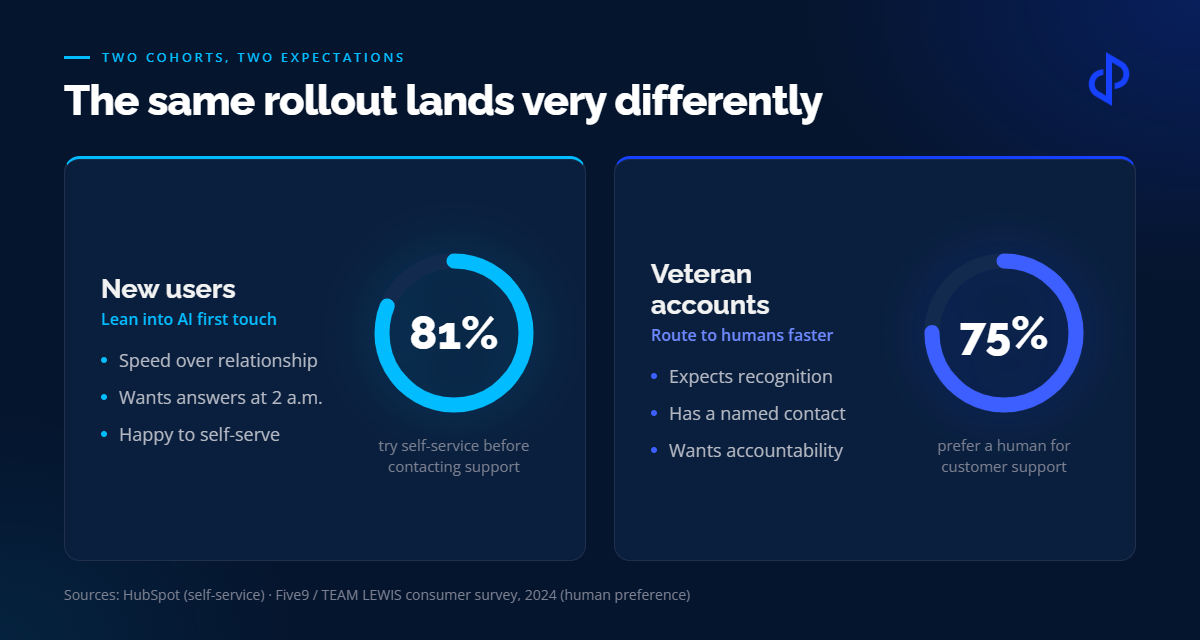
Speed versus recognition. No single first touch serves both cohorts well.
The Veteran
You trained these accounts to expect a human. They have a person they email and a reflex that fires automatically: when it matters, talk to someone. Route them to a bot and they do not judge the answer, they judge the demotion.
The research backs the instinct. In one 2024 survey, 75% of consumers said they prefer a human for support, and 56% said chatbots frequently frustrate them. For your oldest accounts that frustration does not stay in the ticket. It lands in the account manager's inbox, then in the renewal conversation.
The Net-New Customer
Day-one users have nothing to protect. There is no "Sarah" to lose. They arrived expecting to help themselves, and a conversational AI assistant that answers instantly at 2 a.m. is genuinely the better onboarding experience.
Most people try to self-serve before they ever contact a person, so meeting new users with AI conversational assistance is just meeting them where they already are. They will lean on it hard, and that is a feature, not a bug.
Treat tenure as expectation debt. Every month of dedicated human service adds to a balance you now owe. New users owe you nothing, which is why they are the safest place to let AI earn its keep. Handing new users the bot is not generosity. It is putting risk where it costs the least.
Rolling Out By Topic Hits Your Worst-Case Customers First
The common advice, AI takes password resets first, then order status, then billing, sounds cautious. It is the riskiest sequence you can pick.
A topic rollout switches the bot on for your entire base at first touch. Every veteran who asks about that topic meets AI on day one. You have quietly maximized exposure to the exact people most primed to reject it.
Audience sequencing inverts that. Point the bot at your lowest-expectation cohort, learn from real conversations, and widen only once it holds. Same technology, opposite risk profile.
Only 15% of people get a smooth handoff from AI to a human. A tenured customer who explains the issue twice, once to the bot and again to the agent, does not just have a bad ticket. They have proof the new system made their life worse.
The Rollout That Protects Revenue, Phase By Phase
Here is the sequence that banks the efficiency without torching relationships. The image to hold in your head: AI earns trust from the front line inward, not the other way around.
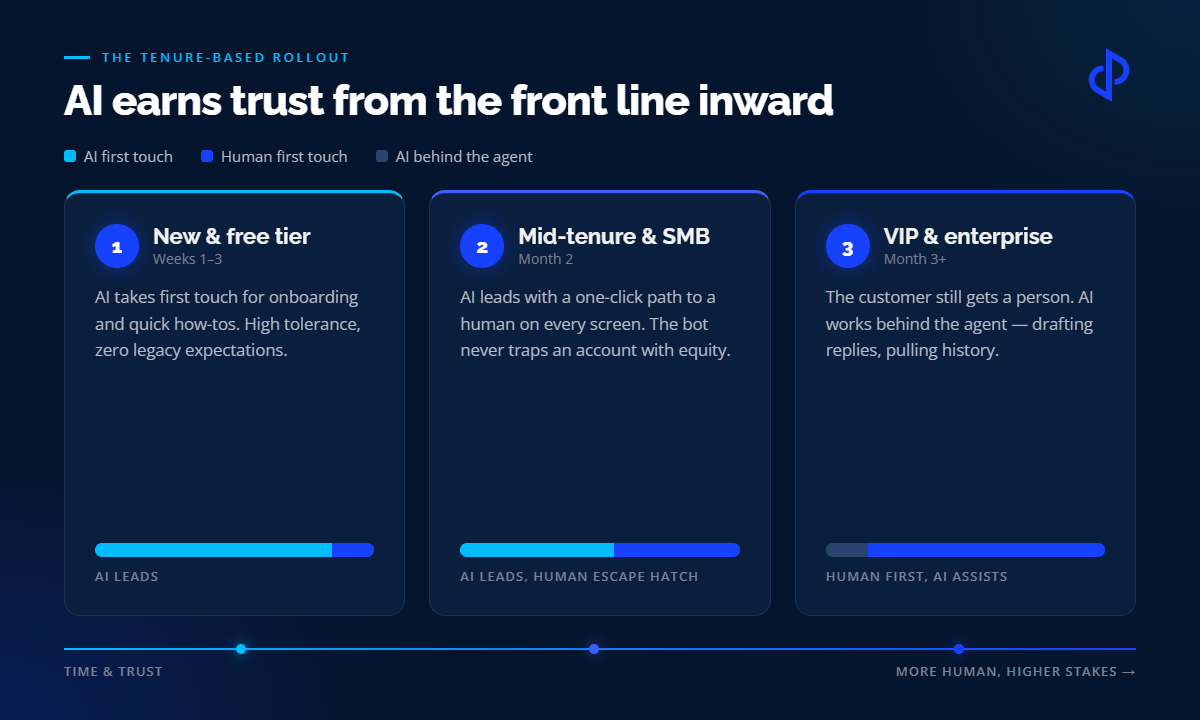
First touch shifts from mostly AI to mostly human as tenure and stakes rise.
Phase 1: New Signups and the Free Tier
Start where patience is highest and there is nothing to break. New and free-tier users get AI as their first touch for onboarding and quick how-tos. The round-the-clock speed helps them activate, and nobody is losing a relationship they never had.
A trial user signs up and, at 2 a.m., fires fourteen setup questions at the bot. Instant answers, activated by morning, five stars. No human pulled in, none expected. That is the sweet spot: no relationship to protect, high need for speed, low emotional stakes.
Phase 2: Mid-Tenure and SMB Accounts
When Phase 1 holds, extend to mid-tenure and SMB, but change your posture. AI leads, with a one-click path to a human on every screen. These accounts have equity with you, so the bot never traps them.
Where do you draw the tenure line? Do not guess it. Pull the last few months of tickets and plot the rate at which customers ask for a human against account age. You are looking for the cliff. In most B2B bases there is a point, often somewhere between eighteen months and two years, where "get me a person" requests jump sharply. That inflection is your line. Set the threshold just below it, route on it, and re-plot the chart every quarter as the base ages.
Phase 3: The VIP and Enterprise Holdouts
Your top accounts change last, and they barely notice when they do. AI runs as agent-assist here: it drafts replies and pulls up account history to make the human faster, while the customer still reaches a person. Customer-facing bot time for this group stays near zero.
Flip AI on for everyone and here is your Tuesday. A major enterprise client, used to emailing Sarah, gets stopped by a bot asking them to summarize their issue. They escalate to their account manager instead. Ops scrambles to whitelist the domain after the damage is done. Every step was predictable. One routing rule prevents all of it.
The Rollout Your Agents Feel Too
There is a second rollout happening inside your own team, and it is the one leaders forget. The moment you announce AI is taking first touch, a quiet question runs across the floor: is my job next?
Ignore it and you get the worst version of adoption. Agents route around the bot, reopen tickets it closed, or stop flagging its misses because fixing the thing feels like training their own replacement.
The tenure model gives you a clean answer, and it is a true one. AI absorbs the repetitive first-touch volume; your agents move to the work the bot cannot do, the high-tenure accounts, the messy escalations, the conversations that decide renewals. That is not a demotion. For most agents it is the part of the job they wanted in the first place.
Say that out loud before launch, not after. Walk agents through the Phase 3 plan where they own the VIP relationships and the bot sits behind them as assist. Tie their goals to resolution quality and retention on those accounts, not to raw ticket count, which the AI is about to distort anyway. An agent who understands they are being moved up the value chain becomes your best source of bot feedback instead of your quietest saboteur.
Your Routing Rules Are the Real Product
Most teams spend three weeks tuning the bot and twenty minutes on routing. Reverse it. The routing logic decides whether the rollout works. The bot just executes underneath it.
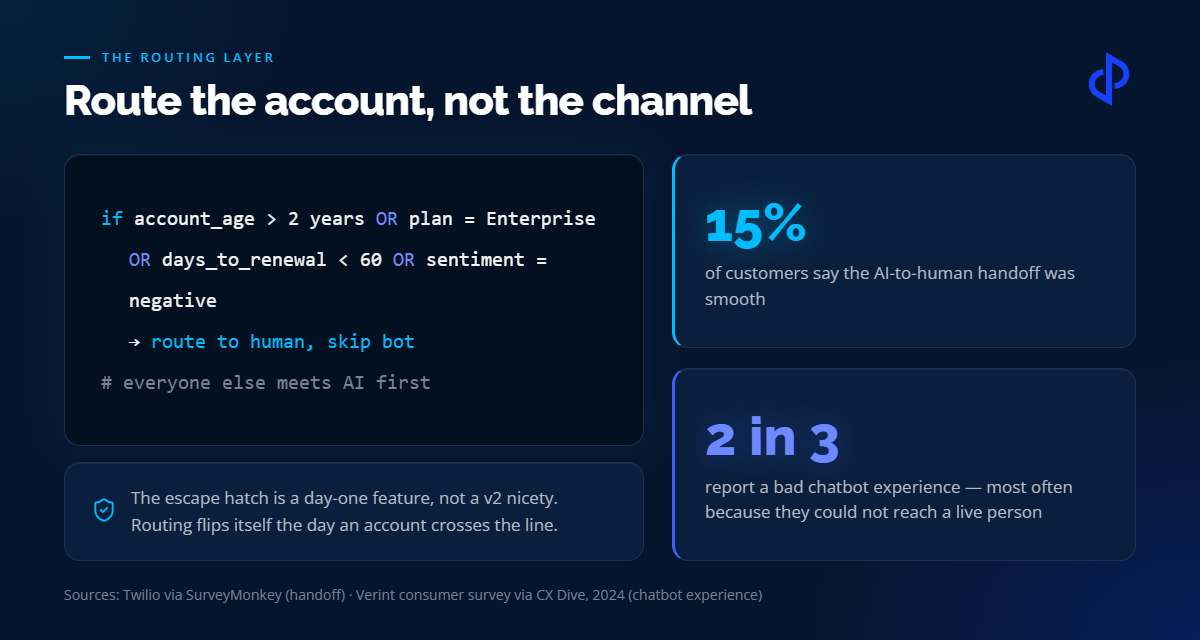
Map your cohorts before you open the AI tool, then encode them as rules in the CRM or helpdesk. The rule itself is boring, which is the whole point:
if account_age > 2 years OR plan = Enterprise
   OR days_to_renewal < 60 OR sentiment = negative
   → route to human, skip bot
# everyone else meets AI first
Three things make that rule stronger than it looks. It runs on live data, so the day an account crosses your tenure line, its routing flips on its own. You maintain a threshold, not a list.
It respects the moment, not just the tenure. A two-year account sixty days from renewal should hit a human even for a trivial question. Expectation spikes around renewals, and that is the worst possible time to introduce friction. This is the "expectation" half of the mandate that pure tenure rules miss.
It reads the mood, not only the record. An already-angry customer should skip the bot no matter their tenure, because a frustrated person handed to automation is how a solvable ticket turns into a churn event.
Most modern help desks can score sentiment on the first inbound message, so wire that into the same rule. Tenure, lifecycle moment, and emotional state are three faces of the one thing you are really routing on: expectation.
And it holds across channels. The veteran who emails Sarah cannot get a bot the instant they open live chat, or you have simply moved the insult to a new window. Route the account, not the channel.
One unglamorous prerequisite: your tenure data must be clean enough to route on. The first thing most operations teams find is that signup date and plan tier live in three systems that quietly disagree. Fix that before you write a single flow. The rule is only as good as the field it reads.
The escape hatch is a day-one feature, not a v2 nicety. Customers forgive a mediocre bot far faster than a dead end. In a 2024 study, more than two-thirds of customers reported a bad chatbot experience, usually because they could not reach a live person. The bot does not need to be brilliant if the exit to a human is one obvious click.
A Wrong Answer Costs More Than a Slow One
Every rule above assumes the bot gives good answers. That assumption is exactly where regulated and high-consideration products get burned. A slow human reply is a minor annoyance. A confident, wrong AI answer about billing, contract terms, or anything with compliance weight is a real liability, and your newest users are the least equipped to tell it is wrong.
So, before Phase 1, pressure-test what the bot is allowed to say, not just what it can say. Set a confidence threshold below which stops guessing and hands off. Teaching it that "I am not certain, let me get a person" is a success state, not a failure. And audit the content it draws from first, because the quickest way to ship wrong answers at scale is to point a capable bot at a stale knowledge base.
For LegalTech, SaaS, and anyone in a regulated space, this is the line that matters most. The goal was never a bot that answers everything. It is a bot that knows the edge of its own competence and steps back cleanly when it gets there.
Blended CSAT Is Lying to You
This is where the dashboard misleads you. One CSAT number across all customers can sit perfectly flat while two opposite trends cancel out underneath it: new users delighted with instant answers, veterans quietly furious that they now must argue with a bot. The average looks calm. Your revenue base is fraying.
Break CSAT, escalation rate, and resolution time out by tenure cohort. That is the difference between AI support metrics that soothe you and ones that inform you. Blended numbers hide the split. Segmented numbers expose it.
Watch the behavioral tells, because they move before CSAT does. How often do people press zero or type "human." Repeat contacts on a single issue. Escalations that skip the queue and land straight on an account manager. Pipe those into your AI reporting so the whole team reads the same customer experience metrics, not just the headline score.
Then read the transcripts, not only the ratings. A four-star chat that ends "fine, whatever, just get me a person" is not a win, and only the transcript catches it. Good chatbot analytics flag a rising veteran escalation rate in days. Weak AI chatbot performance tracking flags it in a lost renewal a quarter later.
The AI Chatbot Is Never Done Training, And That Is An Ops Job
"How do I train the chatbot" is almost always asked as a setup question. Treat it that way and the bot peaks in week one, then quietly drifts as your product, pricing, and customers change. Training is not the launch task. It is the standing job that keeps the whole rollout honest.
Your best training data is already sitting in your helpdesk, and it is not the tickets the bot resolved. It is the ones it kicked to a human. Every AI-to-human handoff is a labeled example of where the bot fell short, so tag each one with a reason: did not understand, wrong answer, no content, or the customer simply wanted a person. That running log is worth more than any generic training set you could buy.
Then close the loop on a cadence. Once a week, someone reads the misses, groups them, and sorts each into one of three buckets: a content gap (fix the article), an intent gap (teach the bot the phrasing customers use), or correctly escalated human work (leave it alone). Assign that owner by name. A feedback loop with no owner is just a backlog with better branding.
And mind the input. The bot learns from your knowledge base whether you curate it or not, so a stale article is a wrong answer waiting to happen. Retire the dead content before you widen the bot to the next cohort, not after it embarrasses you in front of them. Training the AI chatbot and grooming your content are the same task wearing two hats.
What The Rollout Looks Like, Week by Week
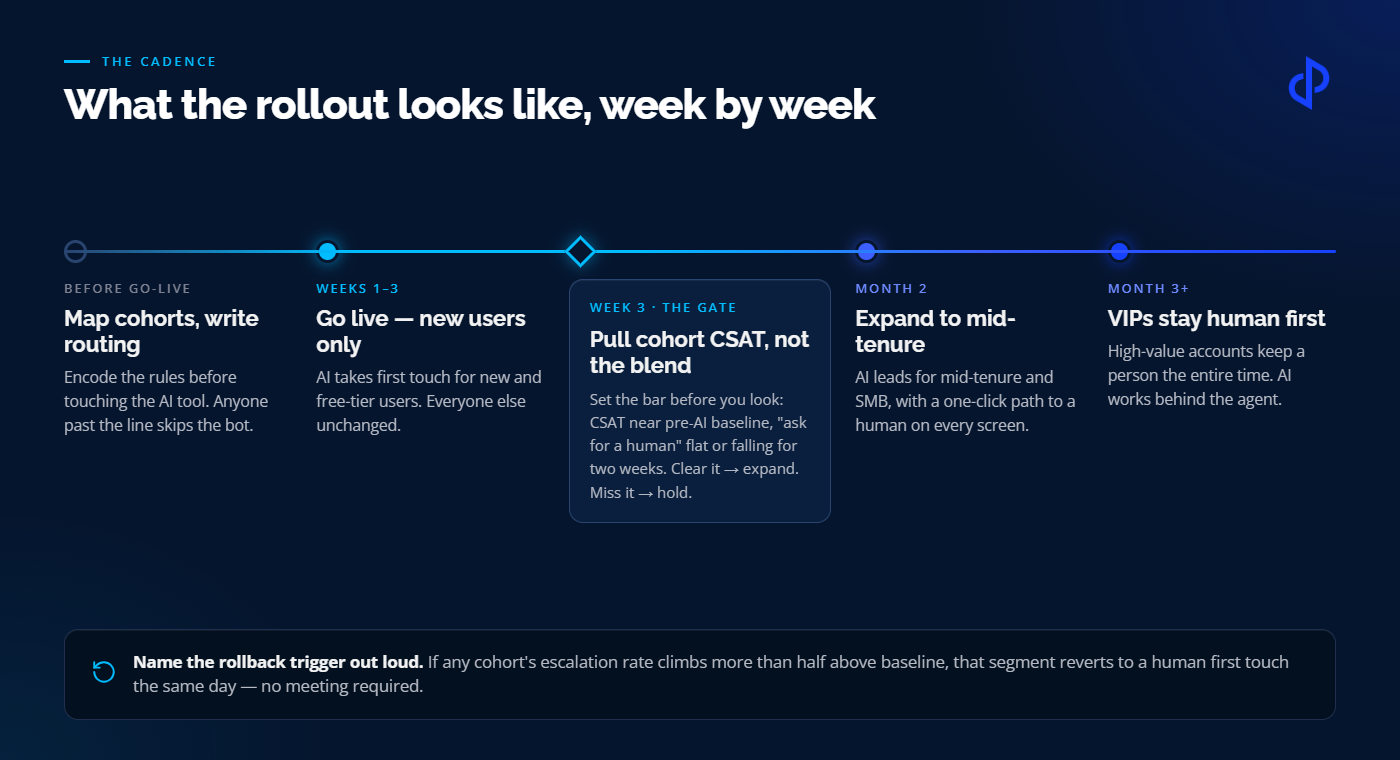
Operational design is where teams stall, and where DemandPulse works
Everything above is operational design: cohorts, thresholds, routing, escape hatches, coverage. The technology is rarely what stalls a team. This is. And it is the work DemandPulse does.
A U.S.-based strategist embeds with your team to build the cohorts, the routing rules, the phase gates, and the escape hatches, then owns the human coverage for the accounts that still expect a person. The playbooks and QA come standard, so the next hire routes exactly like the last one.
The stance is AI-empowered, not AI-replaced. AI clears the repetitive first touch, so your people spend their hours on the high-stakes conversations that keep accounts, which is the human coverage your tenured customers still expect.
In one LegalTech engagement, DemandPulse reports 82% faster first-response times, a 40% reduction in support costs, and 90%+ customer satisfaction sustained, with a 60% cut in resolution times and a 74% lift on complex tickets.
75% of CX leaders expect most interactions to be resolved without a human within a few years. The teams that win will not be the fastest to automate. They will be the ones who sequenced conversational AI for customer service so carefully their best relationships never felt the seams.
Sequence the rollout, keep the relationships
DemandPulse designs the cohorts, routing, and escape hatches, then runs the human coverage behind them, so AI earns its keep without costing you your best accounts.
Subscribe for Insights That Drive Growth
Practical tips to help you grow your business and build a great team, sent to your inbox.