What Services Do Accounting Firms Provide?


37%
Time on billable work
48%
Time on admin tasks
10-50%
Revenue loss from delayed time entry
Did you know that an average lawyer spends only 37% of their workday on actual billable work? Furthermore, a staggering 48% of their time is engulfed in administrative tasks. Managing a successful law practice requires more than just winning cases and securing favorable settlements; it demands rigorous, unyielding financial oversight.
For many managing partners and law firm owners, the operational side of the firm becomes a significant burden as the practice scales. You are trained to practice law, not to untangle complex reconciliation discrepancies.
This is where specialized Law Firm Accounting services comes into business. Unlike standard retail, manufacturing, or tech businesses, law firms operate under stringent regulatory and ethical frameworks regarding client funds, revenue recognition, and partner compensation.
Relying on a generalist accountant often leaves money on the table—or worse, exposes the firm to severe compliance risks. To save the losses in the revenue, you need specialized Law Firm Accounting services.
According to the American Bar Association, recording time at the end of the day results in at least 10% loss of billable hours. Waiting until the end of the week can cost a firm up to 50%.
Outgrowing Your Current Generalist CPA?
Standard accounting advice leaves money on the table. Upgrade to DemandPulse for specialized law firm tax strategies, KPI tracking, and complex partner compensation management.
The Critical Difference: General vs. Specialized Legal Accounting
The legal industry's financial ecosystem is unique. If a typical B2B service company mixes up an invoice payment, it is an administrative headache that can be fixed with a quick journal entry. If a law firm misapplies a retainer payment or drafts from the wrong account, it can trigger an immediate state bar audit, severe penalties, or even disbarment.
This high-stakes environment is why dedicated legal accounting services are not just a luxury, but a baseline necessity for risk management.
A specialized firm deeply understands the mechanics of retainers, the nuances of advanced client costs, and the specific metrics that drive legal profitability. They do not just categorize expenses; they build financial systems designed specifically for the ethical and operational realities of running a law firm.
Trust accounting is under stricter surveillance than ever. In just one sweep in 2023, the State Bar of California suspended more than 1,700 lawyers for failing to comply with new Client Trust Account Protection Program reporting rules.
Core Law Firm Accounting Services You Should Expect
When you partner with a specialized financial team, the scope of work extends far beyond annual tax prep. Here are the core services an expert accounting firm provides.
Trust Accounting and IOLTA Compliance
Perhaps the most critical function an accounting firm performs for legal clients is managing trust accounting for lawyers. Handling Interest on Lawyers' Trust Accounts (IOLTA) is fraught with ethical landmines. Commingling firm operating funds with client funds is one of the leading causes of attorney discipline.
A specialized accountant ensures strict IOLTA compliance through meticulous three-way reconciliation. This process involves matching three distinct records to ensure absolute accuracy:
- The bank statement balance for the trust account.
- The trust account book balance in your general ledger.
- The sum total of all individual client ledger balances.
Real-World Scenario
Consider a mid-sized personal injury firm that accidentally pays a medical vendor for case costs using funds from the general IOLTA pool, rather than the specific client's ledger. A generalist bookkeeper might classify this as a simple business expense. A legal accounting specialist will immediately flag this as a commingling violation, correcting the error and updating the firm's workflow before a random audit occurs.
Advanced Law Firm Bookkeeping and Software Integration
Accurate law firm bookkeeping goes far beyond basic categorization. It requires seamless, bi-directional integration between your practice management software (such as Clio, MyCase, or PracticePanther) and your accounting ledger (like QuickBooks Online).
Accountants manage the complex workflow of moving funds from trust to operating accounts once fees are earned and invoiced. They diligently track advanced client costs, distinguishing between hard costs (e.g., court filing fees, expert witness retainers) and soft costs (e.g., in-house printing, postage), ensuring they are billed back to the client and reimbursed to the firm correctly.
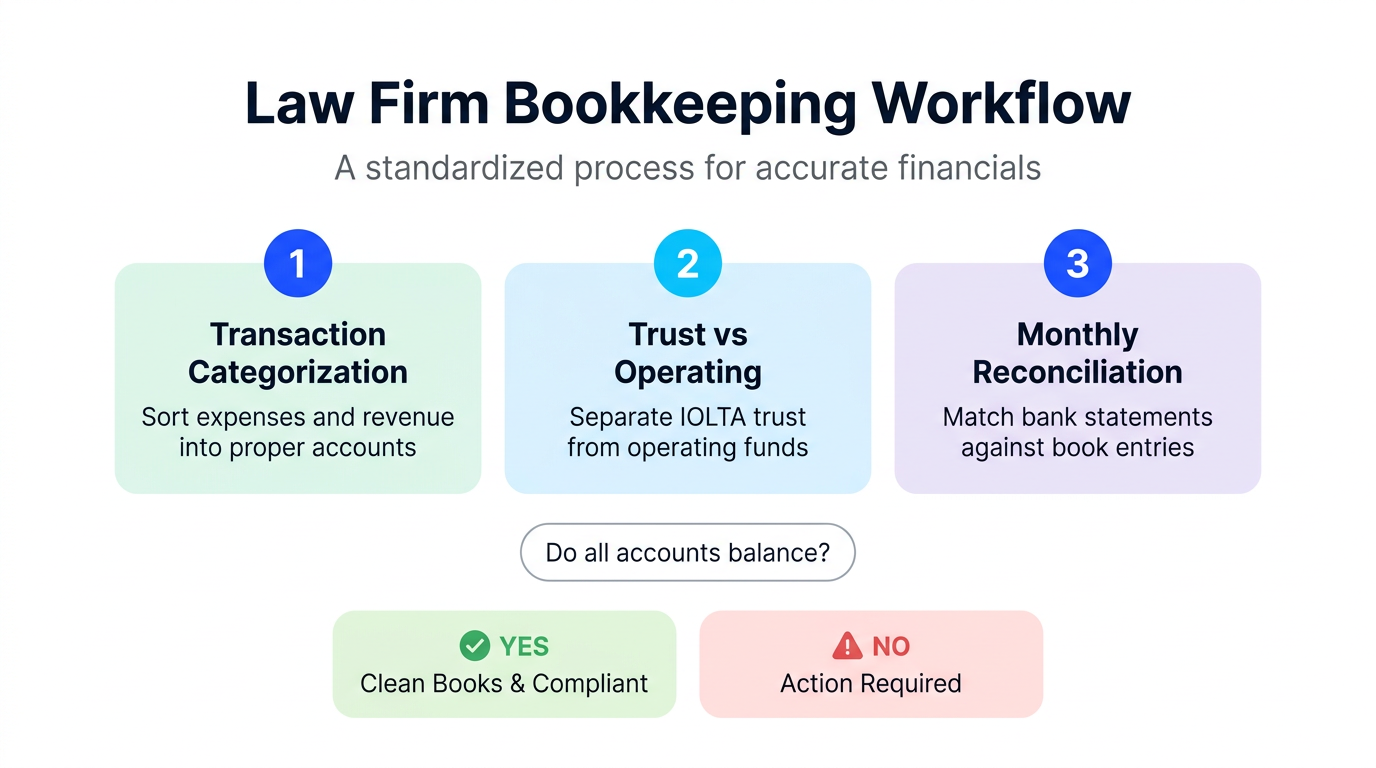

If your firm is currently struggling to keep your practice management software and financial ledger in perfect sync, a professional assessment of your tech stack can quickly reveal critical efficiency gaps and prevent revenue leakage.
Partner Compensation and Profit Allocation
As law firms grow and add partners, compensation models become increasingly complex. Are you using an "eat-what-you-kill" model, a lockstep system, or a customized hybrid formula?
Accounting firms calculate and manage these periodic distributions. They meticulously track origination credits, working attorney revenues, and overhead allocations to ensure that every equity and non-equity partner is compensated accurately according to the firm's specific partnership agreement. This objective transparency prevents internal disputes and keeps the partnership unified and focused on client service.
Payroll and Contractor Compliance
Law firms employ a diverse mix of personnel, from W-2 salaried associates and hourly paralegals to 1099 expert witnesses and contract attorneys. A specialized accounting firm ensures that all payroll is processed accurately, benefits are administered properly, and—crucially—that worker classifications meet IRS standards to avoid severe misclassification penalties.
Strategic Advisory: Moving Beyond the Balance Sheet
A modern accounting partner does more than report on the past; they help dictate your firm's future. Once the foundational bookkeeping is automated and compliant, specialized accountants step into a fractional CFO or strategic advisory role.
Cash Flow Forecasting
Law firms frequently deal with irregular cash flow. This is especially true for contingency-fee practices where revenue is tied to unpredictable settlement dates, or litigation firms dealing with protracted court battles. Specialized accountants build robust cash flow forecasts, ensuring the firm has adequate runway to cover overhead, payroll, and marketing expenses during lean months.
Tracking Legal-Specific KPIs
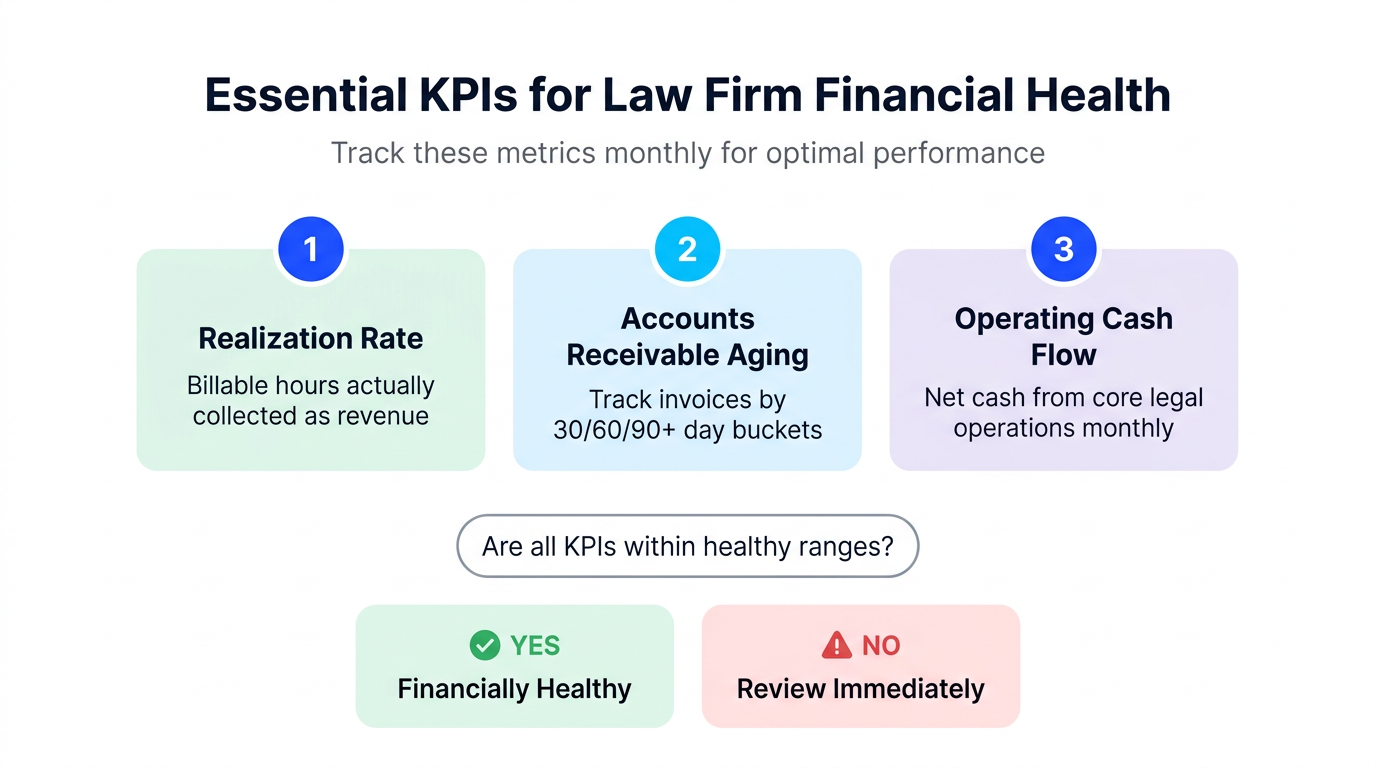
To scale a law firm profitably, you must track the metrics that actually matter. An expert accountant will monitor and report on vital Key Performance Indicators (KPIs):
Realization Rate
How much of your billed time is actually collected from clients? A low rate indicates billing or collection issues.
Utilization Rate
How much of your fee-earners' day is spent on billable work versus administrative tasks?
Revenue per Matter
Essential for determining your most profitable practice areas and where to direct marketing dollars.
Discovering your firm's true realization rate is often the fastest way to uncover revenue. Consulting with a legal financial specialist can help clarify these vital metrics and improve your bottom line.
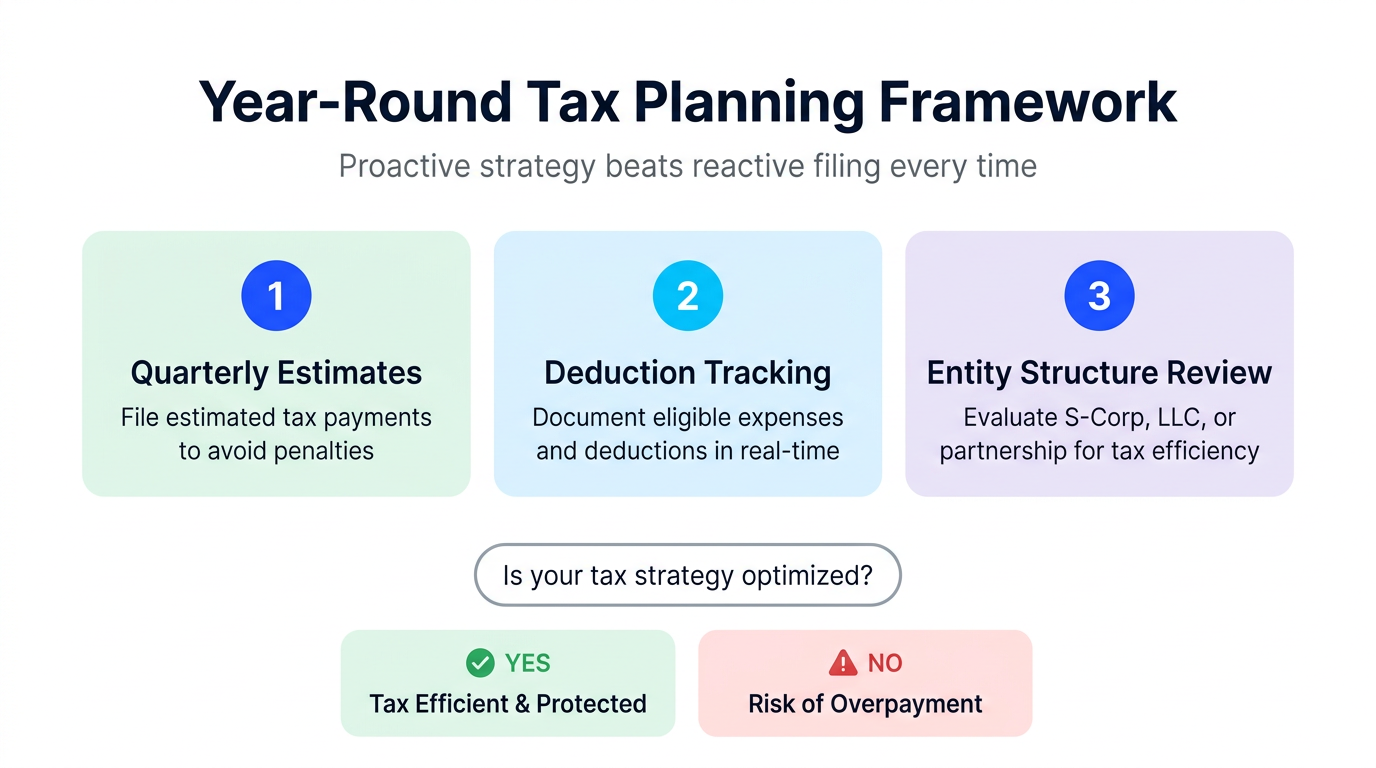
Proactive Tax Planning and Entity Structuring
Generalist CPAs often meet with clients in April to file taxes based on what happened last year. Specialized legal accountants engage in proactive, year-round tax planning. They navigate the specific tax implications for law firms, such as advising on cash versus accrual accounting methods, accelerating deductions for advanced case costs, and evaluating if transitioning from an LLC to an S-Corp or PC structure will yield significant tax savings for the partners.
Partnering with DemandPulse: Premier Law Firm Accounting in the USA
Navigating the complexities of legal finance requires a partner who understands the business of law inside and out. That is where DemandPulse steps in.
"We do not just balance your books; we optimize your financial operations so you can focus entirely on practicing law, winning cases, and scaling your firm with absolute confidence."
As a leading accounting partner for law firms across the USA, DemandPulse provides tailored, end-to-end financial solutions designed exclusively for the legal sector. We recognize that generic accounting advice does not cut it when your license to practice and your partners' capital are on the line.
Why Law Firms Choose DemandPulse:
Bulletproof Compliance
We implement rigorous IOLTA management and three-way reconciliation processes to ensure your firm is always audit-ready and compliant with your state bar's ethics rules.
Tech-Forward Integrations
Our team seamlessly integrates your legal practice management software with top-tier accounting platforms, eliminating double data entry and human error.
Strategic Growth Advisory
From fractional CFO services and cash flow forecasting to partner compensation structuring, we provide the financial intelligence you need to scale aggressively and profitably.
Proactive Tax Optimization
We design tax strategies specific to legal entities, ensuring partners keep more of what they earn while remaining fully compliant with state and federal tax codes.
The Bottom Line
Did you know that the average industry realization rate is roughly 88%. This means that around 12% of the work your law firm performs simply vanishes into the gap between working, invoicing, and collecting.
The right financial partner acts as both a shield against compliance risks and an engine for sustainable growth. When you transition from a generalist CPA to a specialized provider who deeply understands the nuances of Law Firm Accounting, you eliminate the operational friction that stalls growth. You gain clarity on your metrics, bulletproof compliance for your trust accounts, and the confidence to make aggressive, decisions.
Ready to elevate your firm's financial strategy, optimize your tax position, and eliminate IOLTA compliance anxiety? Reach out today to discuss how a specialized accounting partnership can protect and grow your practice.
Scale Your Law Firm with Total Financial Clarity
Stop guessing your cash flow and start making decisions. Partner with DemandPulse for end-to-end legal accounting, tech integrations, and strategic CFO advisory.
Subscribe for Insights That Drive Growth
Practical tips to help you grow your business and build a great team, sent to your inbox.