Senior CSM vs. Junior CSM: The Cost of Mismatched Coverage in SaaS

When a $750K ARR account gets assigned to a CSM who has never sat across the table from a CFO during a renewal negotiation, you don't see the damage right away. You see it two quarters later - in slipped renewal dates, missed expansion targets, and a churn explanation that starts with "they were always going to leave."
If you're a COO or CCO inside a mid-market SaaS company, this post isn't going to convince you that a senior customer success manager is nice to have.
It's going to give you a framework for deciding when entry-level coverage is actively costing you revenue, what a senior CSM owns that a junior CSM structurally can't, and how to identify the gaps in your current customer success org.
What Is a Senior Customer Success Manager?
A senior customer success manager is not a CSM with a longer tenure. It's a fundamentally different operator profile - one built around commercial accountability, executive credibility, and strategic account ownership.
Where a standard CSM is measured on adoption, ticket triage, and CSAT, a senior CSM carries a net revenue retention target, owns the customer P&L, and is expected to grow accounts, not just keep them.
According to Founderpath's 2026 SaaS salary data, senior customer success managers earn 20-30% more in base salary than standard CSMs, with stronger variable pay components tied directly to NRR - a signal of how differently companies hold them accountable.
This matters because the way SaaS organizations now measure customer success has changed. Custify's 2026 industry report found that 93.7% of companies that measure the impact of customer success do so using a revenue target like gross or net revenue retention. Customer success managers in SaaS aren't a soft function anymore - they're a revenue function. And revenue functions need senior operators on the accounts that move the number.
What a Senior Customer Success Manager Owns That a Junior CSM Can't
The gap between a junior and a senior customer success manager isn't experience for its own sake. It's the specific work that only shows up in enterprise and strategic accounts.
Complex Renewal Negotiations
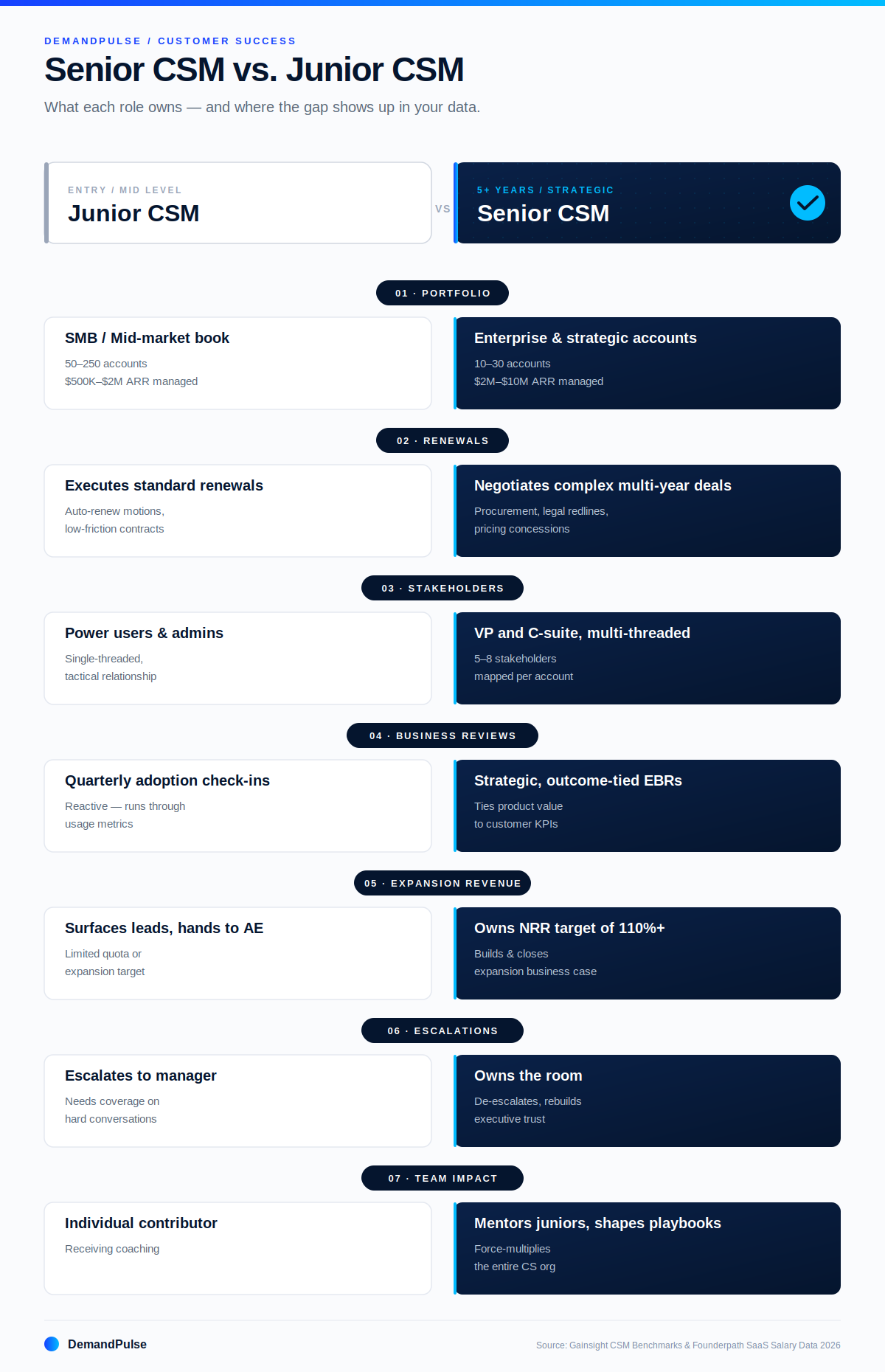
A standard SMB renewal is a click. An enterprise renewal is a 90-day commercial cycle involving procurement, legal redlines, multi-year pricing concessions, and competitive bake-offs. Senior CSMs run that cycle without escalating every blocker to a manager. They know when to hold price, when to trade a discount for a longer term, and when to walk a CFO through the cost of switching.
Multi-Threaded Executive Relationships
A junior CSM typically has one strong relationship in an account - usually a power user or admin. When that person leaves, the account is exposed. A senior customer success manager maps 5-8 stakeholders across the buying organization: champion, economic buyer, IT, security, finance, and end users. They run a multi-threaded relationship motion that survives turnover.
Strategic Executive Business Reviews
Junior CSMs run EBRs as usage check-ins ("here's your adoption rate"). Senior CSMs run EBRs as strategic conversations - connecting product usage to the customer's own business KPIs and surfacing where the partnership is unlocking or blocking revenue for the customer. That reframing is what makes the renewal a foregone conclusion six months later.
Expansion Revenue Ownership
Senior customer success managers carry a quota. They build the expansion business case, identify the right buyer, and close it themselves - often partnering with sales, but not handing the deal off. An enterprise CSM job benchmark shows the typical NRR target for the role sits at 110%+ - meaning the account base is expected to grow net of churn, year over year.
How a Senior Customer Success Manager's Portfolio Differs
The economics of the role are also different. According to Gainsight's CSM benchmark data, 69% of enterprise CSMs manage more than $2M in ARR, with a typical book of 10-50 customers. Mid-market CSMs manage roughly the same ARR - but spread across 100-250 accounts.
That ratio matters: a junior CSM running 200 SMB accounts is doing volume work. A senior customer success manager running 15 enterprise accounts is doing depth work. The two motions require entirely different operating rhythms, and you cannot turn one into the other by raising someone's quota.
This is also why retention rates diverge sharply by segment. Industry benchmarks from Customer Success Collective show enterprise-focused SaaS vendors regularly post renewal rates above 90%, while SMB-focused vendors typically sit in the 70-85% range. The delta isn't accidental - it reflects the level of senior coverage on the accounts that matter most.
Signs Your SaaS Organization Needs a Senior Customer Success Manager
If you're inside a mid-market SaaS org and you've already had this conversation with your CFO, the question isn't whether you need senior CS coverage - it's where the threshold is. Here's the framework most COOs and CCOs use:
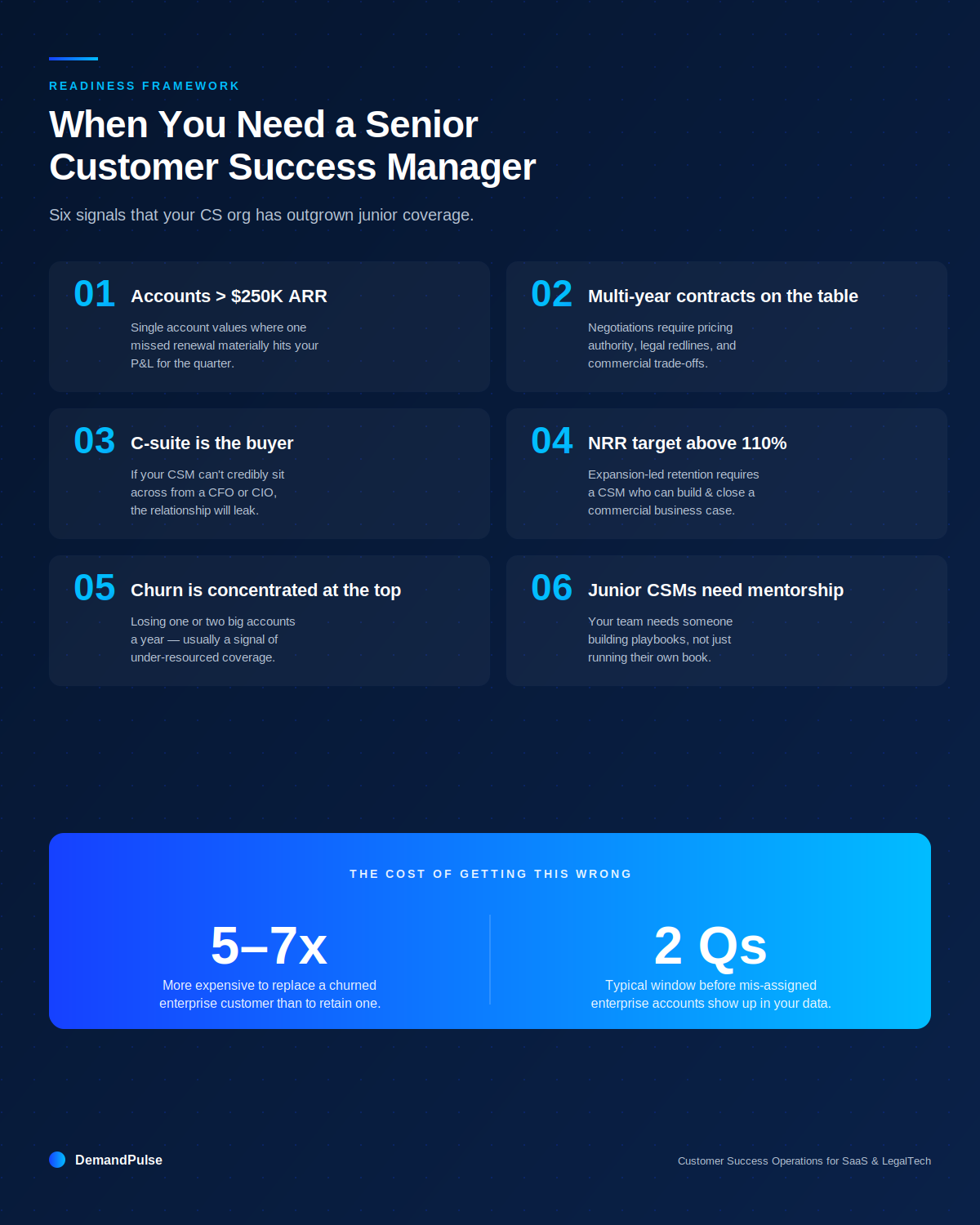
- Single-account ARR concentration. If any one customer represents more than $250K in ARR, a missed renewal materially hits your quarterly number. That account needs senior coverage.
- Multi-year contracts and procurement-driven renewals. Once legal redlines and procurement enter the cycle, junior CSMs are operationally over their skis.
- C-suite stakeholders on the buyer side. If your customer's CFO or CIO is in the room, your CSM has to be able to hold that room.
- NRR targets above 110%. Expansion-led retention can't be run by a CSM who doesn't own a commercial business case.
- Concentrated churn at the top of the book. Losing one or two strategic accounts a year is almost always a coverage problem, not a product problem.
- Junior CSMs without mentorship. Your team needs someone building playbooks and calibrating QA, not just running their own portfolio.
Free Customer Success Audit - Find the Gaps in Your Senior Coverage
We'll map your top accounts to the right CSM profile, score your retention risk, and show you exactly where senior coverage is missing.
Start the Conversation →The Cost of Mismatched Coverage
The reason this question matters at the COO and CCO level is the math. UXCam's 2025 SaaS retention research puts the cost of acquiring a new customer at 5-7 times the cost of retaining an existing one.
For an enterprise account, that gap is even wider - because the replacement isn't one new logo, it's a 12-18 month sales cycle to land a comparable contract. Every enterprise customer you lose because a junior CSM couldn't navigate a renewal is a multi-quarter revenue drag that doesn't show up cleanly in any one P&L line.
How DemandPulse Helps SaaS Companies Scale Senior Customer Success Coverage
DemandPulse builds and runs customer success and customer support operations for SaaS and LegalTech companies - specifically the model most growing organizations actually need, which is a hybrid U.S. and global team where senior customer success managers anchor the strategic accounts and a calibrated bench handles the rest.
We recruit specifically for SaaS and LegalTech experience, embed a U.S.-based customer success lead with your team, and build the playbooks, QA rubrics, and renewal motions that let senior CSMs scale without burning out or fragmenting their book.
The same operating model extends into customer support: 24/7 follow-the-sun coverage, native integration with Zendesk, Intercom, and Help Scout, and a tiered escalation structure that protects your senior CS team from being pulled into ticket triage. The result is a customer operations function that compounds - senior CSMs protecting and expanding your top accounts, while a calibrated support layer drives down cost per ticket and surfaces churn signals before they hit a renewal cycle.
Senior Customer Success Manager Coverage Is a Revenue Decision, Not a Headcount One
Treating every customer success manager role as interchangeable is one of the most expensive mistakes a scaling SaaS org makes.
A senior customer success manager isn't a luxury layered on top of a CS org - it's the only profile that can credibly own enterprise renewals, multi-threaded executive relationships, and expansion revenue at the same time.
If your highest-ARR accounts are being run by entry-level talent, you're not saving budget. You're financing a churn event two quarters from now.
Don't Staff Enterprise Accounts With Entry-Level Talent
DemandPulse recruits senior customer success managers built for complex renewals, expansion revenue, and high-stakes relationships. Request a free customer success audit and we'll come prepared with a recommended approach - not a pitch deck.
Start the Conversation →Subscribe for Insights That Drive Growth
Practical tips to help you grow your business and build a great team, sent to your inbox.