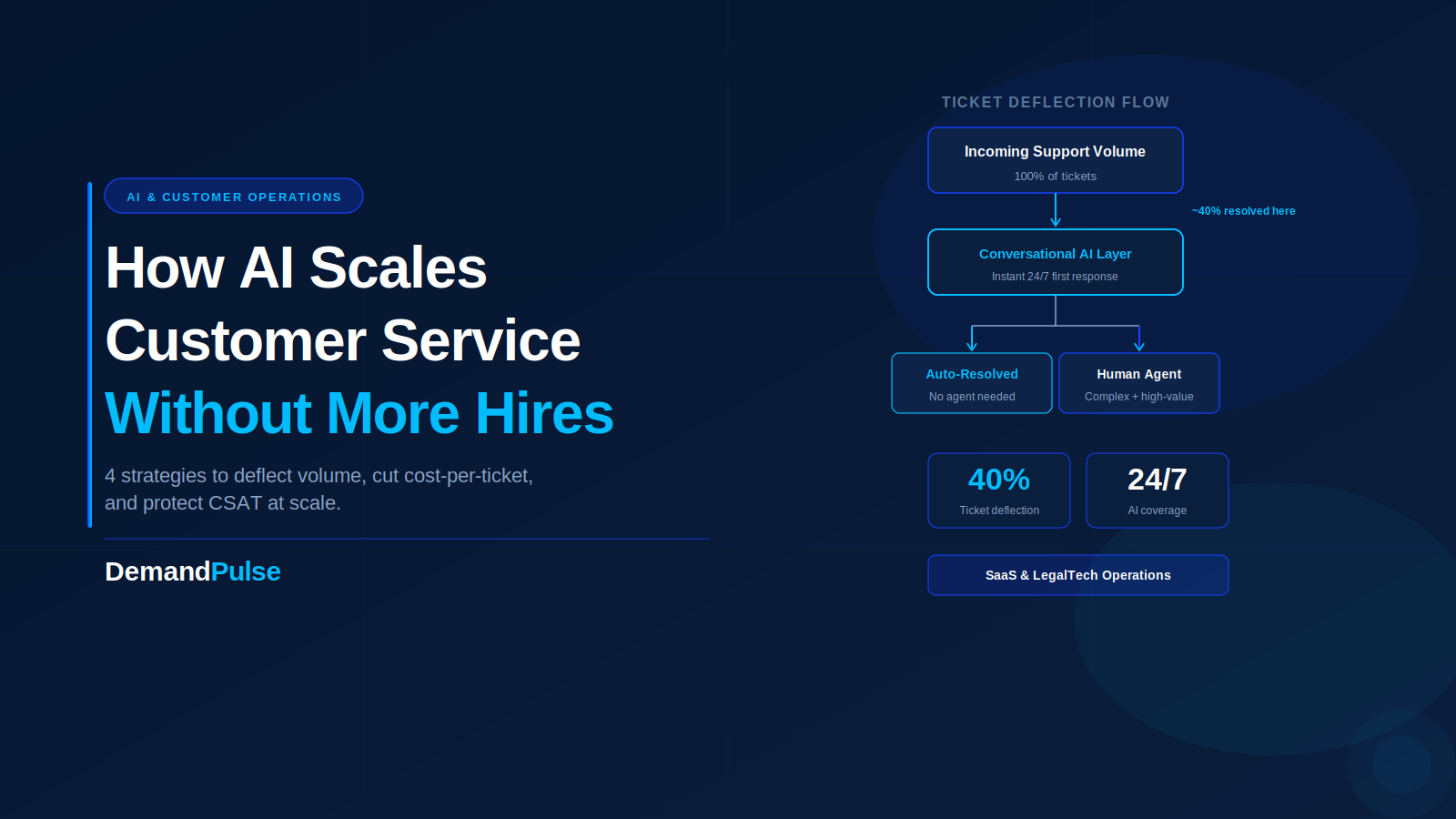
Conversational AI for Customer Service: Scale B2B SaaS Support Without More Hires
There's a moment every SaaS founder and Head of Support dreads. ARR is up. The board is happy. And then the message arrives: "We can't keep up. We need to hire - fast."
That moment is a symptom, not a problem. The real problem is a support model that scales headcount in lockstep with ticket volume - where every new customer adds cost instead of margin, every product launch triggers a hiring wave, and every all-hands has a CSAT slide trending quietly in the wrong direction.
Conversational AI for customer service breaks that model. At DemandPulse, we build, staff, and run customer support operations for SaaS and LegalTech companies - and AI is the layer that lets our clients absorb 30-50% of inbound ticket volume without adding a single headcount. This post gives you the honest framework: what AI handles, what it doesn't, and the four strategies that drive cost-per-ticket down without letting CSAT follow it.
What Is Conversational AI for Customer Service?
"AI in customer service" has been used to describe everything from a basic FAQ chatbot to a fully autonomous support layer. Those are not the same thing - and the distinction matters.
Conversational AI for customer service refers to AI-powered tools - virtual agents, intelligent chatbots, and AI-assisted ticketing platforms - that engage customers in natural language, resolve common issues automatically, and hand off to human agents with complete context already attached.
Here's the gap between what most teams have and what actually moves the metrics:
For B2B SaaS and LegalTech companies, this distinction is the difference between an AI tool that frustrates customers and one that genuinely reduces your cost-per-ticket while protecting the CSAT scores that determine whether accounts renew.
Most SaaS support teams know AI can help - but aren't sure which part of their operation to start with, or whether their current setup is ready. The scorecard maps your starting point in 5 minutes.
Run Your Free AI Support Scorecard - 5 Minutes →The Business Case: Benefits of AI in Customer Service That a CFO Will Approve
Before the strategies, the numbers. Because the conversation you need to win isn't with your support team - it's with your CFO.
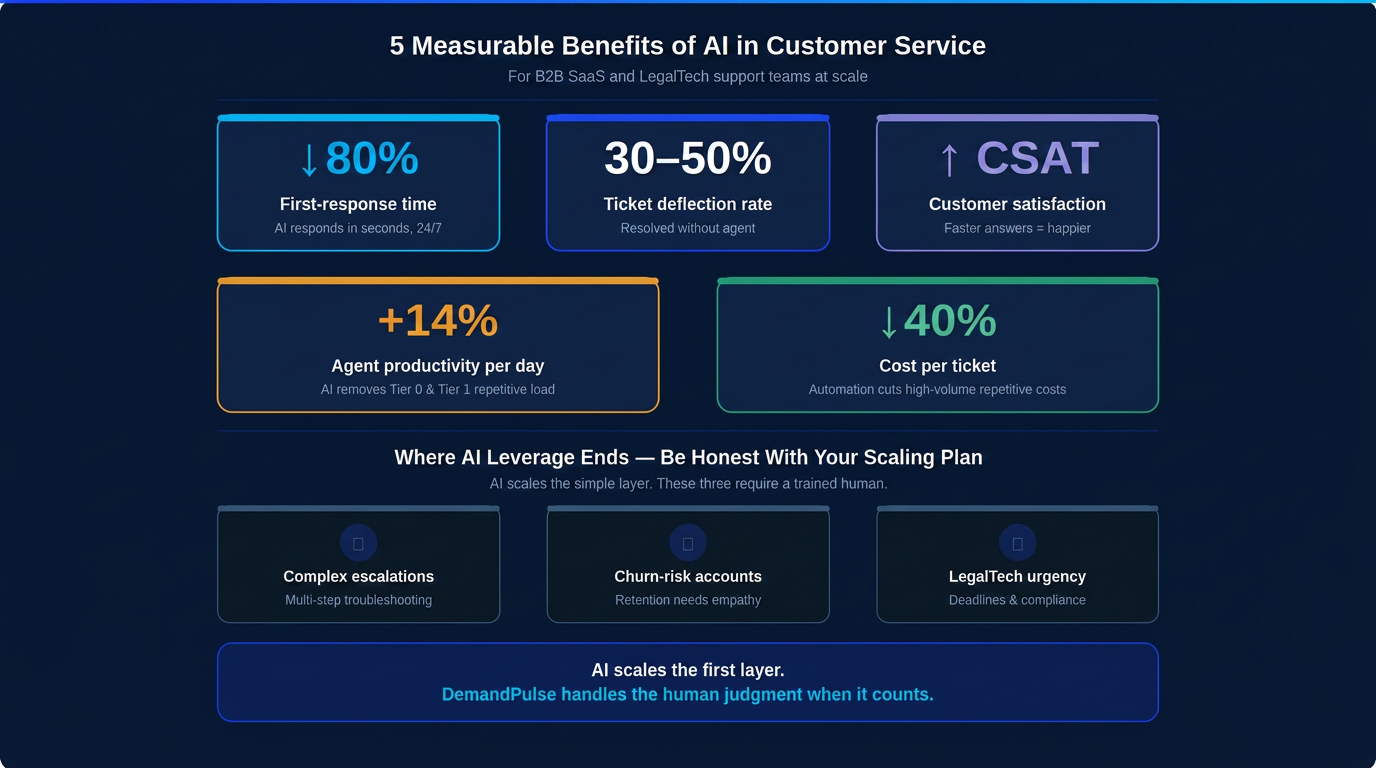
Benefit 1: First-response time drops by up to 80%
Every ticket that sits in queue overnight is a customer forming an opinion about your company. Zendesk's 2024 CX Trends data shows that customers who receive an immediate AI-assisted first response are significantly more likely to rate the full interaction positively - even when a human resolves the issue. AI owns that first moment 24/7, at zero marginal cost per response. Source ↗
Benefit 2: 30-50% of tickets never reach a human agent
Intercom's 2024 Customer Service Trends Report found that teams running properly architected AI deflection models resolve between 30-50% of inbound tickets without any agent involvement. Source ↗
On a team handling 5,000 tickets per month, that removes 1,500-2,500 tickets from your human queue every single month. That is not a marginal efficiency gain - that is the difference between opening a headcount req next quarter and not needing to.
Benefit 3: Agents handle 14% more cases - and close them faster
When AI handles Tier 0 and Tier 1 volume, your human agents stop triaging repetitive noise and start handling the conversations that actually require judgment. Salesforce's State of Service report found that agents using AI assistance handle 14% more cases per day and achieve first-contact resolution rates 20% higher than unassisted peers. Source ↗
For a 10-person support team, that's the productivity equivalent of 1-2 additional FTEs - without a single hire.
Benefit 4: Cost-per-ticket falls without CSAT following it
Customer support automation deflects repetitive, low-complexity volume - it does not cut corners on complex resolutions. The result is a leaner human team handling fewer tickets but handling them better. Teams that implement this model correctly see cost-per-ticket fall and CSAT improve simultaneously, because the human capacity freed by AI gets redirected to the renewal-stage accounts and high-tier customers where attention actually matters.
4 Conversational AI Strategies That Scale SaaS Support Without New Headcount
Strategy 1: Build a Tiered Deflection Model - Stop Routing Everything to a Human
The highest-leverage move in SaaS support operations is not hiring faster. It is designing a system where AI catches the right volume before it ever enters your human queue - so every agent you employ is spending their time on work that actually justifies their cost.
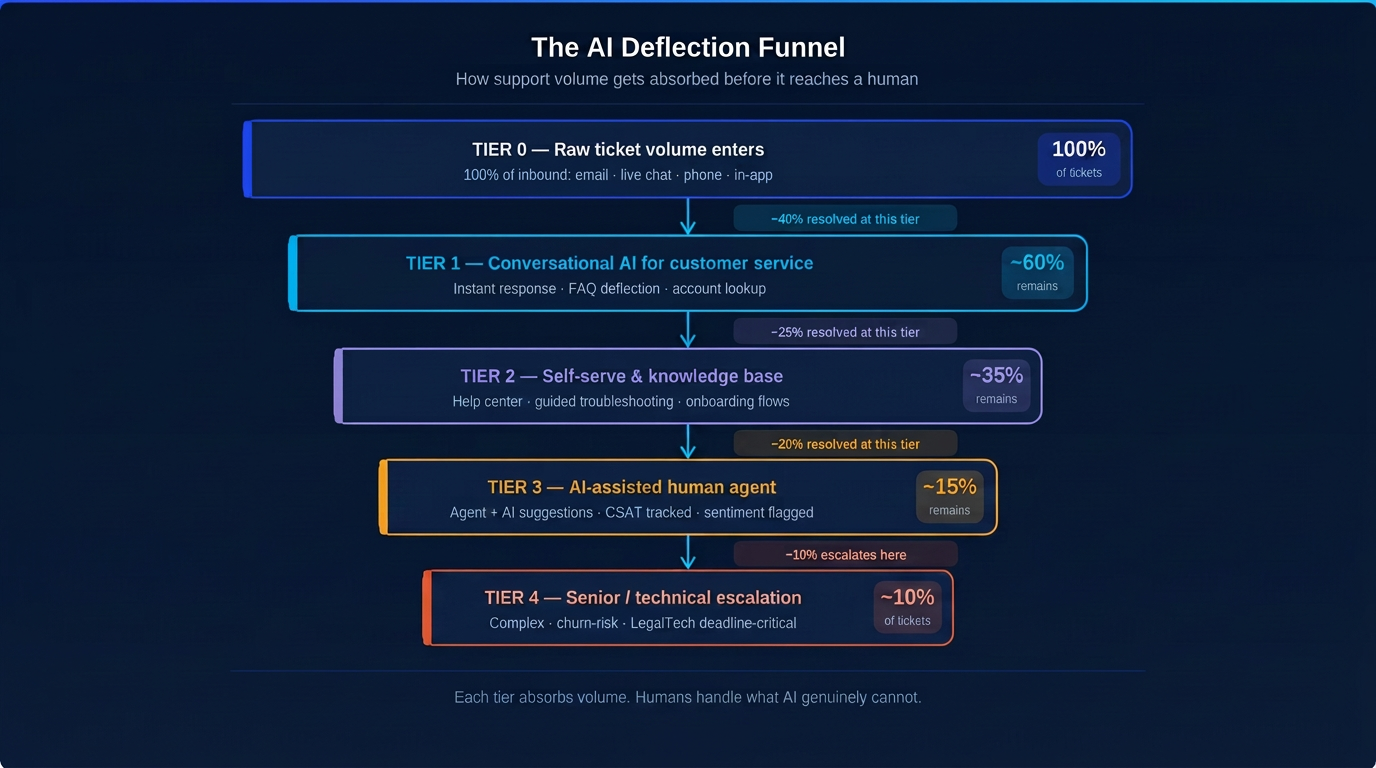
A properly tiered deflection model works like this:
- Tier 0 - Full AI resolution: Password resets, billing status, integration FAQs, account lookups, SLA confirmations. No agent involvement. AI resolves, closes, and auto-sends the CSAT prompt.
- Tier 1 - AI-led, escalates on failure: Conversational AI for customer service handles the exchange. If it cannot resolve within two turns, it escalates with full conversation context - no dead ends, no loops.
- Tier 2 - Self-serve, surfaced in context: Help center articles and guided troubleshooting surfaced inside the product at the exact moment a user hits friction - before they open a ticket.
- Tier 3 - Human agent, AI-assisted: Agent owns the resolution. AI suggests responses, auto-populates account context, flags sentiment, surfaces runbooks. Handle time drops 20-30%.
- Tier 4 - Senior specialist only: Complex multi-step issues, churn-risk accounts, LegalTech deadline escalations. Expert capacity, deployed only where judgment cannot be automated.
Most SaaS teams have a chatbot. They do not have this architecture. The chatbot sits disconnected from their ticketing system with no product data access, no escalation path, and no knowledge base - so it deflects nothing and frustrates customers. Real conversational AI for customer service requires deliberate design: integrated knowledge base, clean handoff logic, and tier definitions mapped to your actual ticket categories.
Teams that build this correctly remove 30-50% of tickets from the human queue within 60 days of launch.
At DemandPulse, building this architecture is step one of every new client engagement - before we staff a single agent. We map your ticket flow by tier, identify the deflection opportunities your current setup is missing, and deploy the AI layer inside your existing Zendesk, Intercom, or Help Scout instance. No rip-and-replace. No 6-month implementation. Live in weeks.
Strategy 2: Use Conversational AI for 24/7 First-Touch Coverage - Eliminate the Overnight Blackout
Here is the retention risk most SaaS support leaders underestimate: the ticket that arrives at 11 p.m. on a Friday.
For a SaaS company with European customers, that is a normal business-hours ticket in London. For a LegalTech firm serving U.S. attorneys, that is a matter deadline that will not wait until Monday morning. For a startup scaling into APAC, overnight silence is not a minor inconvenience - it is a churn signal.
Conversational AI for customer service eliminates that blackout completely. It responds within seconds, at 2 a.m. on a Sunday, with identical quality to peak hours. No degradation. No overnight headcount. No tickets sitting cold until the team clocks in.
What this looks like in practice: A customer in London hits a billing issue at 11 p.m. their time. AI responds in 3 seconds, identifies the issue category from their account data, resolves it if Tier 0, and - if not - queues it with a complete context summary, sentiment score, and suggested resolution for the human team at 8 a.m. CST. The customer received an immediate response. The agent starts from a brief, not a blank screen. Nobody worked overnight.
DemandPulse clients get this coverage by default. Our hybrid model pairs the AI first-touch layer with a follow-the-sun human team - U.S.-based support lead, in-office global specialists - so the handoff from AI to human is seamless and no escalation ever goes cold.
Strategy 3: Turn Your Help Center Into an Active Deflection Engine
Every SaaS support team has a help center. Almost none of them are using it to actively deflect tickets. The problem is architectural: customers do not browse help centers before submitting tickets. They open a ticket. Your knowledge base sits comprehensive and invisible while your agents answer the same 20 questions for the hundredth time.
Customer support automation solves this with one shift: surface the right content in context, at the moment of friction, before the ticket is submitted.
This means:
- An in-app AI trigger that detects when a user is stuck in your billing flow and surfaces the relevant article before they hit "submit a request"
- A chatbot trained on your knowledge base that answers the question correctly instead of routing to a human
- Proactive in-app messages triggered by user behavior signals - repeated error, long pause, failed action - that resolve issues before they become tickets
The ROI is direct. If 35% of your monthly ticket volume is questions your help center already answers, AI-powered in-context surfacing deflects a significant share of that volume with zero agent cost.
One SaaS client we work with reduced their inbound ticket volume by 31% within 90 days - not by changing their product or adding agents, but by activating the knowledge base they already had. The deflection was sitting there unused.
Strategy 4: AI-Assisted Agents - Get More Output From the Team You Already Have
The most overlooked benefit of AI in customer service is what it does for the agents you already employ. AI-assisted tools do not replace agent judgment - they remove the friction that inflates handle time and increases error rates:
- Suggested responses based on ticket category, product context, and past resolutions - agent reviews, edits if needed, sends. Handle time falls 20-30%.
- Auto-populated account context - customer tier, open issues, recent activity, renewal date. No mid-conversation CRM tab-switching.
- Real-time sentiment flagging - AI detects frustration or churn language and surfaces it to the agent so de-escalation happens before the conversation hardens.
- Runbook surfacing - for LegalTech and SaaS escalations with complex resolution paths, AI surfaces the correct runbook automatically.
For a team of 10 agents, the 14% productivity gain from AI assistance produces the output equivalent of 1-2 additional FTEs. You do not hire them. You do not onboard them. You configure your AI layer correctly and your existing team absorbs the capacity gap.
Where AI Leverage Ends - What No Vendor Will Tell You
Here is what separates a support operation that wins long-term from one that collapses the first time volume spikes or a critical account goes sideways: knowing exactly where AI stops and a human must take over.
Every week, a SaaS company somewhere guts its human support layer because an AI vendor promised full autonomous coverage. CSAT craters within 90 days. Churn-risk accounts receive chatbot responses. A LegalTech client with a court deadline gets routed into a dead-end loop. The post-mortem always says the same thing: we over-automated.
The teams that win draw the line clearly:
AI scales volume. It does not save a CFO who is about to cancel a $240,000 annual contract. It does not navigate a LegalTech matter with a 48-hour filing deadline. It does not rebuild trust after a product outage hits your top 10 accounts simultaneously.
The human layer is not a cost center. It is the competitive moat that no competitor can automate around. Build it with the same deliberateness as your AI layer - trained specialists, real escalation paths, QA on both layers - and give it the capacity AI creates, not the same workload it had before.
How DemandPulse Builds the AI + Human Support Model for SaaS and LegalTech
DemandPulse is a customer support operations partner that builds, staffs, and runs support teams for B2B SaaS and LegalTech companies. We are not a generic BPO. We are not a software vendor. We are the team that designs the AI architecture, hires and trains the specialists, and runs the QA program - so our clients get a complete, accountable support operation instead of a headcount contract.
Here is what an engagement looks like from day one:
We start with a free diagnostic - no pitch deck, no proposal. We map your ticket flow by tier, measure your actual SLA and CSAT baselines, identify where conversational AI for customer service can deflect volume, and show you the cost-per-ticket math in plain numbers before we recommend anything. Most clients see 3-5 clear deflection opportunities they were not capturing.
Then we build. We deploy AI deflection triggers, macro libraries, and escalation workflows inside your existing Zendesk, Intercom, or Help Scout instance. We do not require a new tech stack. We do not run a 6-month implementation. Our clients go live in 2-3 weeks and see cost-per-ticket move in the first sprint - not quarter two.
Then we staff the human layer. We recruit and train dedicated, in-office support teams built specifically for SaaS and LegalTech workflows. Every agent we hire understands subscription billing complexity, matter confidentiality, attorney workflow urgency, integration escalation paths, and tiered customer SLAs. When AI flags a churn signal inside a support conversation, our specialists respond to it. When a LegalTech client calls with a filing deadline, they reach a senior voice who understands the stakes.
The result: a support operation that stops generating cost and starts protecting revenue. AI absorbs the volume. Our specialists win the hard conversations. Your leadership team stops defending headcount requests and starts reporting CSAT gains.
That is what DemandPulse delivers. And it starts with a free audit.
Frequently Asked Questions About Conversational AI for Customer Service
The Bottom Line - AI Scales the Volume. DemandPulse Protects the Revenue.
Every SaaS support leader who has defended a headcount request, watched SLAs slip during a product launch, or tried to explain why CSAT dropped on a renewal-stage account knows the truth: hiring your way out of the problem is not a strategy. It is a delay.
Conversational AI for customer service breaks the link between ticket volume and headcount. It absorbs 30-50% of inbound tickets automatically. It covers every time zone without overnight staffing. It makes the agents you already have materially more productive. And it does this at a fraction of the cost of another hiring wave.
But the operations that win long-term are not the ones that automate everything. They are the ones that build the human layer beneath the AI with the same deliberateness - trained specialists, real escalation paths, QA on both sides - and use AI to give that human layer more capacity, not less.
That is the model DemandPulse runs for SaaS and LegalTech companies every day.
Get a Free AI Readiness Audit for Your Support Team
About DemandPulse
DemandPulse is a customer operations partner for B2B SaaS and LegalTech companies. We build, staff, and run customer support and customer success operations - combining AI-powered deflection architecture with dedicated, in-office specialist teams trained on SaaS and LegalTech workflows. Our clients get 24/7 coverage, lower cost-per-ticket, and CSAT improvement without proportional headcount growth, typically going live in 2-3 weeks. DemandPulse is headquartered in Austin, Texas, and serves scaling companies across the United States.