AI-to-Human Handoff: How to Design Chatbot Escalation That Works

Did you know that HubSpot Research found that a 33% of customers rank repeating themselves to multiple representatives as their single biggest service frustration, tied with waiting on hold.
Somewhere right now, a support leader is staring at a weird combination of numbers. The chatbot's answer accuracy looks great. Containment is up. And CSAT is quietly sliding in the wrong direction. So, they do what everyone does: they open a ticket with the AI vendor and ask how to make the answers better.
Wrong door. The answers are usually fine. What's broken is the thing nobody's dashboard measures: the moment the AI hands the customer to a human.
Here's a pattern that shows up constantly in conversation reviews: the AI chatbot gives accurate answers, follows its flows correctly, and does everything its designers intended. And the customer still leaves furious.
When support leaders dig into why their AI feels frustrating, they usually start in the wrong place. They audit the answers. They tune the knowledge base. They rewrite responses. Meanwhile, the actual breakage is sitting somewhere else entirely: in the transition from AI to human.
The data backs this up. In Zendesk's CX Trends research, about half of consumers said chatbots ask too many questions before recognizing they can't resolve the issue, and 46% said the most frustrating part of the experience is having to start the conversation over with a human agent. Neither of those complaints is about answer quality. Both are about the handoff.
What Is An AI-To-Human Handoff?
An AI-to-human handoff (also called chatbot escalation or live agent escalation) is the point in a support conversation where an AI chatbot transfers the customer to a human agent, ideally passing along the customer's identity, issue, and everything already attempted so the agent can continue the conversation instead of restarting it.
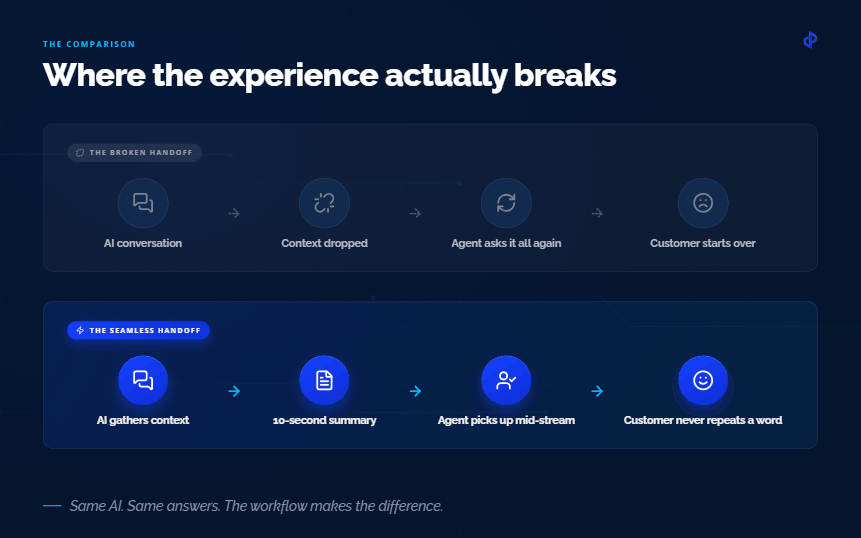
That last clause is where the whole discipline lives. Any platform can transfer a chat. Very few operations transfer the context, and customers can tell the difference immediately.
The Common Misconception
The default assumption in AI support is that customer frustration maps to answer quality. If satisfaction is low, the AI must be getting things wrong. So teams invest in retrieval, tuning, and content.
Conversation reviews tell a different story. Read fifty escalated conversations end to end, not just the AI portion, and you'll notice something uncomfortable. In a large share of the frustrating ones, the AI's answers were fine. What went wrong looked more like this:
The AI kept troubleshooting long after it was obvious the issue needed a human.
The customer asked for a person and got redirected back into a flow.
The escalation happened, but the context didn't come with it.
The agent asked for the account number, the product, and the error message. All three were already in the transcript.
None of these are AI accuracy problems. There are escalation design problems. And they're invisible if your review process only evaluates the AI's messages in isolation, because each individual message looks reasonable. Friction only appears when you read the conversation about the way the customer lived it: as one continuous experience that happened to involve two different responders.
of customers who use chatbots still end up contacting a human agent afterward, per Zendesk. If roughly three out of four AI conversations eventually touch a human, then the handoff isn't a fallback path. It's your main path.
"Customers don't remember the answer. They remember the restart."
Think about the last time you contacted support as a customer. You probably don't remember whether the first response was precisely correct. You remember whether you had to repeat yourself.
Customers put a price on this. According to Zendesk, 93% of consumers say they'll spend more with companies that don't make them repeat themselves, and 70% expect anyone they interact with to have full context on their situation. Your escalation layer either delivers that context or it doesn't. There's no neutral.
The behavioral damage compounds, too.
The customer who got burned once will type "agent" or "human" as their first message next time, because they've learned the AI portion is a toll booth, not a helper. Your deflection numbers get worse. Escalations arrive with less context because customers refuse to engage with intake. The whole system degrades because of one bad handoff, not one bad answer.
The escalation itself often determines whether customers trust AI. Which means the seam between AI and human isn't an edge case to handle. It's a core part of the product.
Containment Is a Vanity Metric When It Is The Primary Goal
Almost every AI support platform reports a containment or deflection rate: the percentage of conversations the AI resolved without a human. It's a useful number. It becomes a dangerous number the moment it's the primary target.
Here's why. Containment is trivially easy to inflate in ways that hurt customers. Make the "talk to a human" path harder to find. Add another round of "have you tried..." before escalating. Ask the customer to rephrase one more time. Every one of those tactics raises containment. Every one of them raises customer effort.
A scenario that plays out in reviews more often than anyone wants to admit: a customer opens chat and immediately writes "I need to speak to a person about a charge on my account." The chatbot, tuned for containment, responds with billing FAQ articles. The customer repeats the request. The chatbot offers to walk through common billing questions. On the third attempt, the customer closes the window.
On the dashboard, that conversation counts as contained. No human was involved. It is the worst possible outcome: an unresolved issue, an angry customer, and probably a follow-up contact through a more expensive channel like email or phone, where the whole story starts from zero again. Containment went up. Everything that matters went down.
There's a simple operational fix for this blind spot, and surprisingly few teams run it: pair containment with a recontact check. Take a sample of conversations marked "contained" and look for the same customer appearing on any channel within the next 72 hours.
A successful AI chatbot doesn't avoid human agents. It knows exactly when to involve them.
"Delayed Escalation Doesn't Save Agent Time. It Borrows It at Interest."
There's an intuitive but wrong belief hiding inside most escalation logic: every extra minute the AI spends with the customer is a minute saved for the human team. So flows get built to exhaust every self-service option before escalating.
Watch what happens to handle time. When the AI over-troubleshoots, the customer who finally reaches an agent is not the same customer who started the conversation. They're irritated, they've lost confidence in the process, and the agent now must do emotional recovery before they can do technical work. The first two minutes of human conversation get spent on apology and de-escalation instead of the actual issue. Then, if the handoff didn't carry context, the agent re-collects information the AI already had.
Add it up and the delayed escalation frequently produces a longer total resolution than an early one would have. The AI minutes weren't free. They were borrowed against the agent's time, and the interest rate was the customer's patience.
One pattern appears repeatedly in reviews: the AI correctly identifies the issue category early, sometimes in the very first exchange, and then keeps going anyway. A customer describes a billing discrepancy. The chatbot correctly recognizes it as a billing issue that requires a human with account access.
Instead of escalating right there, it asks six more questions. What plan are you on? When did you first notice the charge? Have you checked your invoice history? Each question is individually reasonable. Collectively, they're a delay the customer can feel. By the time the agent joins, and asks two of the same questions again, the customer's satisfaction score was already decided.
Nothing about the AI's answers was wrong. The timing was.
Not sure what your escalated conversations would reveal?
DemandPulse offers a free support review: we'll look at your current escalation flow, tiering, and routing, and show you exactly where customers are falling through the cracks.
Escalation Triggers: Design For Signals, Not Turn Counts
So, when should the AI stop? The lazy answer, and the default in a lot of configurations, is a turn count: escalate after N failed exchanges. Turn counts are better than nothing, but they treat every conversation as identical. A customer calmly working through a genuinely multi-step setup issue at turn eight is fine. A customer who is confused at turn three is not.
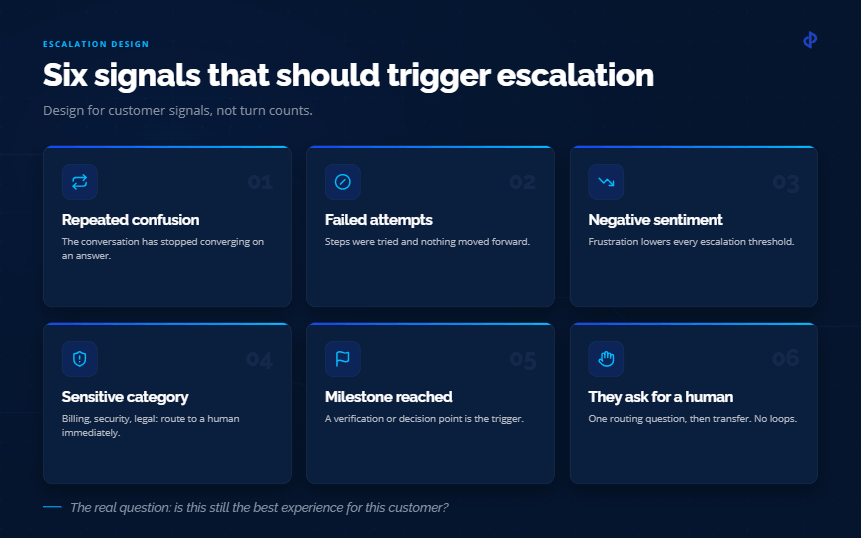
Mature escalation logic is built on signals instead. The triggers that show up in well-designed systems tend to fall into six families:
Confusion signals
The customer rephrases the same question, responds with "that's not what I meant," or answers a clarifying question in a way that shows the AI's last message didn't land. Repeated confusion is a stronger escalation signal than any turn count, because it means the conversation has stopped converging.
Failure signals
Two or three troubleshooting steps attempted without progress. The useful design detail here: count failed attempts, not exchanges. A long conversation where each step visibly moves forward is healthy. A short one where nothing works is not.
Sentiment signals
Frustration, sarcasm, all caps, "this is ridiculous." Negative sentiment should lower every other escalation threshold, not act as a separate track. A frustrated customer at attempt two deserves the treatment a calm customer gets at attempt four.
Category signals
Some issue types should route to humans the moment they're identified, regardless of how the conversation is going. Billing disputes. Security and account-compromise concerns. Anything legal or compliance-adjacent. Questions about products or scenarios the AI wasn't trained to cover. For these, the AI's whole job is recognition and preparation, not resolution.
Account signals
In B2B, who is asking matters as much as what they're asking. An enterprise account with a named CSM and a seven-figure renewal should not meet the same flow as a free-tier signup, yet in most deployments they do, because the chatbot was configured before anyone asked the question.
Milestone signals
Sometimes escalation should fire on success, not failure. If the AI's role in a flow is to verify the account and collect the error details, then completing verification is the escalation trigger. The conversation graduated. Treat it that way.
What The Human Agent Should Receive
Most platforms handle context transfer by attaching the chat transcript to the escalated ticket and calling it done. Technically, no information was lost. Practically, it usually is.
An agent picking up a live escalation is working in seconds, not minutes. A twenty-five message transcript is not something they can absorb while the customer waits. So they do the rational thing: skim it or skip it, and ask the customer directly. The context existed. It just wasn't usable, so it functionally didn't exist.
The fix is a structured handoff summary: a short, consistent briefing the agent can read in ten seconds. The strongest versions answer five questions:
- Who is this? Account, plan, verification status.
- What's the issue? One sentence, in concrete terms.
- What has already been tried? Steps completed and their results, so the agent never re-suggests them.
- Why did this escalate? The trigger that fired. "Customer requested a human after second failed troubleshooting step" tells the agent far more than a transcript does, including how the customer is likely feeling.
- What's the emotional temperature? Calm, frustrated, urgent. Agents open completely differently depending on this line, and it's the line transcripts hide best.
When this works, the handoff is invisible in the best way. The customer gathered their account number, product, error message, completed steps, and urgency with the AI. The agent joins and their first message is "Thanks, I can see the error you're hitting on the Pro plan and that reinstalling didn't fix it. Let me check something on our side." The customer never repeats a word. The AI resolved nothing, and the AI was the reason the human resolution was fast. That conversation is a success by every measure that matters, and a failure by containment. Sit with that contradiction for a second, because your metrics probably haven't.
A special case deserves its own line item: verification. The most infuriating repeat in any escalated conversation is re-verification, because it's the one repeat the customer can see no excuse for. They proved who they were to the chatbot two minutes ago, and now a human is asking for the account email and the last four digits again.
The usual cause isn't agent laziness. It's that chatbot verification and agent-side verification were signed off as two separate processes, and nobody ever asked whether one could satisfy the other.
The Escalation Nobody Designs: When No Agent Is Available
Every escalation flow gets designed around the happy path: trigger fires, agent is online, transfer happens. Then the trigger fires at 2am, or during a queue spike, and the flow does whatever the platform's default is. Usually that default is bad, and usually nobody finds out until a conversation review surfaces it.
It helps to name the two transfer types. A warm transfer moves the customer to a live agent in the same conversation, context attached, with the agent joining in seconds or minutes. A cold transfer converts the conversation into a ticket, an email follow-up, or a callback.
The design rules that separate a good cold transfer from an abandonment machine:
Tell the truth about timing immediately. "Our team is offline until 8am ET. I've created a ticket with everything you've told me, and you'll hear from a person by 9am" is a fine experience. "Connecting you to an agent..." followed by silence is how customers learn to distrust the entire channel. The chatbot should know business hours and current queue depth, and say so.
The summary still travels. Everything the AI collected goes onto the ticket in the same five-field structure a live agent would get. The cold-transfer version of repeating yourself is the follow-up email that opens with "Can you describe the issue you're experiencing?" after the customer already described it in detail. Reviews surface this constantly, because ticket templates and chat summaries are usually owned by different people who have never compared notes.
Give the customer their exit. Offer the ticket number, confirm the contact address, and let them leave. A chatbot that keeps a customer engaged at midnight so the session doesn't count as abandoned is optimizing a dashboard, not an experience.
Queue overflow during business hours follows the same logic. Past a wait threshold you set deliberately (not the platform default), offer the cold path: "It's about a 20-minute wait right now. I can hold your place, or I can have someone email you within the hour with everything we've covered." Customers who choose the callback are not lost containment. They're customers whose time you just respected, and they remember it.
How Experienced Teams Review Handoffs
Here's what separates support operations that improve from ones that plateau: the ones that improve review escalated conversations every week, and they review the seam, not just the AI.
A typical weekly review at a mature operation doesn't ask "did the chatbot escalate?" That's a yes/no question with no design information in it. Instead, the team pulls a sample of escalated conversations and works through a harder set of questions:
- Did it escalate early enough? Not "did it eventually escalate," but "mark the message where a human reading this would have escalated, and measure the gap." That gap, sometimes called escalation lag, is one of the most actionable numbers in the whole operation, and almost nobody measures it.
- Did the customer repeat themselves? Read the human portion and flag every question whose answer already existed in the AI portion. Each flag is either a summary problem (the AI didn't pass it), a tooling problem (the agent couldn't see it), or a trust problem (the agent didn't believe it). Those are three different fixes, and the review is what tells you which one you have.
- Did agents use the summary? If agents consistently ignore it, the summary is wrong, badly placed, or unreliable, and the fix is on the operations side, not the AI side.
Which escalation reasons appear most often? If "unsupported product question" dominates, that's a knowledge base roadmap. If "customer requested human immediately" is climbing, customers are losing faith in the AI portion, and that's usually downstream of a previous handoff problem, not a current answer problem.
Which conversations should never have reached a human? And, just as important, which ones stayed with the AI too long? These two lists, reviewed side by side, are how trigger thresholds get tuned. Not by intuition, and not annually. Weekly, in small adjustments, with real conversations as evidence.
Where Most Handoffs Get Stuck
It helps to name the stage you're actually in, because the work to get unstuck looks different at each one.
Transcript Toss
The transcript is attached and the agent starts from zero. Every escalation restarts the conversation.
Structured Summary
A five-field briefing travels with every escalation. Agents can read it in ten seconds and continue the conversation.
Signal-Driven Handoff
Triggers fire on signals, not turn counts. Warm and cold paths are designed, verification is shared, and weekly reviews tune the seam.
How DemandPulse Helps Customer Support Teams Grow with AI
This kind of work sits in an awkward spot for most support organizations. It's not a software purchase, so the vendor won't do it for you. And it's not a hiring problem you can solve with one job req, because it spans escalation design, routing logic, staffing, QA, and documentation all at once. It usually lands on a support leader who already has a full-time job.
That gap is exactly what DemandPulse was built for. DemandPulse designs, builds, and runs customer support operations for SaaS and LegalTech companies, and the operating philosophy matches everything in this article: AI-empowered, not AI-replaced.
AI handles the repetitive intake and resolution work it's genuinely good at. Human agents handle complex, sensitive conversations where a person is the right answer, which, as this article has argued, is a design decision you make on purpose rather than a fallback you tolerate.
DemandPulse works on both sides of the seam. On the design side: support tiers, escalation paths, and routing logic built around your actual ticket volume and complexity, plus the playbooks, QA rubrics, and documentation that keep the handoff consistent as your team grows.
On the human side: trained, managed support teams in structured Centers of Excellence, with a U.S.-based strategist embedded alongside your leadership, so the agents receiving those escalations are prepared to continue conversations instead of restarting them.
Score Your Handoff Before Your Customers Do
If you want to know where your escalation layer actually stands, pull ten escalated conversations from last week and answer these against what you see, not what the workflow diagram says. One point per yes.
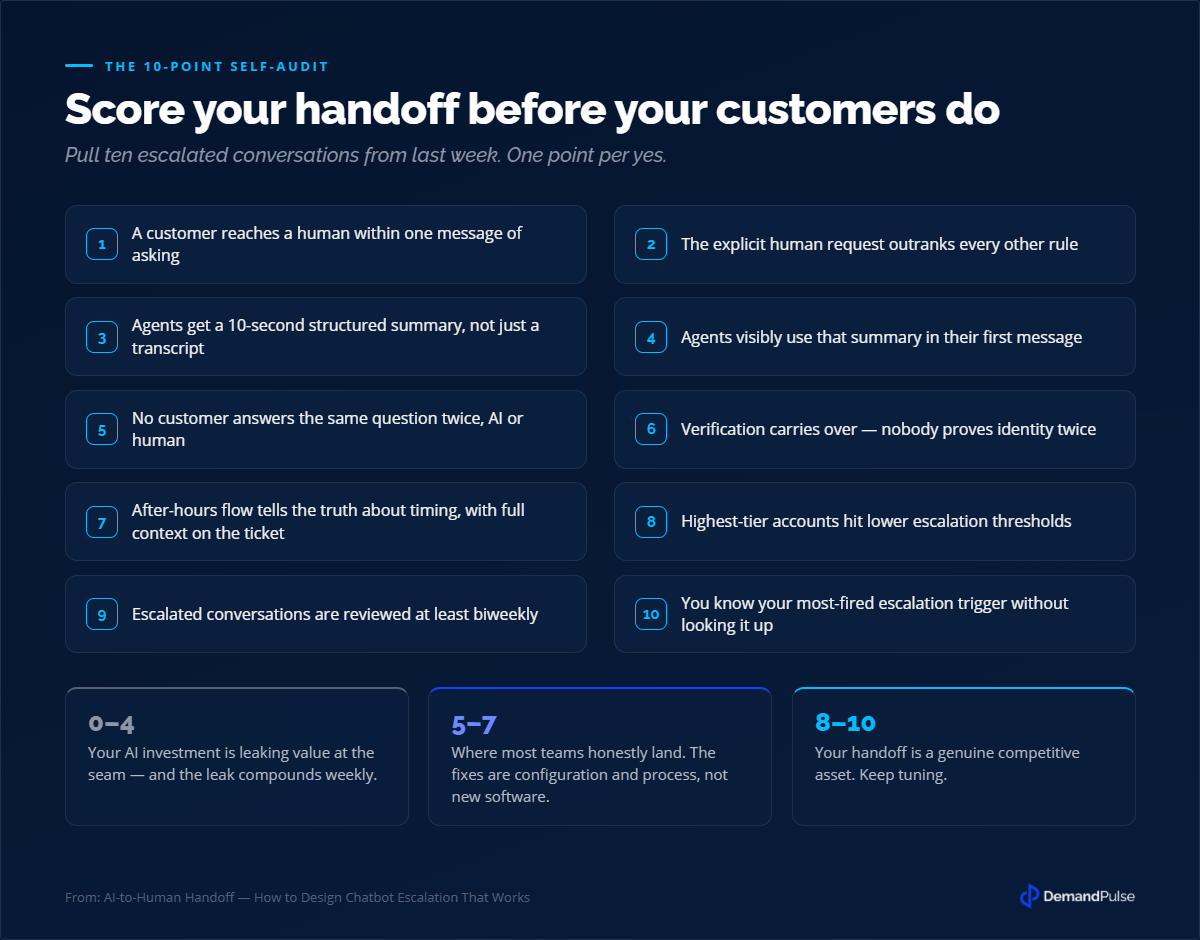
Eight or higher and your handoff is a genuine competitive asset; keep tuning. Five to seven is where most teams honestly land, and the fixes are usually configuration and process rather than new software. Below five, your AI investment is leaking value at the seam, and the leak compounds every week it runs, because every bad handoff teaches another customer to skip the AI entirely.
Ready to design a handoff your customers trust?
Let's review your current escalation flow and show you exactly where customers are falling through the cracks.